
Sudan peace talks must accompany concrete steps to end war, Quintet says
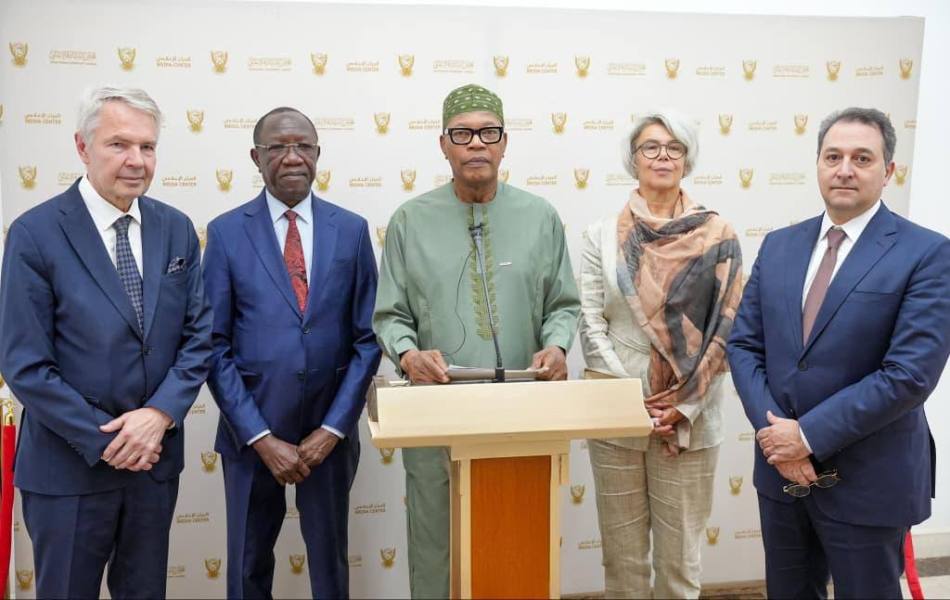
September 10, 2026 (KHARTOUM) – Any political process in Sudan must be paired with tangible actions to end the war that has gripped the country since April 2023, the Quintet group said on Thursday.
Concluding consultations in Khartoum, the group said it maintained a “firm conviction that there is no military solution to the conflict in Sudan.”
A sustainable political settlement must be coupled with concrete measures to safeguard civilians and halt hostilities, it added.
The Quintet said it had wrapped up a good offices mission to engage local stakeholders and link international diplomacy with homegrown Sudanese initiatives.
Those joint efforts should eventually advance an inclusive, Sudanese-led political path toward a civilian-led democratic transition, the group said.
The Quintet group comprises the United Nations, the African Union, the European Union, the regional IGAD bloc, and the Arab League. It has been facilitating talks among political factions and armed groups on Sudan’s future governance.
During the mission, delegates met Transitional Sovereign Council head Abdel Fattah al-Burhan, his deputy Malik Agar, and Prime Minister Kamil Idris.
The delegation also attended a working dinner hosted by Finance Minister Gibril Ibrahim alongside political and civil society figures.
The delegation held discussions with several civic and political coalitions, including the Democratic Bloc, and received a briefing from a committee tasked with laying the groundwork for a broader national dialogue.
However, the Declaration of Principles alliance, which includes the Sumood coalition, the Sudan Liberation Movement led by Abdel Wahid al-Nur, and civic groups, has boycotted the committee-led process.
On Tuesday, Sumood leader Omer al-Digair urged the Quintet not to endorse the initiative, which has government backing and offers participants immunity from prosecution.
The Quintet reiterated its commitment to Sudan’s sovereignty and territorial integrity and rejected any parallel governance structures.