
AU insists on leading Sudan peace process, coordinates with UN
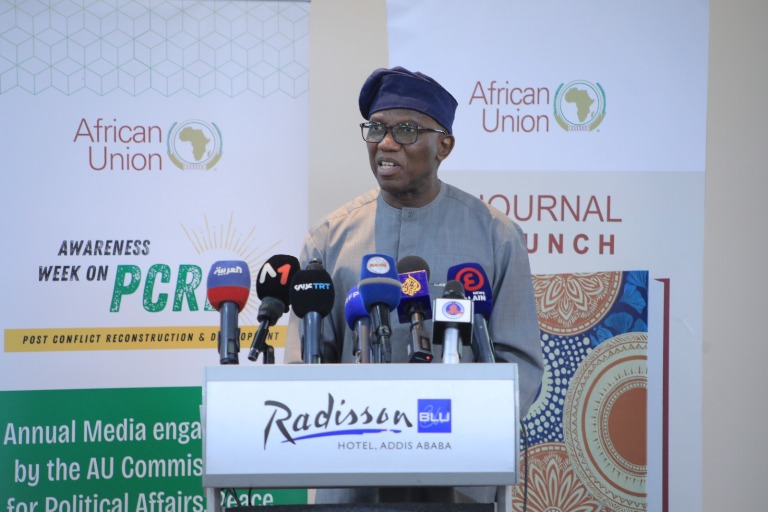
November 18, 2025 (ADDIS ABABA) – The African Union Commissioner for Political Affairs, Peace and Security, Bankole Adeoye, stressed that the African Union must be the locomotive leading the peace process in Sudan, affirming that sustainable solutions to the crisis must stem from the principle of “African solutions to African problems.”
In the context of bolstering the legitimacy of its moves, the Commissioner revealed high-level and continuous coordination between the African Union and the United Nations, represented by the Personal Envoy of the UN Secretary-General for Sudan, Ramtane Lamamra, to unify platforms and initiatives and avoid a multiplicity of tracks.
These joint African-UN efforts enjoy political and technical support from the European Union, which has announced on more than one occasion its support for the African approach to ending the war, calling for uniting international efforts behind the continental organization and the United Nations.
These moves are based on decisions issued by the African Union Peace and Security Council (AUPSC), which drew a roadmap for ending the conflict, including the formation of high-level mechanisms to engage with the warring parties and civilian forces to ensure a comprehensive political process.
The African Union’s desire to lead the scene faces challenges posed by parallel international initiatives, most notably the “Quad Mechanism” led by the United States, which includes Saudi Arabia, Egypt, and the United Arab Emirates.
However, this mechanism faces diplomatic obstacles, as the Sudanese government has expressed clear and declared reservations about the participation of the United Arab Emirates in any settlement or mediation. Khartoum accuses Abu Dhabi of bias, lack of neutrality, and supporting the Rapid Support Forces (RSF), complicating the work of the Quad.
During a press conference held on Tuesday in Addis Ababa on the occasion of the launch of the “African Union Journal on Post-Conflict Reconstruction,” Adeoye clarified the Union’s firm stance against interference, stating: “Regarding foreign interference, we do not allow those who try to fuel the conflict, and we condemn all forms of interference in Sudan.”
The Commissioner affirmed the importance of an immediate ceasefire and an opportunity for political actors to launch a national dialogue, while stressing the necessity of ending impunity and bringing perpetrators of gross violations to justice.
Adeoye’s statements coincided with criticism directed by Sudanese political and civilian forces at the African Union due to what they describe as the “slowness” of its response to the crisis, despite the recent activity of the Peace and Security Council and its decision to hold an upcoming presidential summit on the situation in Sudan.
On another note, Bankole indicated that combating terrorism remains a top priority for the continental organization, stressing the need to prevent conflicts and support states in building their security capabilities to defend their sovereignty.