
Unregulated gold boom triggers toxic crisis in northern Sudan safe havens
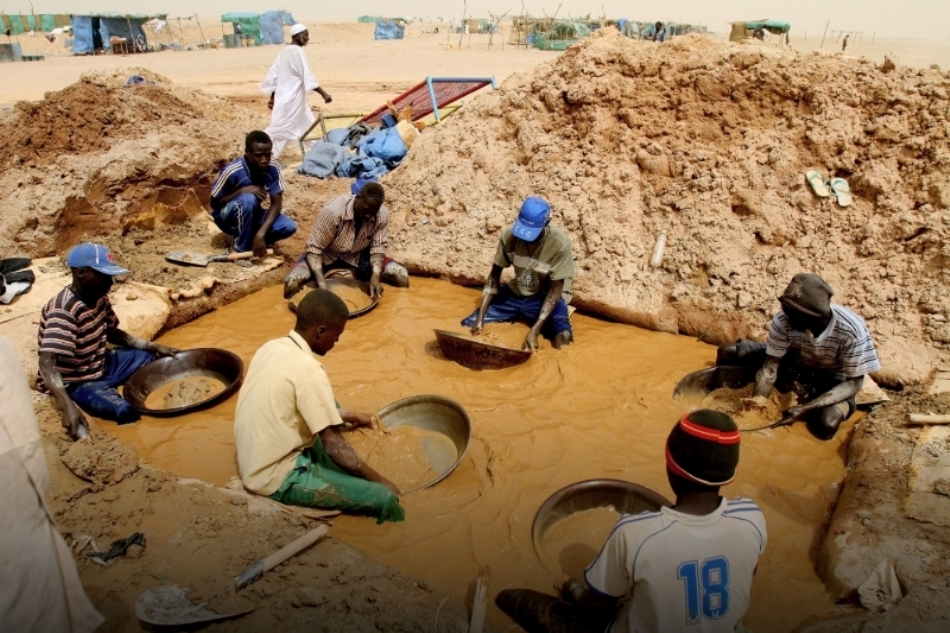
October 19, 2026 (ABU HAMAD) – An unprecedented expansion of artisanal gold mining in northern Sudan’s River Nile and Northern states has unleashed severe environmental and health hazards, as hundreds of thousands displaced by the war turn to hazardous extraction methods.
Driven from their homes by fighting across Sudan, displaced civilians flocked to relatively secure northern regions, where an unregulated gold rush reliant on mercury and cyanide has expanded rapidly.
Data from the Ministry of Minerals and the state-run Sudanese Mineral Resources Company show that artisanal mining forms the backbone of Sudan’s gold production.
Official reports indicate the sector generates over 80% of Sudan’s gold, accounts for more than 58% of national exports, and generates over $1.5 billion annually.
With the war halting agriculture, industry, and trade, gold prospecting has become one of the few available livelihoods, drawing between two and five million people into direct or indirect roles in an informal mining economy that largely operates outside state oversight.
Millions of tonnes of toxic tailings, locally known as “karta,” sit saturated with mercury and cyanide near residential communities, farmlands, and waterways in River Nile and Northern states.
Field findings by Sudan Tribune show processing hubs rapidly expanding across El-Obeidiya, Abu Hamad, and adjacent seasonal valleys.
Miners operate open extraction basins treated with cyanide and chemical spirals just yards away from date palm groves and shallow groundwater sources.
Seasonal rains periodically wash these open basins into water systems, causing mass livestock poisoning, soil contamination, and water supply pollution in rural areas.
Laboratory analyses of samples obtained by Sudan Tribune from “Village 3” in River Nile state revealed extreme mercury contamination levels in soil and water systems.
Soil tests showed readings reaching up to 2,825.24 units at neutral pH, alongside readings exceeding 1,055 and 866 units at greater depths, far exceeding permissible thresholds under World Health Organization and U.S. Environmental Protection Agency standards.
Water sources, including traditional clay cooling pots, livestock troughs, and the main Keheila canal, showed significant contamination risks, with experts warning that toxic compounds are steadily leaching into the water table.
Previous academic surveys by researchers from Neelain University, the Sudanese Environment Conservation Society, and the Higher Council for the Environment identified widespread contamination north of Atbara and south of Berber.
Those studies found mercury and cyanide in 20% of sampled drinking water supplies.
Tests also confirmed alarming mercury levels in human biological samples, with positive readings among young children aged four to 11.
Miners say economic desperation driven by the conflict leaves them with few alternatives.
“We work in harsh conditions searching for a livelihood after the war displaced us,” Osman Mohamed, a miner in El-Obeidiya, told Sudan Tribune.
Mohamed acknowledged using cyanide basins and mercury mixers to extract gold quickly, saying workers lacked safe alternatives despite knowing the environmental risks.
In Abu Hamad, mining equipment trader Ahmed al-Tayeb said primitive extraction ponds are constructed without standard plastic liners, allowing toxic runoff to penetrate the water table directly.
Al-Tayeb noted an increase in unexplained respiratory illnesses and acute dermatological conditions among workers and nearby residents.
Local farm owner Babiker Abdel Rahim said illegal mixers operate around the clock without regulatory enforcement.
“Some operators evade environmental standards by setting up illicit sites in remote areas, dumping large amounts of chemicals without regard for human life,” Abdel Rahim said.
An official at the Sudanese Mineral Resources Company told Sudan Tribune that wartime conditions have severely disrupted regulatory oversight.
The official said the state agency strictly prohibits using mercury and cyanide outside certified facilities, but acknowledged that mass displacement and vast geography have fostered unregulated markets beyond government control.
Joint inspection campaigns alongside state governments and security agencies continue, the official added, aiming to dismantle unauthorized extraction sites and safeguard local water sources.