
Abdelatty outlines Egypt’s ‘red lines’ at Sudan consultative meeting
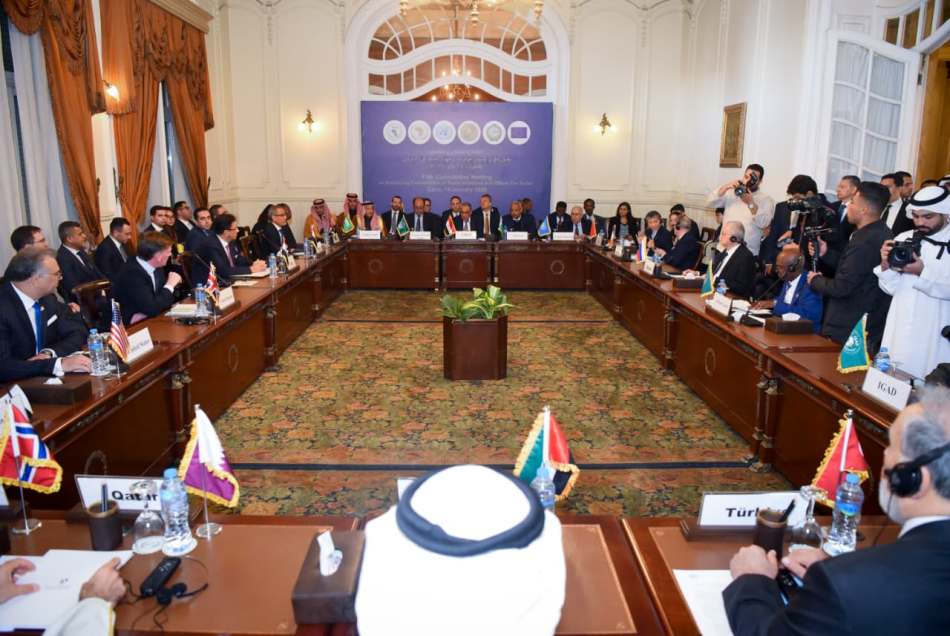
January 14, 2026 (CAIRO) – Egyptian Foreign Minister Badr Abdelatty chaired the fifth meeting of the Consultative Mechanism to enhance coordination for peace efforts in Sudan on Wednesday, hosting a wide array of international and regional delegations in Cairo.
The high-level gathering included Ramtane Lamamra, the Personal Envoy of the UN Secretary-General for Sudan, and Djibouti’s Foreign Minister Mahmoud Ali Youssouf. Also in attendance were Massad Boulos, senior advisor to the U.S. President, UAE Minister of State Sheikh Shakhbout bin Nahyan Al Nahyan, and Saudi Deputy Foreign Minister Walid Al-Khuraiji.
Representatives from Germany, Turkey, Norway, Qatar, the United Kingdom, China, Russia, France, Iraq, and Angola participated, alongside officials from the European Union, the Arab League, the African Union, and IGAD.
During his opening remarks, Abdelatty emphasized that the Sudanese crisis demands sincere international and regional cooperation to stop the ongoing bloodshed. He warned that the current phase poses grave risks to regional peace and security, particularly for neighboعring countries, the Horn of Africa, and the Red Sea region.
The Foreign Minister pointed to a presidency statement issued on December 18, which clearly defined Egypt’s “red lines.” These include the preservation of Sudan’s unity and territorial integrity, a categorical rejection of any secession attempts, and the protection of Sudan’s national state institutions.
Abdelatty explained that Egypt’s commitment to peace was first formalized through the Sudan Neighboعrs initiative launched in July 2023. That initiative called for an immediate ceasefire, inclusive political consultations, and guaranteed humanitarian access.
Egypt remains active in several diplomatic tracks, including the international Quad mechanism and the African Union’s expanded mechanism. Abdelatty stressed the importance of continued work within the Quad to reach a comprehensive humanitarian truce that paves the way for a sustainable ceasefire.
He noted that any political process must be characterized by “Sudanese ownership” to ensure its legitimacy. He recalled Cairo’s hosting of Sudanese political and civil forces during the “Cairo 1” dialogue in July 2024 as a model for such engagement.
The minister underscored that ending the deadly conflict requires an urgent humanitarian truce followed by an inclusive political process. He warned that this transition must preserve state institutions and prevent the formation of “parallel entities” that could further fragment the country.
Abdelatty concluded by reaffirming Egypt’s full solidarity with the Sudanese people. He called on the international community and global donors to fulfil their financial pledges to address the worsening humanitarian catastrophe.
Participating delegations echoed these sentiments, stressing the need to protect civilians and facilitate the delivery of aid without obstacles. The attendees reached consensus in support of a political process that meets the aspirations of the Sudanese people for security and stability while maintaining the country’s unity.