
Sudanese pound edges up on black market, easing pressure on staple goods, gold
September 17, 2026 (KHARTOUM) – The Sudanese pound strengthened modestly on the parallel market on Thursday as hard-currency demand subsided, triggering a brief retreat in the local prices of staple foods and gold.
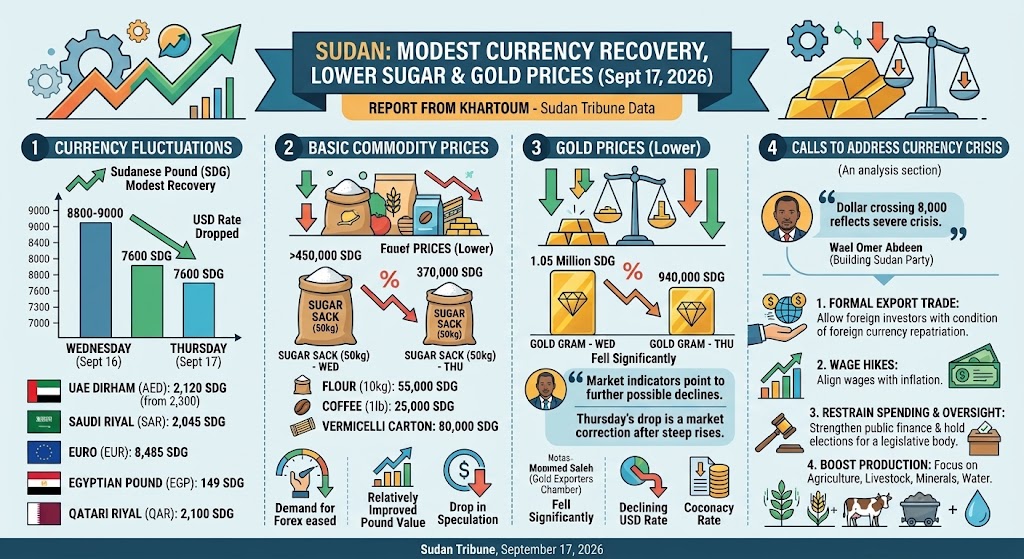
The dollar changed hands at roughly 7,600 pounds at the close of end-of-week trade, according to currency dealers, after sliding to between 8,800 and 9,000 pounds on Wednesday.
The currency has swung wildly in recent sessions, stoking inflation across most everyday goods and services as businesses and households rushed to acquire foreign banknotes.
Dealers told Sudan Tribune the demand for foreign exchange eased slightly on Thursday, providing temporary respite for the local unit.
The UAE dirham dropped to 2,120 pounds from 2,300 pounds a day earlier, while the Saudi riyal traded at 2,045 pounds. The euro fetched 8,485 pounds, the Egyptian pound traded at 149 pounds, and the Qatari riyal stood at 2,100 pounds.
Dealers attributed the decline in foreign exchange rates to the drop in spot demand, adding that major parallel-market operators continue to dictate street prices based on immediate liquidity shifts.
The sharp depreciation earlier in the week prompted black-market traders to speculate in basic commodities alongside foreign cash, notably sugar, to shield their capital from currency erosion. That drove sugar above 450,000 pounds per sack.
Households have also ramped up dollar and gold purchases to hedge savings against triple-digit inflation and a depreciating currency.
Economists said the pound remains vulnerable to sharp volatility, cautioning that Thursday’s bounce reflected speculative adjustments rather than a structural turnaround in macroeconomic fundamentals.
Consumer prices reacted immediately to the currency’s modest rebound.
A 50-kg (110-lb) sack of sugar fell to around 370,000 pounds from 450,000 pounds on Wednesday, merchants said. A 10-kg sack of flour traded at 55,000 pounds, coffee beans at 25,000 pounds per pound, and a carton of Nobo noodles at 80,000 pounds.
Domestic gold prices fell in tandem with the dollar, opening at roughly 980,000 pounds per gram before easing to 940,000 pounds at the close, down from 1.05 million pounds on Wednesday.
Moatasem Mohamed Saleh, secretary-general of the Gold Exporters Chamber, told Sudan Tribune that technical indicators pointed to further short-term downside, noting that the preceding spike was detached from physical fundamentals.
Saleh said Thursday’s drop represented a technical correction following excessive gains, adding that local market trends would track global bullion prices, foreign-exchange rates, and domestic liquidity conditions.
Wael Omer Abdeen, head of the opposition Building Sudan Party, said the dollar breaching 8,000 pounds underscored the crisis’s severity and called for state wages to be indexed to inflation.
Abdeen urged the government to allow foreign companies to participate formally in export activities, provided they repatriate foreign-currency proceeds through the banking system to narrow the trade gap.
He also called for tighter fiscal spending, stronger state audits, and a functional parliament to scrutinize fiscal deficits and government accounts.
Administrative and security crackdowns alone would not halt the currency’s slide, Abdeen said, arguing that long-term stabilization required export recovery, tighter budget controls, and restored confidence in state institutions.
Sudan has substantial agricultural, mineral, and livestock resources, but lacks the institutional framework to translate those assets into foreign reserves and formal employment, he added.
The parallel dollar had approached 9,000 pounds earlier in the week as fighting between the army and paramilitary forces continued to strangle commercial output, farm yields, and port shipments.
Analysts warned that the currency remains structurally weak, noting that any sustained recovery will depend on reviving formal exports, replenishing depleted central bank reserves, and ending the conflict that has battered the nation’s productive capacity.