
Beyond the barrel of a gun: Why Sudan requires a new founding moment
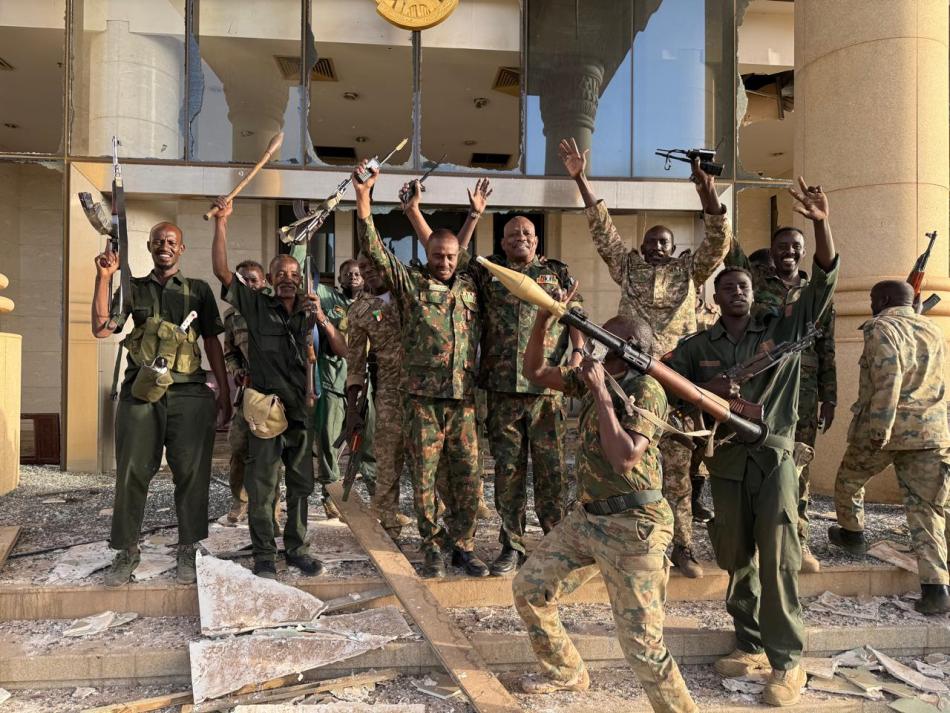
The dream of returning to Um Dafuq and Khartoum: The mirage of absolute victory and the deadlock of war
Yasir Arman
Returning to geography or to the founding moment?
 The leaders of the Sudanese Armed Forces (SAF) dream of reaching El Geneina and Um Dafuq, at the far western reaches of our beloved yet distant country. Meanwhile, the leaders of the Rapid Support Forces (RSF) dream of returning to the banks of the Nile, to Al-Tabiya, Al-Rabiya, the Presidential Palace and the General Command headquarters, which are equally far away. In this, both sides see an uncompromising and definitive answer to what they call “absolute victory.”
The war that began on 15 April has reached an impasse and a clear deadlock that must be broken in the interests of millions of starving people, who are now paying the price of war through drone attacks. These attacks create memories devoid of a unifying national consciousness, one that brings people together rather than dividing them.
The question ordinary people ask — the real question — stripped of philosophical pretension and intellectual grandstanding is: When will the war end, and how will it end? This profound yet practical question demands new ideas.
Throughout General Bashir’s Salvation regime, and until the coup of 25 October 2021, the army was present in Um Dafuq and El Geneina. Did it succeed in resolving Sudan’s problems? Was the RSF not present in Khartoum, Port Sudan and Kassala? Did its presence resolve Sudan’s problems?
If the RSF returns to the starting point of the 15 April war and makes its way back to Khartoum, will it be able to answer Sudan’s historical questions? The same question applies to the army. Both sides know perfectly well that the length of a gun’s barrel cannot provide sound answers to the questions of the past, present and future. What we need is the depth and breadth of ideas about how to build a New Sudan.
The slogans of Dignity and Founding are slogans built upon the barrel of a gun, and therein lies their limitation. If a people were to be led by the gun, Omar al-Bashir would have led them. Yet he is now searching for a place to receive medical treatment, having failed to build a hospital that could provide him with that treatment in his own country.
Nor does he raise the question of justice for the victims. We uphold his right to medical treatment, but we are even more committed to securing justice for the victims. He should go to The Hague, home of the International Criminal Court (ICC), the only place that can bring together his right to medical treatment and the victims’ right to accountability.
The notion of absolute victory in war is an old concept, drawn from religion, history books, the hooves of horses, the length of cannons and the wings of aircraft. Yet it offered no answers to Alexander the Great or Hulagu. And the killing of Al-Hussein, may God be pleased with him, continues to look out from the balcony of history to this very day.
Absolute victory, as a military concept, rests on violence and force without asking the fundamental question: What are the causes of violence and the reasons behind war in the first place? Behind every Rapid Support Force, another force will emerge. Without addressing the underlying causes, every old war will give birth to a new one.
Addressing the causes of war and reaching a formula for national reconciliation cannot be achieved through the length of a gun’s barrel. It requires a constitutional national dialogue on how Sudan should be governed. In such a dialogue, people should participate not through the might of their weapons, but through the value of their ideas and interests.
This cannot be achieved through absolute victory, but rather by returning to the founding moment — whether that means the founding of 1956, 1898, 1885, 1821, 1504 (the Funj Sultanate), or 641, the year of the Baqt Treaty; or going further back to the ancient civilisations of the Nile Valley, before returning to our present day.
All of this must happen before we return to Um Dafuq or Khartoum; before drones destroy people and infrastructure, and before human blood becomes entangled with famine and economic collapse, which are already destroying our shared future.
Our collective memory should not be like that of a fish. We should learn from three strategically significant events for nation-building. The first was the separation — or independence — of South Sudan, a traumatic event. The second was genocide and war crimes. The third is the war of 15 April, which must produce a new consciousness of the causes of war and how to address them.
We must go beyond merely condemning war if we are to achieve sustainable peace — a peace that will not come simply by returning to Um Dafuq or Khartoum.
One of the first symptoms of the deadlock in war is that its warring parties attempt to cure themselves with the very thing that caused the disease: they seek to treat war with more war and chase the mirage of absolute victory.
They have failed to learn from the lessons of our own country and from the wars in neighbouring countries. In some countries, armies have been forcibly replaced four times within our own lifetimes, before our very eyes, without addressing the root causes of war.
Defeating and uprooting the army will only lead to the emergence of a new army through the very channels of defeat. Likewise, inflicting a final defeat on the RSF will not resolve Sudan’s fundamental problems.
The more important question is this: Is there a political answer to the question of absolute victory, with all its military dimensions? And can political solutions be found to achieve the goals of reaching Um Dafuq and Khartoum through ideas rather than guns? This is the task facing Sudanese political thought at its finest.
The causes and roots of this war lie in the contempt for and neglect of rural areas; development models that produce neither bread nor employment; the rejection of equal citizenship without discrimination; and the absence of freedom, food and justice. The closer we come to justice, the closer we move towards peace.
The guns participating in this war are the product of rural collapse and poverty, the ruralisation of cities, and the unemployment and joblessness endured by millions of young people from Generation Z and those who came before them, all of whom are looking towards the future.
Sustainable peace is impossible without establishing an organic relationship between rural areas and cities, restoring the productive character of rural communities, respecting equal citizenship without discrimination, and ensuring the peaceful transfer of power.
Is it possible to convene a conference bringing together all democratic platforms and the diverse banners of the December Revolution, with the aim of reaching a Declaration of Principles to stop and end the war?
The objective should be to move beyond generalities and address the substance of the issues involved in ending the war, while mobilising the broadest possible front in support of the Declaration and coordinating efforts among all democratic platforms.
The Declaration of Principles must be clear and straightforward, drawing on national, regional and international efforts. It should be based on establishing one unified national army and dissolving all armed formations outside it, as well as excluding Islamists from the security and military sectors and ending their hijacking of the state. Furthermore, it must establish a civilian democratic transition that recognises the changes brought about by the December Revolution, while ending the system of political enablement, or Tamkeen, and impunity. Finally, it requires adopting an economic programme that expands the reach of an inadequate state to include rural areas and marginalised communities in neglected urban centres, alongside recognising the right of others to be different and to exist in their diversity.
We must address the fears and concerns of both the army and the RSF, while rejecting their ambitions. We must also confront the issues surrounding a ceasefire and move beyond the mirage of absolute victory, affirming the right of all Sudanese to reach Um Dafuq and Khartoum through national reconciliation, not through the barrel of a gun.