
Sudanese pound slides to 12,000 per dollar as authorities push economic reforms
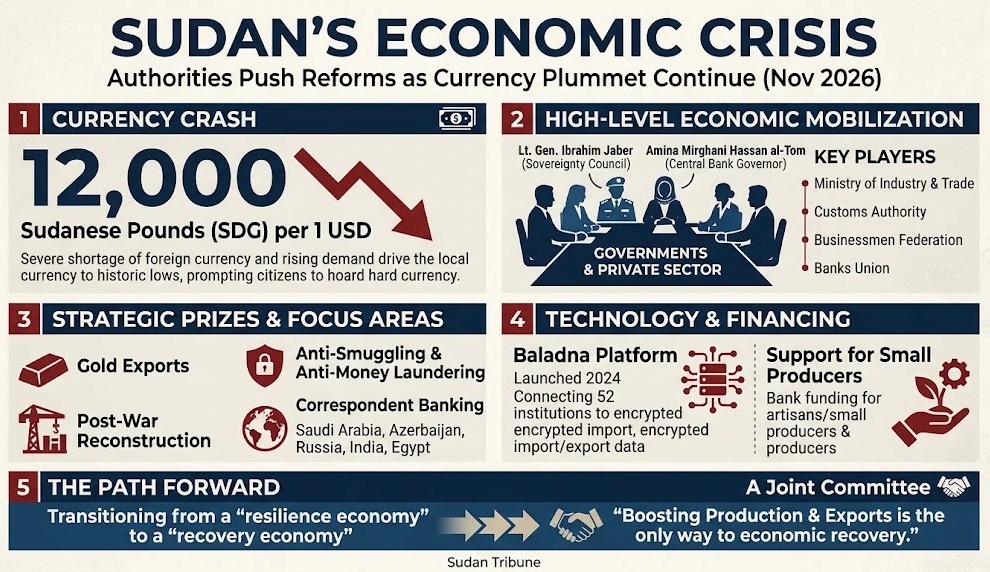
November 18, 2026 (KHARTOUM) – Sudanese authorities have stepped up efforts to tackle an economic crisis, exchange rate distortions and smuggling as the U.S. dollar traded at around 12,000 Sudanese pounds on Wednesday amid scarce foreign currency and rising demand.
Currency dealers told Sudan Tribune the dollar reached roughly 12,000 pounds in Wednesday’s trading. They cited growing demand for foreign exchange as the local currency weakens and citizens hold hard-currency savings to hedge against further depreciation.
In a statement on Wednesday, the Central Bank of Sudan said Transitional Sovereignty Council member Lieutenant General Ibrahim Jabir chaired an expanded meeting hosted by Central Bank Governor Amina Mirghani Hassan al-Tom at the bank’s headquarters.
The meeting brought together the Sudanese Businessmen and Employers Federation and the Sudanese Banks Union, alongside the ministers of industry and trade and communications and digital transformation.
Customs Authority representative Major General Magdi Madani al-Sheikh, economic security officials and Flour Importers Chamber Chairman Arif Nour al-Din also attended.
Participants discussed strengthening public-private partnerships, streamlining customs procedures, addressing trade bottlenecks, managing export proceeds and supporting reconstruction. They focused in particular on gold exports and combating money laundering and terrorism financing.
Jabir pledged to remove economic obstacles facing the country and the private sector. He said specialized committees would be formed to ensure smooth trade flows in the post-war phase as the country shifts from a resilience economy to a recovery economy.
Sudanese Banks Union Chairman Abbas Abdallah Abbas said banks were ready to finance artisans and small producers under central bank regulations.
The minister of communications and digital transformation reviewed the Baladna platform, launched in 2024 as an accredited single window linking 52 institutions to exchange unified, encrypted import and export data.
Officials also reviewed trade finance, electronic system activation, non-performing loan resolution, bank recapitalization and stronger correspondent banking ties with Saudi Arabia, Azerbaijan, Russia, India and Egypt.
Exporters Chamber Chairman Wagdi Mirghani said participants agreed that economic recovery could be achieved only by boosting production and exports. They decided to form joint government and private-sector committees to follow up on proposals and monitor implementation.
Ali Salah Ali, deputy head of the Businessmen and Employers Federation, said the talks addressed exchange rate challenges and anti-smuggling measures. He said the federation would fully support state efforts to ease living costs.