
Hamdok calls for urgent UN-AU talks to end war in Sudan
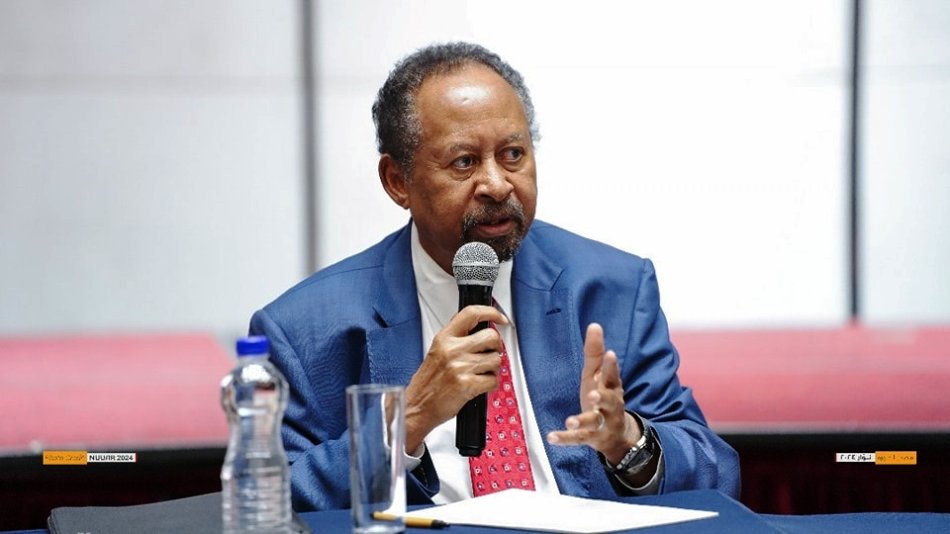
March 4, 2025 (ABU DHABI) – Former Sudanese Prime Minister Abdallah Hamdok on Tuesday called for an urgent joint meeting of the U.N. Security Council and the African Union’s Peace and Security Council to find a way to end the war in Sudan.
In a video address, Hamdok, head of the civilian coalition, Smoud, urged the meeting to include the commanders of the army and the paramilitary Rapid Support Forces (RSF), as well as civilian and other armed groups, to agree on a humanitarian truce and an immediate, unconditional ceasefire.
“I address you with this appeal as the holy month of Ramadan approaches, the third to pass over Sudan since the outbreak of the war that has stolen the meanings of this holy month from our people,” he said. “I speak to you today on behalf of the forces that rejected the war since its outbreak and did not side with any of its parties but rather continued to seek peace.”
He called for the urgent meeting to include the commander of the Sudan People’s Liberation Movement-North (SPLM-N), Abdelaziz al-Hilu, the commander of the Sudan Liberation Movement, Abdel Wahid Mohamed Nur, and representatives of democratic civilian forces.
Hamdok called for confidence-building measures, including effective ceasefire monitoring mechanisms, a possible regional and international peacekeeping mission, safe corridors for aid delivery, and guaranteed freedom of movement for civilians.
He also urged the establishment of safe zones free of military activity, a halt to media escalation between the warring parties, and the release of all prisoners and detainees.
“The current conflict is not just a military struggle between two forces, but an expression of structural imbalances that have plagued our history since independence,” Hamdok said, adding that military regimes had failed to manage Sudan’s diversity or achieve balanced development.
He accused the National Congress Party/Islamic Movement of obstructing the democratic transition following the December Revolution “by all means, including orchestrating the October 25, 2021 coup, and igniting this damned war.”
He reiterated that there is no military solution to the conflict and that the only option was an immediate end to the war and agreement on a new national project establishing a democratic civilian system based on citizenship without discrimination, a true federal system, and a single, professional, national army removed from politics and the economy.
Hamdok urged regional and international actors to refrain from actions that could prolong the conflict, including imposing a comprehensive arms embargo on all parties and cutting off funding for the war.
He proposed an international donor conference to address the humanitarian funding gap identified by the U.N. response plan and the launch of a credible, Sudanese-led peace process. This process should have three interconnected tracks: a humanitarian track for aid delivery and civilian protection, a ceasefire track building on the Jeddah Agreement, and a political track involving a national dialogue.
Hamdok said he hoped a political process would lead to a permanent ceasefire, a comprehensive peace agreement, transitional constitutional arrangements based on broad consensus, a return to the democratic transition, a unified and professional military, transitional justice, and a civilian government with full powers to lead the country to elections.
He said he would immediately begin contacting Sudanese military and civilian parties to discuss his proposals, and would reach out to regional and international powers to rally support.
He also plans to present a detailed vision on ending the wars, achieving sustainable peace, and establishing Sudan on a democratic foundation. He also seeks broad agreement on the principles for ending the war through a Sudanese-led roundtable involving the broadest possible range of pro-peace forces. This process would be organized by a preparatory committee of key Sudanese parties, excluding the National Congress Party and its affiliates.