
MSF chief accuses Security Council of ‘indifference’ on Sudan, demands accountability
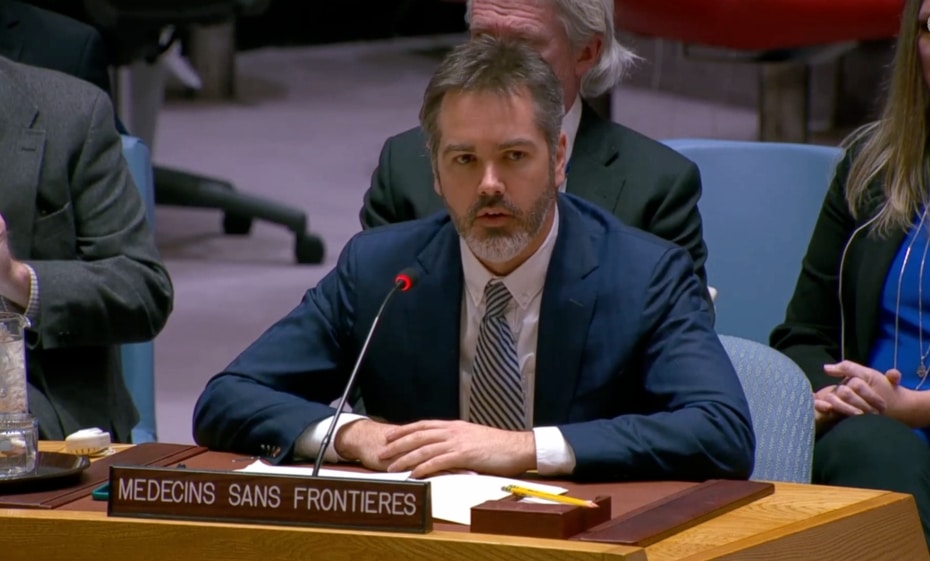
March 13, 2025 (UNITED NATIONS) – The head of Médecins Sans Frontières (MSF) on Thursday accused the international community of “indifference” in the face of Sudan’s two-year-long civil war, demanding the U.N. Security Council take immediate action and adopt a new approach to delivering humanitarian aid.
In a strongly worded address to the council, MSF Secretary General Christopher Lockyear painted a grim picture of a conflict marked by deliberate violence against civilians, widespread suffering, and a woefully inadequate humanitarian response.
“Two years of unrelenting violence have plagued Sudan,” Lockyear said. “Two years of devastation, displacement, and death… met with two years of indifference and inaction.”
He accused both the Sudanese Armed Forces (SAF) and the Rapid Support Forces (RSF) of actively targeting civilians. Lockyear cited instances, including the SAF’s indiscriminate bombing of populated areas and the RSF’s campaign of sexual violence, mass killings, and looting of aid. He described scenes of “utter carnage” witnessed by MSF teams in hospitals overwhelmed with casualties.
“The war in Sudan is a war on people,” Lockyear said, adding that violence against civilians was “central to how this war is being waged.”
Lockyear detailed the immense challenges MSF faces providing medical care amid the violence and deliberate obstruction of aid. He highlighted severe malnutrition, a spike in preventable diseases, and the crippling impact of bureaucratic hurdles imposed by both sides of the conflict. He specifically cited the RSF’s use of its humanitarian agency, SARHO, to impose “crippling bureaucratic hurdles” and “unjustifiable tolls and taxes” on aid deliveries.
“Assertions of sovereignty cannot continue to be weaponized to restrict the flow of aid,” Lockyear said. “Aid and aid agencies cannot continue to be exploited to derive legitimacy.”
While acknowledging some minor progress in aid access, Lockyear argued the gains were “negligible compared to the overwhelming scale of needs.” He cited the slow pace of aid delivery through the Adre crossing and the continued lack of repair to the vital Mornei bridge as evidence of the international community’s failure.
The MSF chief directly criticized the U.N. Security Council for failing to enforce its own resolutions calling for an end to the conflict and the protection of civilians. “Your calls ring hollow,” he said, adding that the Council’s inaction felt like “abandonment” to the people of Sudan.
Lockyear called for a “new compact” to protect civilians, guaranteeing aid organizations operational space, enforcing a moratorium on aid restrictions, and ensuring independent monitoring and accountability for all parties to the conflict. He also urged increased and sustained funding from member states and a full redeployment of U.N. humanitarian agencies across Sudan.
“The crisis in Sudan demands a fundamental shift away from the failed approaches of the past,” Lockyear said. “Millions of lives depend on it.”
MSF’s condemnation is one of the strongest yet of the international response to the Sudan crisis. Lockyear directly challenged the Security Council to move beyond rhetoric and take concrete action to alleviate the suffering of millions, warning that the looming rainy season and a widening hunger gap make immediate action even more critical.