
Sudan’s deputy leader tells South Africa rebels could be defeated by end-April
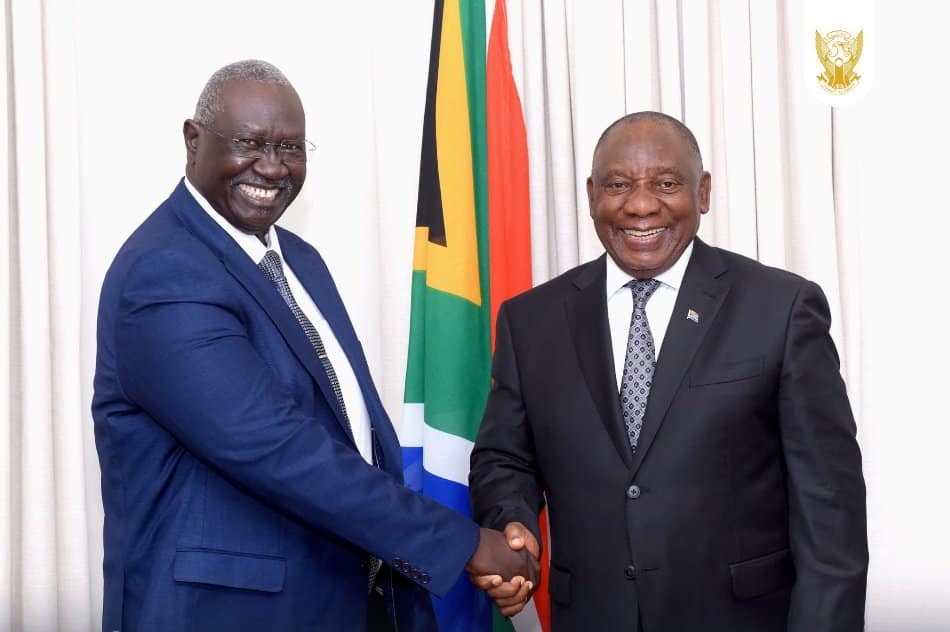
March 18, 2025 (PRETORIA) – Sudan’s deputy leader, Malik Agar, told South African President Cyril Ramaphosa on Tuesday that the Sudanese government expects to defeat the rebellion by the Rapid Support Forces (RSF) in most states by the end of April.
Agar arrived in the South African capital on Monday, accompanied by the undersecretary of the foreign ministry, as part of an African tour that began weeks ago and has included Uganda and Djibouti.
“I confirmed to President Ramaphosa that we expect to eliminate the rebellion by the end of next April in most of Sudan’s states,” Agar said in a Facebook post.
The Sudanese official expressed concern about the RSF’s repeated use of a racially-charged approach against African communities in the Darfur region. “The burying alive of members of the Masalit ethnicity remains a testament to these grave violations, and the militia’s current military mobilization on racial grounds in Darfur reinforces these concerns,” he added.
He said he briefed the South African president on the humanitarian situation and the extent of the destruction caused by the rebel forces in the service sector through their targeting of infrastructure and various service facilities.
The meeting also discussed the Sudanese government’s position on ending the war, and Agar provided an explanation of the roadmap that would lead to that. He affirmed the government’s readiness to end the war but added, “There is difficulty in communicating with the militia due to the multiplicity of decision-making centres, in addition to the presence of foreign mercenaries in its ranks.”
Agar also briefed Ramaphosa on the Sudanese government’s reform plan and its strategy for promoting interests among community components immediately after the war ends, which will coincide with the reconstruction process.
The Sudanese deputy leader said the meeting also addressed the “dangerous step” taken by the Kenyan government in supporting the militia’s positions in forming a parallel government. He stressed that this represents a clear violation of international laws and the African Union charters, and is classified as a hostile move against Sudan, explicitly targeting its unity and territorial sovereignty, threatening its division.
Agar said Sudan was satisfied with the positions of most regional neighbouring countries rejecting the establishment of a parallel authority, calling on the African continent to resist such negative moves aimed at fragmenting states for the benefit of external parties.
On February 23, Kenya hosted meetings of the RSF and its allies from the SPLM-N led by Abdel Aziz al-Hilu, factions of the Revolutionary Front, the head of the National Umma Party, and a number of political entities.
These parties signed a political charter and another for the transitional constitution, paving the way for the formation of a parallel authority in areas controlled by the RSF. This move sparked internal and external rejection.
Agar quoted the South African president as saying they were seeking to end the war in Sudan and working to support the restoration of Sudan’s historical role on the continent.