
Sudan war halts production at vast Al Jazirah farm scheme for first time in century
By Sudan Tribune
WAD MADANI, April 14, 2025 (Sudan Media Forum – Joint News Room) – The war in Sudan has forced the sprawling Al Jazirah agricultural scheme, Africa’s largest irrigated farm under single management, out of production for two consecutive seasons – the first such halt since its establishment exactly 100 years ago.
Founded in 1925, the scheme covers about 2.2 million feddans (approximately 2.3 million acres) in Al Jazirah state, central Sudan. Most of this area ceased production after the paramilitary Rapid Support Forces (RSF) seized control of much of the state in December 2023. The Sudanese army regained control this past January.
The scheme’s infrastructure, including vital irrigation canals, workshops, cotton gins, and warehouses, has suffered extensive destruction, sabotage, and widespread looting. This has compounded the deterioration and neglect the project faced even before the conflict began.
Ali Ahmed Ibrahim, Secretary-General of the Al Jazirah Scheme Board, told Sudan Tribune that initial estimates place the project’s losses between $15 billion and $20 billion, adding that the final figure could be higher.
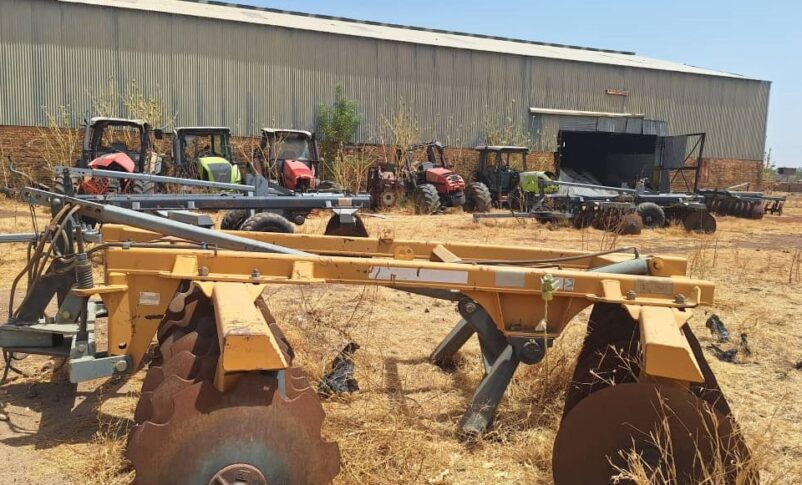
Touring the scheme’s damaged headquarters in Barakat, a visibly distressed Ibrahim said RSF forces looted more than 50 tractors with attachments and over 50 vehicles used by field inspectors for monitoring agricultural work. Money safes at the Al Jazirah Scheme headquarters also showed signs of being forced open and looted; some safes, considered antiques brought from Britain at the scheme’s inception, were damaged.
Ibrahim confirmed that sabotage and looting affected warehouses and workshops, accusing RSF forces of involvement and of encouraging thieves to steal remaining Al Jazirah scheme assets.
The impact extends across Al Jazirah state, where about 80% of the roughly 6 million residents depend on agriculture. A recent report from the Al Jazirah State Ministry of Production and Economic Resources, obtained by Sudan Tribune, highlighted the broader devastation. Al Jazirah, considered Sudan’s agricultural heartland with 6.2 million feddans (approx. 6.4 million acres) of farmland, saw widespread damage to its horticulture, poultry, and livestock sectors.
According to the ministry report, the war took one million out of 1.5 million feddans (approx. 1.04m/1.56m acres) in the rain-fed sector out of production. Furthermore, 150,000 out of 200,000 feddans (approx. 156k/208k acres) in the horticultural industry – a key source of fruit and vegetable exports like bananas – were ruined.
The report stated the war caused the complete (100%) devastation of the state’s poultry sector, wiped out 80% of livestock, and involved the looting of approximately 90% of agricultural machinery.
Individual farmers have also suffered greatly. Bakri Moawiya, a farmer near Barakat, said RSF elements looted his tractor and car at gunpoint. He added that the same individuals returned later, stealing grain from his stores and accusing him of affiliation with “feloul” – remnants of the ousted regime of former President Omar al-Bashir.
The crisis is visible in the Al Jazirah scheme’s fields, which are now choked with weeds and pests, and its dry irrigation canals that require major clearing. “It’s the first time in my life I’ve seen these canals dry, without water,” Moawiya said.
Despite the challenges, Moawiya has started preparing a small part of his land with limited resources, hoping to plant during the summer season and cultivate more extensively next winter.
Infrastructure damage is severe. Dozens of warehouses across the Al Jazirah scheme in areas like Al-Baqir, Al-Hasahisa, and Marangan were looted, sabotaged, or burned. Al-Fateh Haj Babiker, the scheme’s head of Media and Public Relations, described catastrophic damage to key facilities in Marangan that supplied the entire project.
The main fertilizer and pesticide warehouse there was looted, burned, and its structure largely dismantled by thieves, leaving only fire-damaged ruins. A massive fire destroyed the century-old main spare parts warehouse for cotton gins, causing it to collapse. Seed warehouses in Barakat and Marangan were also looted of contents and structural materials. Even the main treasury office at the Al Jazirah Scheme headquarters in Barakat suffered extensive looting and vandalism.
Despite the immense destruction and operational paralysis caused by the war at the Al Jazirah Scheme, compounded by prior neglect, efforts are underway to revive the historic scheme. The Al Jazirah Scheme management has acquired about 20 large tractors with attachments to begin land preparation. It is working to source seeds needed for the upcoming planting season, though resources and funding remain scarce.