
Saudis warn on parallel govt, UAE urges civilian-led process at Sudan talks
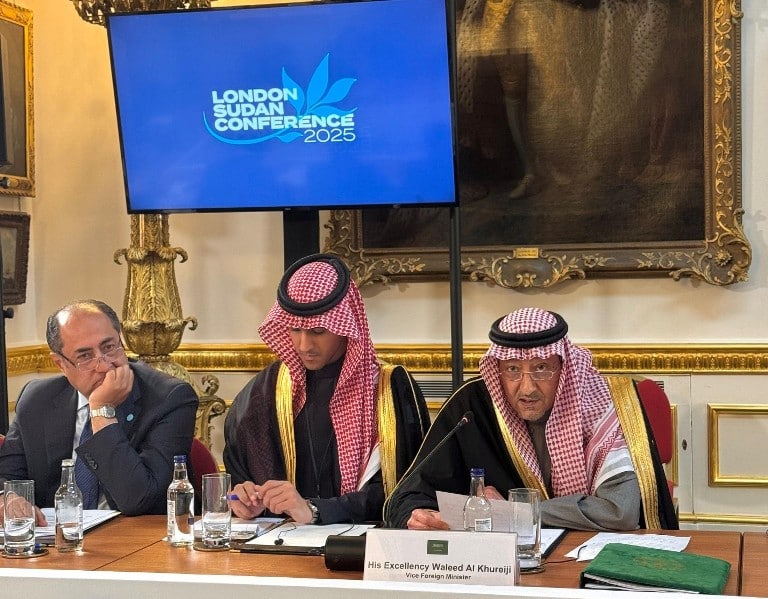
April 15, 2025 (LONDON) – Saudi Arabia and the United Arab Emirates outlined distinct but firm positions on resolving the Sudan crisis at a conference in London on Tuesday, with Riyadh warning against parallel governments and external support for warring factions, while Abu Dhabi emphasized the necessity of a civilian-led political process and new international mechanisms.
Speaking at the conference, Saudi Deputy Foreign Minister Engineer Waleed bin Abdulkarim El-Khereiji stated that the Kingdom “warns against calls for the formation of a parallel government or any alternative entity,” calling them “illegitimate attempts that threaten the political process, deepen division, and obstruct efforts to reach a comprehensive national solution.”
El-Khereiji affirmed that actions outside official state institutions infringe on Sudan’s unity and legitimacy.
He also stressed the need to halt outside interference fueling the conflict. “Stopping external support to the parties of the conflict is an essential matter,” he stated, necessary for creating conditions for a ceasefire and a political solution. He noted that neutralising interventions facilitate aid delivery.
The Guardian said on Tuesday that the disputes between Egypt, Saudi Arabia, and the United Arab Emirates over the wording of the final statement scuttled hopes for a unified declaration. Egypt’s stance is similar to Saudi Arabia’s and supports the Sudanese army-led government.
Addressing the conference, Lana Nusseibeh, UAE Assistant Minister for Political Affairs and head of the UAE delegation, stressed that securing peace requires “a viable political process with a clear end game – the transition to an independent, civilian-led government independent from military control.”
She stated unequivocally that “neither the SAF nor the RSF represents the people of Sudan and neither can bring stability,” asserting that “only a Sudanese-led, civilian-driven process rooted in civilian and independent leadership can deliver meaningful change.”
To develop this roadmap, Nusseibeh argued the international community needed to “create new mechanisms that can deliver real impact,” including new measures to tackle security threats and end the obstruction of humanitarian aid.
Highlighting the regional dimension, Nusseibeh said the approach must address wider risks, “ensuring that Sudan never again becomes a safe haven for extremism, terrorism, and threats to international maritime security.” Preventing these networks from taking root is “integral to any serious effort to support Sudan’s future,” she added.