
Former PM Hamdok dismisses Sudanese army’s new government as ‘fake’
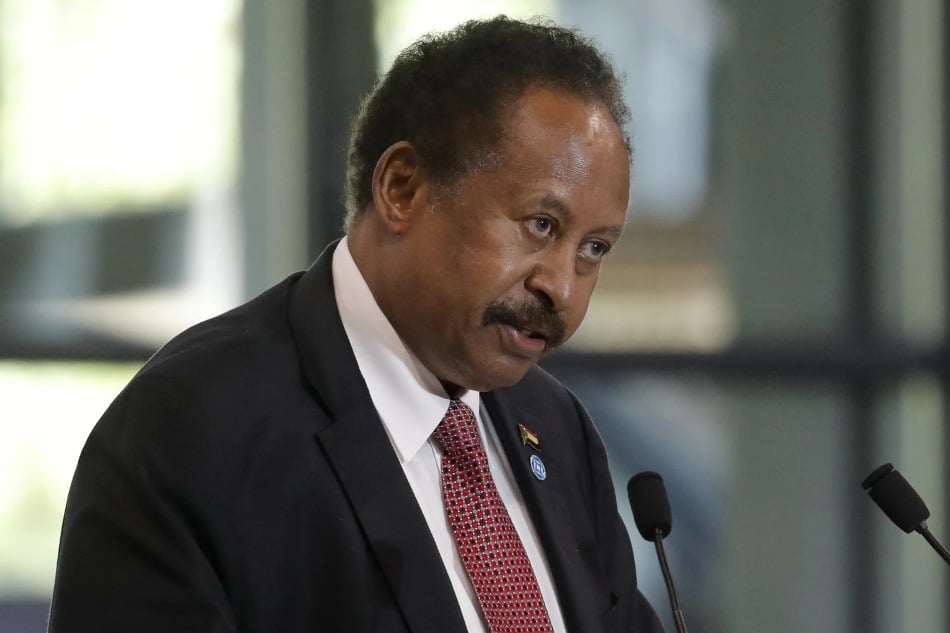
June 4, 2025 (MARRAKECH, Morocco) – Sudan’s former Prime Minister Abdalla Hamdok on Wednesday dismissed the military’s recent moves to form a new government as “fake,” saying battlefield gains would not end the country’s two-year civil war.
In a rare interview with The Associated Press, Hamdok, who now leads a civilian coalition from exile, said no military victory, in Khartoum or elsewhere, could end the conflict that has killed tens of thousands and displaced millions.
“Whether Khartoum is captured or not captured, it’s irrelevant,” Hamdok told AP on the sidelines of the Mo Ibrahim Foundation’s governance conference in Morocco. “There is no military solution to this. No side will be able to have outright victory.”
Hamdok became Sudan’s first civilian prime minister in 2019, following decades of military rule, and attempted to lead a democratic transition. He resigned in January 2022 following a turbulent period that included his ouster in a coup and brief reinstatement. The following year, warring generals plunged the country into civil war, triggering one of the world’s worst humanitarian crises.
Fighting between the Sudanese army and the paramilitary Rapid Support Forces (RSF) has left at least 24,000 people dead, though many believe the true toll is far higher. Both factions are accused of war crimes, with the RSF, which has roots in Darfur’s Janjaweed militia, accused of carrying out genocide. The army is accused of using chemical weapons and targeting civilians.
The conflict has driven some 13 million people from their homes, including 4 million who have crossed into neighbouring countries. Famine is taking hold, and cholera is spreading.
The army recaptured the Khartoum area from the RSF in March, with army chief Gen. Abdel-Fattah Burhan presenting these advances as a major turning point. Last month, Burhan appointed Kamil al-Taib Idris as prime minister to form a new government. However, fighting has persisted, with the RSF regrouping in its stronghold in Darfur and making advances elsewhere, including in Kordofan.
Hamdok, a 69-year-old former economist, called the idea that the conflict was drawing down “total nonsense.” He described the notion of starting reconstruction in Khartoum while fighting continued elsewhere as “absolutely ridiculous.”
“Any attempt at creating a government in Sudan today is fake. It is irrelevant,” he said, arguing that lasting peace cannot be secured without addressing the war’s root causes.
Hamdok stated that a ceasefire and a credible process to restore democratic, civilian rule would need to confront Sudan’s deep inequalities, including uneven development, issues among different identity groups, and questions about the role of religion in government.
“Trusting the soldiers to bring democracy is a false pretence,” he added.
While rooted in longstanding divisions, the war has been exacerbated by foreign powers accused of arming both sides. Pro-democracy groups, including Hamdok’s Somoud coalition, have condemned atrocities committed by both the army and the RSF.
Asked about accusations that the United Arab Emirates has supplied weapons to the RSF, Hamdok avoided direct accusation. He said those who singled out the Gulf state while ignoring others accused of backing the army, including Iran, were “pushing a narrative.”
“What we would like to see is anybody who is supplying arms to any side to stop,” he concluded.