
Trump advisor: Sudanese army amenable to humanitarian truce, work underway on agreement details
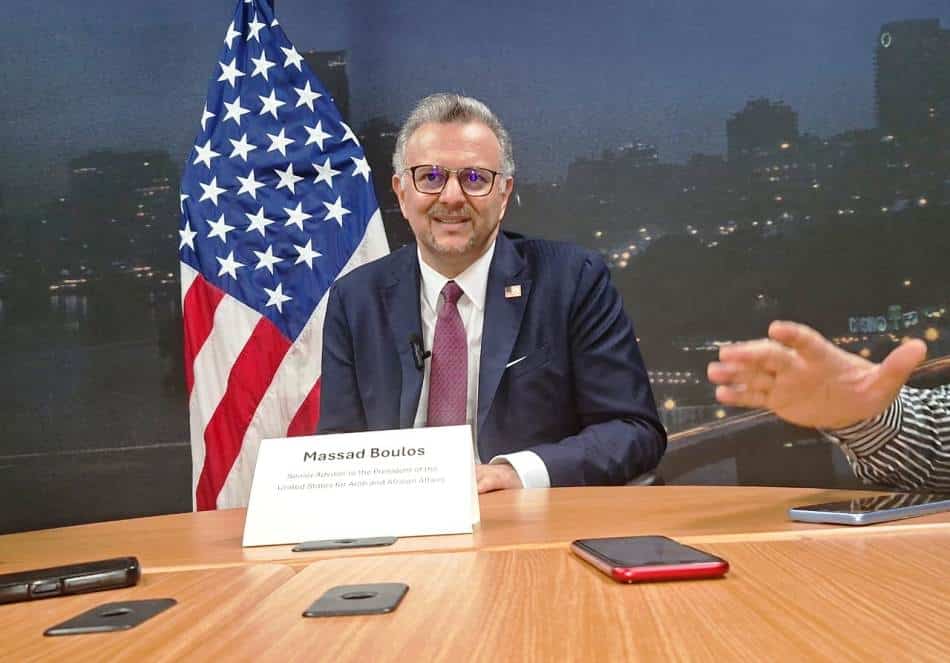
November 3, 2025 (CAIRO) – U.S. President Donald Trump’s senior adviser for Africa, Massad Boulos, said that the Sudanese army does not object in principle to a three-month humanitarian truce initiative. He noted an initial welcome from both parties and that US efforts are currently focused on finalizing the details of the agreement.
Boulos indicated that reaching a truce agreement requires time due to the “complex technical, security, and logistical details,” including monitoring, follow-up, and implementation mechanisms. He emphasized that the goal is to reach a comprehensive understanding that paves the way for the post-truce phase, as part of a nine-month plan mentioned in the Quad’s statement.
He added: “Both parties have agreed in principle, and we have not recorded any initial objection from either side. We are now focusing on the fine details.”
Boulos stressed that the current objective is to reach an understanding on a complete framework for a ceasefire and then open the door for the post-truce phase.
He continued, “This is what the Quad Committee addressed in its statement issued on September 12. We spoke then about the post-humanitarian truce phase, and you will find mention of three months and nine months therein.”
Boulos said that work on the nine-month phase would begin immediately after concluding this truce agreement. He noted their serious reliance on what he termed “the wisdom of both parties” to achieve this.
Boulos explained that the initiative was proposed within the framework agreed upon by the Quad and was announced on September 12. He added that the United States prepared a working paper based on this consensus, presented it to both parties a week ago, and it is now under study, research, and negotiation with each party separately.
Boulos affirmed that there are no direct or indirect negotiations between the two parties, but rather separate communication from the American side, expressing his hope of reaching an agreement.
He described the humanitarian situation in Sudan as “very urgent,” adding that what happened in El Fasher is “painful and condemned in the strongest terms,” at a time when about 25 million Sudanese need assistance.
He stressed that humanitarian work “must not be linked to any political or military arrangements,” affirming that the United States is coordinating with international organizations, including the Office for the Coordination of Humanitarian Affairs (OCHA), the World Food Programme, and the Red Cross. He added that a US follow-up committee is working with both parties to secure aid delivery throughout Sudan, even without a formal ceasefire.
Regarding the city of El Fasher, Boulos said a coordination body was established during the UN General Assembly meetings between OCHA, the Rapid Support Forces (RSF), and the United States. It managed to deliver aid to areas surrounding El Fasher before security events surpassed the coordination’s ability to operate inside the city.
Boulos affirmed that the Quad is an effective framework because it includes influential countries, explaining that other countries—including Qatar, the European Union, Turkey, and others—are ready to contribute, and that everyone’s participation is necessary for the success of current efforts.
Regarding external military support and Sudan’s accusations against the UAE of involvement in fueling the conflict, Boulos said the Quad addressed this file in its September 12 statement, calling for a complete cessation of all forms of external support. He emphasized that the focus now is on stopping the conflict and achieving comprehensive peace.
Massaad Boulos warned against repeating the “Libyan scenario” in Sudan, especially after the fall of El Fasher and the RSF’s control over areas in Kordofan. He reiterated Washington’s rejection of the “parallel governments” principle, considering it detrimental to Sudan’s unity.
Responding to Sudan Tribune about the US ignoring calls to designate the RSF as a terrorist group despite its horrific violations, Boulos said the current phase does not require designating one group or another. He noted that the US government has not hesitated to condemn what happened in El Fasher through official statements and pointed out that his country has imposed sanctions on individuals from both warring parties, the latest of which were imposed last August.
He continued, “Our primary concern now is to address the humanitarian situation urgently, then achieve lasting peace in Sudan and preserve its unity.”