
RSF continues body disposal operations in Sudan’s El-Fasher – report
November 23, 2025 (KHARTOUM) – Sudan’s Rapid Support Forces are conducting ongoing body disposal operations in El-Fasher weeks after mass killings that began when the paramilitary group captured the city in late October, Yale University researchers said on Thursday, citing satellite imagery showing continued burning activity through mid-November.
The Humanitarian Research Lab at Yale School of Public Health identified repeated patterns of likely body disposal at sites that previously held large civilian populations and are at or near locations where the lab had previously documented evidence consistent with RSF-conducted mass killings, according to a November 21 report.
The findings indicate body disposal operations have continued for at least three weeks since the RSF captured the North Darfur capital on October 26, researchers said, raising concerns about the scale of atrocities and the fate of an estimated 250,000 civilians who remained in the city before it fell.
Reuters could not independently verify the findings. The RSF did not immediately respond to requests for comment.
Repeated burning activity
At Saudi Hospital, which was El-Fasher’s last functioning medical facility before the city fell, researchers documented a repeated pattern throughout November of white objects placed in a hole, set on fire and burned to ash.
“This activity pattern was first visible at this location on 6 November 2025 and is visible in satellite imagery collected on 9 and 13 November 2025,” the report stated, noting the pattern continued through at least November 17.
At a compound in the Daraja Oula neighbourhood – the last major civilian refuge before the RSF completed its siege – satellite imagery from November 13 showed clusters of burning objects that were not present the previous day. By November17, clusters of white objects and areas of ground disturbance or charring were visible.
“Body disposal at these locations – on the Saudi Hospital facility grounds and around a compound in Daraja Oula neighbourhood – are at or near areas where HRL previously identified evidence consistent with RSF-conducted mass killings,” the report stated.
The researchers assessed the activity as consistent with body disposal, possibly through immolation. Saudi Hospital staff and patients were reportedly killed or kidnapped after RSF forces took control on Oct. 26, according to the report.
No civilian life visible
Yale researchers found no visible market activity at seven major commercial sites since the city’s capture, with satellite imagery showing no civilian vehicles, animal-drawn carts or human presence through mid-November.
The Grand Market, Umm Defso Market, Navaisha Market in Abu Shouk internally displaced persons camp, and other major commercial hubs showed no signs of normal civilian activity. Several locations displayed abnormal vegetation overgrowth, indicating sustained inactivity during a period when markets would typically be operating.
“The lack of market activity further corroborates HRL’s finding that there are no current patterns of life visible that are consistent with civilian presence and freedom of movement in El-Fasher,” the report stated.
The Navaisha Market sustained at least 22 munition impacts between Aug. 30 and Sept. 10 before the RSF captured Abu Shouk camp in early October, researchers documented. The Abu Qurun Market was struck by a drone attack on Sept. 27.
Burial activity ceased
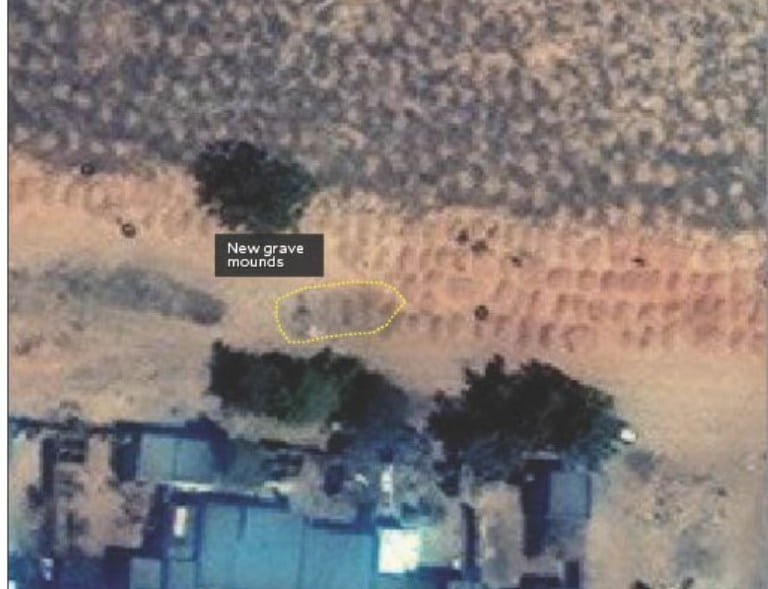
While researchers identified five new grave mounds at Al-Rahma cemetery and two possible mounds at a Daraja Oula cemetery between Oct. 26-28, no additional traditional burial activity has been observed since Oct. 28.
“Individuated burial does not appear to have continued since 28 October,” the report stated, noting that all confirmed burial mounds were created during a two-day period immediately after the city fell.
The cessation of traditional burial practices, combined with ongoing body disposal operations, “raises significant concerns about the presence of civilians and the sustainment of life for those who remain in El-Fasher,” according to the report.
Yale researchers assessed it remains “highly likely” that most civilians alive in El-Fasher before Oct. 26 “have been killed, have died, are detained, are in hiding, have fled, or are otherwise unable to move freely.”
RSF controls infrastructure
Satellite imagery showed RSF vehicles, including armored vehicles, at El-Fasher’s water treatment plant throughout November, with increased water seepage suggesting the facility is being used to obtain water. No civilian presence was detected in the area.
The report was produced using satellite imagery from Vantor and Planet Labs combined with open-source data analysis. The lab is supported by the Avaaz Foundation.
Abu Shouk IDP Camp, where one of the monitored markets is located, was founded during the first Darfur genocide in the early 2000s. The Janjaweed militia – predecessors of the RSF – systematically attacked indigenous Black African communities including Zaghawa, Fur and Masalit groups, forcing survivors into displacement camps.
Sudan has been engulfed in civil war since April 2023, when fighting erupted between the national army and the RSF. The United Nations has warned the conflict has created one of the world’s worst humanitarian catastrophes, with millions displaced and famine threatening multiple regions.