Sudan’s agricultural sector suffers sharp collapse affecting GDP

November 23, 2025 (PORT SUDAN) – The agricultural sector in Sudan, the lifeline of the country’s economy, is witnessing a sharp collapse that has significantly impacted the Gross Domestic Product (GDP).
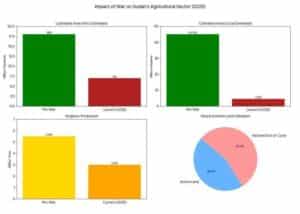
Cultivated areas in the country have shrunk to 35% of the total area, according to preliminary estimates by experts and specialists. This deterioration is a direct result of the ongoing war, with experts confirming that a total of 25 million Sudanese are now threatened by severe famine.
Mohamed Badr al-Din, a former employee at the Sudanese Ministry of Agriculture, told Sudan Tribune that about 60% of the agricultural area used before the war has gone out of production due to the conflict.
He confirmed a funding decrease, which affected major projects such as the Gezira Scheme, where 55% of the project’s land dropped out of the agricultural cycle.
He revealed recent information indicating a drop in grain production, such as sorghum, to less than 3 million tons, down from about 5-6 million tons before the war.
Exiting the economic cycle
Before the conflict, the agricultural sector accounted for 48% of the country’s GDP, according to 2017 statistics (the last scientific census), and employed 61% of the workforce, according to economic expert Dr Haitham Mohamed Fathi speaking to Sudan Tribune.
However, agricultural expert Hamid Abdel Latif Osman explained to Sudan Tribune that the outbreak of war led to agricultural production shrinking to less than one-tenth, noting that the sector “has completely exited the Sudanese economic cycle, not just exports.”
“The majority of the people of Sudan are currently threatened by severe famine, specifically with the shrinking areas of sorghum and wheat,” Osman added.
Shrinking cultivated areas
A report by the Integrated Food Security Phase Classification (IPC) indicated that the agricultural sector’s current contribution to GDP has sharply collapsed, ceasing to be the dominant economic force it once was.
Haitham Fathi asserted that Sudan possesses about 80 million feddans of unutilized agricultural land, equivalent to 47% of the country’s total arable area.
Meanwhile, the two experts confirmed that the area actually cultivated in the irrigated and rain-fed sectors does not exceed one-tenth of the area cultivated during peacetime, compared to about 45 million feddans that were cultivated from the total arable land before the war.
Worsening humanitarian crisis
The experts link the accelerated decline in agricultural production to the internal and external displacement crisis, which has led to the displacement of over 12 million Sudanese inside the country and about 3 million Sudanese refugees in neighbouring countries.
They also noted that displacement is particularly concentrated in major agricultural production areas, such as Darfur, Kordofan, Al Jazirah, and the White Nile. This has led to a complete halt in farming and harvesting operations, exacerbating the food insecurity crisis threatening millions.
Reports indicate the impact of displacement on agriculture in the country is total, in addition to the loss of labour and farmers, pressure on agricultural areas, and the loss of water and electricity sources.
The destruction of assets, infrastructure, and machinery in the projects also worsened the country’s sectoral crisis.
In a recent report, the FAO estimated a catastrophic decline in cultivated areas in Sudan, from 18 million hectares to 7 million hectares.
The report stated that farmers abandoned their farms as they fled the war, leaving livestock herds without shepherds or care.