
Idris proposes peace initiative to UN Security Council to end Sudan conflict
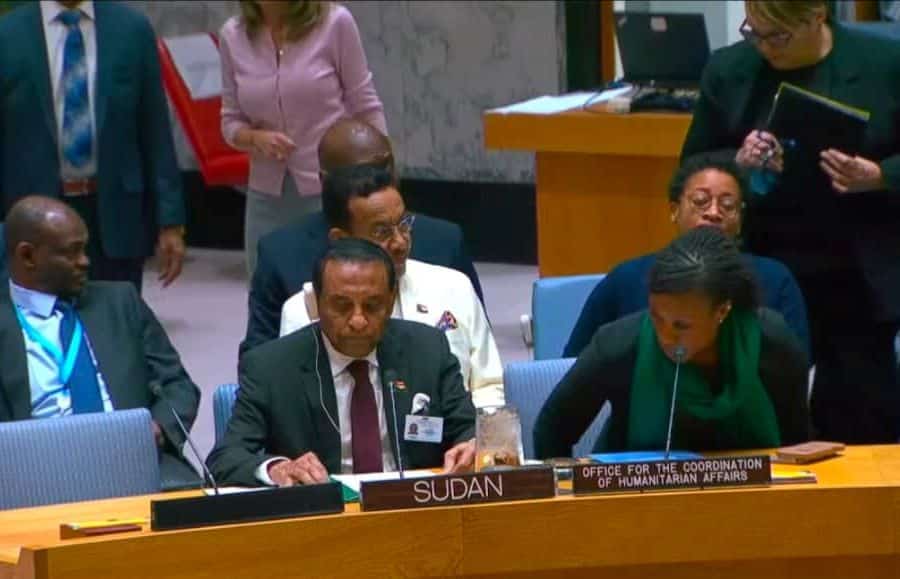
December 22, 2025 (NEW YORK) – Prime Minister Kamil Idris on Monday presented an initiative to the United Nations Security Council to settle the conflict in Sudan, based on a ceasefire, the disarmament of the Rapid Support Forces (RSF), and the achievement of justice and reconciliation.
The Security Council held an open session on Monday evening to discuss the situation in Sudan, 1,000 days after the outbreak of the conflict, at the government’s request.
In a speech to the Security Council, Idris stated that “the Sudanese civilian government’s initiative to end the conflict begins with a ceasefire, disarmament, non-selective justice, and non-formal reconciliation”.
He explained that the initiative starts with a comprehensive ceasefire under the monitoring of the United Nations, the African Union, and the Arab League, followed by the withdrawal of RSF fighters from cities under their control to agreed-upon camps under international and regional supervision.
Idris noted that the initiative includes the disarmament of the RSF with international monitoring and guarantees against arms recycling, as well as securing the return of displaced persons and refugees and the flow of humanitarian aid.
The government will take confidence-building measures, including subjecting perpetrators of crimes to transitional justice, reviewing filed legal claims, and regularizing the status of those wishing to return to the country in preparation for launching a dialogue.
The initiative allows for the integration of RSF members who meet government criteria into the regular forces, alongside supporting development projects in Darfur, Kordofan, and other affected areas.
The prime minister said the plan includes holding local and international conferences to re-establish social peace and reconciliation, as well as a “Sudanese-Sudanese dialogue” in which political forces agree on state management and governance, followed by general elections.
He stated that the initiative provides a realistic, implementable framework for protecting civilians, restoring state authority, and opening the way for national reconciliation, emphasizing that it aims to end the cycle of violence rather than win the war.
The initiative is described as a complement to the roadmap previously proposed by the Sudanese government and the initiatives of Saudi Arabia and Egypt.
Sudan submitted a roadmap to the UN on March 10, which included a vision and practical steps to stop the conflict and arrangements for the post-war transition.
That roadmap stipulated a ceasefire, the withdrawal of the RSF from cities, and the gathering of its forces in areas in Darfur that would accept their presence within 10 days.
It also set a three-month period for the return of displaced persons and the entry of relief, followed by the restoration of water, electricity, health, and education services within six months, after which negotiations on the future of the RSF, the formation of an independent government, and a comprehensive intra-Sudanese dialogue would occur.
Kamil Idris called on members of the Security Council to support his initiative.
He stressed that peace cannot be achieved without accountability, nor can stability be achieved without a unified authority.
“The Sudanese civilian government’s initiative to end the conflict begins with a ceasefire, disarmament, non-selective justice, and non-formal reconciliation,” Idris told the Council. Assistant Secretary-General Khaled Khiari warned that swift, coordinated action is required to preserve Sudan’s territorial integrity.
Khiari noted that U.N. Personal Envoy Ramtane Lamamra is engaging both warring parties on de-escalation while an African Union-led dialogue aims to pave the way for a civilian-led transition.
For his part, Edem Wosornu, director of the OCHA Crisis Response Division, outlined three tracks for urgent international engagement to address the deepening humanitarian crisis.
She emphasized that the Council must deliver an unequivocal message that indiscriminate attacks and sexual violence will not be tolerated to prevent a repeat of the atrocities seen in El Fasher.
Furthermore, she called for guaranteed safe passage for aid workers and life-saving supplies across conflict lines, including the indefinite authorization of the Adre border crossing. Wosornu also stressed that immediate efforts are needed to halt the flow of sophisticated weaponry that continues to fuel the violence.