
Sudan’s Red Sea ports face infrastructure hurdles amid regional shifts
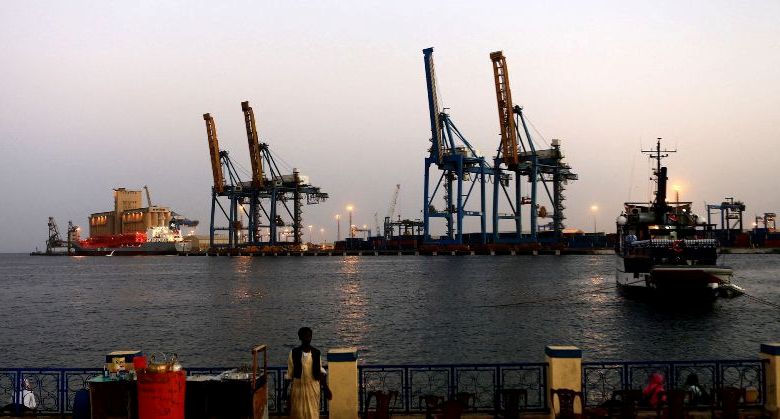
March 6, 2026 (PORT SUDAN) – Sudan’s Red Sea ports are testing their readiness for a potential shift in global trade as conflict in the Arabian Gulf threatens vital maritime corridors, including the Straits of Hormuz and Bab al-Mandab.
Should Middle East instability disrupt international shipping, Sudanese ports—led by Port Sudan—could see their strategic importance grow. Located on Sudan’s eastern coast, Port Sudan is the nation’s primary gateway for exports and imports. Its key facilities include the Southern Container Terminal, the Northern Port for bulk cargo and essential commodities, and the Bashayer Terminal, which handles South Sudanese oil exports.
Maritime experts note that Sudan’s coastline, stretching between 730 and 800 kilometres, offers a strategic opportunity to serve as a logistical gateway for landlocked African nations. However, realizing this potential requires significant infrastructure upgrades and operational improvements.
Deep-water deficit
Former Director General of the Sudanese Sea Ports Corporation, Onour Mohammed Adam Sultan, told Sudan Tribune that global trade relies heavily on “hub ports” capable of receiving ultra-large container ships carrying over 12,000 twenty-foot equivalent units (TEUs). These vessels then redistribute cargo to smaller ports through transhipment.
Sultan explained that these giant ships require depths exceeding 18 meters, which Port Sudan currently lacks. He noted that the port needs to deepen its draft and modernize container handling equipment to accommodate such vessels directly.
Between 2019 and 2021, container traffic in Sudanese ports fluctuated between 450,000 and 500,000 TEUs annually. While the ports are not currently experiencing major congestion or long waiting times, Sultan attributed this to a decline in trade volumes due to the ongoing war in the country, rather than to high operational efficiency.
Logistical hurdles
Port expert Abdel Qader Abu Ali Majzoub told Sudan Tribune that Sudanese ports were originally built to meet domestic needs, leaving them with limited capacity compared to major regional hubs.
The Southern Port features eight berths for container ships, while the Northern Port handles bulk goods like wheat and grain. Suakin Port primarily serves passenger traffic and limited commercial activity. Majzoub noted that some berths lack modern cranes, forcing ships to rely on their own onboard equipment for unloading.
Despite these challenges, Majzoub said Sudan’s location provides a competitive advantage for serving nations like Chad and the Central African Republic. Capitalizing on this requires modern warehouses, logistics zones, and the development of railway and road networks connecting the coast to the interior and neighbouring countries.
Regional race
Sudan faces stiff competition from Red Sea neighbours, particularly Egypt, Saudi Arabia, and Djibouti, which possess modern, deep-water ports capable of handling the world’s largest container ships. While Sudanese ports currently operate with modest capabilities, Majzoub believes future investment in the coastline could bridge this gap.
Economic analyst Haitham Mohamed Fathi told Sudan Tribune that Sudan’s importance stems from its location roughly halfway between Asia and Eastern Europe, making it a candidate for ship services and maintenance. He noted that approximately 20% of global trade and 30% of global oil trade passes through the Red Sea.
Port Sudan exports approximately $4 billion worth of goods annually, while imports total $7.5 billion. A vital component of the city’s economy is the oil refinery, which processes South Sudanese crude. Additionally, a free trade zone established in 1999 links the port to Port Sudan International Airport.
Investment needs
Fathi said rehabilitation efforts began in 2006 with Chinese investment. In 2011, a new container terminal was completed with a capacity of 800,000 TEUs per year, improving operations at the Southern Port and attracting more shipping lines.
Experts agree that becoming a regional hub requires deepening ports to 18 meters, modernizing handling equipment, and attracting foreign investment through partnerships with international operators.
While Sudan possesses the geographical ingredients to play a larger role in the Red Sea trade, success remains tied to internal stability and infrastructure development. Current berths total 1,478 meters with storage space of 1.48 million square meters—figures that remain small compared to global standards.
In a move toward modernization, the Red Sea State government signed a twinning memorandum with Turkey’s Mersin province in December to exchange logistical expertise. However, experts warn that such agreements will have limited impact without substantial capital investment and clear development plans.