
Remembering Nicholas (Fink) Haysom
Francis Mading Deng
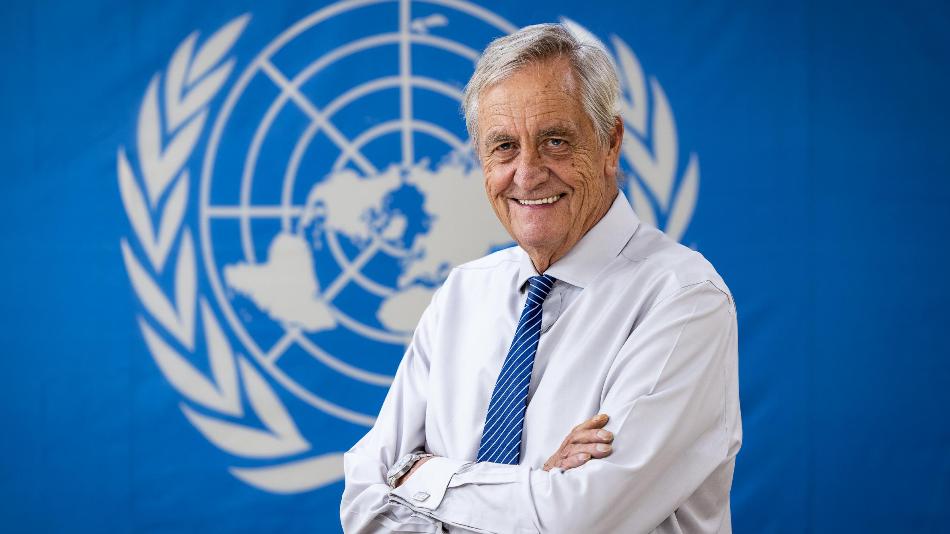
I received the news of Nicholas Haysom’s passing, popularly known as Fink, on March 19th. 2026. Although he had been seriously ill for some time, death is always a tragic event. Fink died in New York, and although I am in Woodstock, a little over ninety miles from New York City, I got the news by a telephone call from Juba, South Sudan, where he had been serving as the Special Representative of the UN Secretary General and Head of the United Nations Mission in South Sudan, UNMISS, from January 2021 until his death.
In this tribute, the portrait I will try to convey is that of an exceptional human being who combined humility with dignity in the pursuit of the ideals of democratic governance, human rights, and humanitarian principles, in his country of South Africa and around the world.
The statement by the Secretary-General summarized the core elements of Haysom’s professional contributions to humanity: “I was deeply saddened to learn of the passing of Nicholas ‘Fink’ Haysom – a principled lawyer, tireless peacemaker, and steadfast champion of the values of the United Nations. Haysom devoted his life to justice, dialogue, and reconciliation — from his central role in South Africa’s democratic transition – serving as Chief Legal and Constitutional Adviser to President Nelson Mandela – to years of leadership in UN posts in some of the world’s most complex and fragile settings, most recently as the head of the UN Peacekeeping Mission in South Sudan.”
I first met Fink in Durban, South Africa, around 2002, when he was to undertake his new assignment as South Africa’s representative in the peace talks between the government of Sudan and the rebel Sudan People’s Liberation Movement, SPLM. Fink was to serve as the principal advisor to General Lazaro Sumbeiywo of Kenya, who was the lead mediator. The meeting was arranged by Vasu Gounden, the Executive Director of the South African think tank, African Centre for the Constructive Resolution of Conflicts, ACCORD. Attending the meeting with me was John Gai Yoh, a South Sudanese who was then living in South Africa, and later served successively as South Sudan’s Ambassador to Turkey, Minister for Higher Education, and Presidential Advisor.
Our first meeting with Fink was unexpectedly adversarial. As I recall, Fink was the first to speak, which was somewhat surprising to me, since I thought the meeting’s objective was to hear from us in preparation for his mission. Obviously, he had already given much thought to the task ahead. Speaking as a lawyer, he ruled out self-determination, which was known to be the demand of the Southern Sudanese people and was widely discussed in public. He said that the most South Sudanese could expect was autonomy.
I was silently outraged. When it was my turn to speak, which I did with a controlled temper, I said that I was also a lawyer, and that while applying the right of self-determination to an area within a post-colonial state might be controversial, it could not be ruled out as he was suggesting. I advised him against proposing autonomy as Southerners had a failed experience with regional autonomy and were allergic to the concept. John Yoh spoke in the same vein. I thought our positions were unbridgeable, and I saw the meeting as an utter disappointment.
I later met Fink again in Cape Town, after the agreement on the Machakos Protocol, which endorsed the right of self-determination for South Sudan. The man I met then was totally different from the one I had met earlier. Fink had become a staunch supporter of the cause of South Sudan, including the right of self-determination extending to full independence. I could not believe the transformation, with which I was, of course, delighted. Fink intimated to me that after they had successfully negotiated the right of self-determination for the South, he advised the Southern negotiators not to display their pleasure over the breakthrough but look despondent as people who had been persuaded to reluctantly compromise. Southern negotiators later confirmed to me how they had acted in accordance with Fink’s advice.
The Machakos Protocol, an agreement between the Sudan government and the Sudan People’s Liberation Movement (SPLM), was signed on July 20, 2002, in Machakos, Kenya. This agreement marked a significant step towards ending the Sudanese Civil War, recognizing the right to self-determination for the people of South Sudan and outlining a framework for governance and a referendum on independence. Haysom remained engaged in negotiations for the 2005 Comprehensive Peace Agreement (CPA), which ushered in the independence of South Sudan on July 9, 2011.
Haysom’s international service had its roots in his country of South Africa. He played an important role in the anti-apartheid movement in South Africa, having served as chief legal and constitutional adviser to Nelson Mandela and helped draft the country’s new constitution. His work laid the foundation for South Africa’s commitment to equality and human rights, which was instrumental in shaping the country’s transition to democracy.
Haysom later served the UN in several conflict countries around the world. His UN work took him to various conflict zones, where he played a crucial role in peace processes. In addition to his service in South Sudan, he served in Somalia and Afghanistan. His experience in these positions earned him recognition for his dedication to promoting peace, justice, and human rights.
Before becoming the Head of UNMISS in South Sudan, Haysom served as the Secretary-General’s Special Adviser on Southern Africa and Sudan from 2019 to 2021. He also held other key positions, including Director for Political, Peacekeeping and Humanitarian Affairs in the Executive Office of the UN Secretary-General from 2007 to 2012, and Head of the Office of Constitutional Support for the UN Assistance Mission in Iraq from 2005 to 2007.
Since the conclusion of the Comprehensive Peace Agreement in 2005, Sudan and South Sudan have hosted several UN Peacekeeping missions, among them:
United Nations Mission in Sudan (UNMIS, 2005-2011.
African Union-United Nations Hybrid Operation in Darfur (UNAMID) 2007-2021.
United Nations Mission in South Sudan (UNMISS) 2011-present.
Interim Security Force for Abyei (UNISFA) 2011-present.
Peacekeeping operations are inherently ambivalent as they reflect the lack of capacity or political will on the part of the host country to protect and assist its needy population. National embarrassment then generates a negative assertion of national sovereignty as a shield against international intervention, which in turn nourishes hostility toward UN missions, even when negotiated and mutually agreed. As colleagues in the UN Department of Peacekeeping Operations used to say, they are supposed to keep peace, which makes their mission an anathema. As the Force Commander of the United Nations Organisation Stabilisation Mission in the Democratic Republic of Congo, MONUSCO, they are trained to fight wars and not to keep peace. The late John Garang de Mabior, the leader of the Sudan Liberation Movement, said to me about the UN peacekeeping mission in Sudan, “If we have concluded a credible peace agreement, why do we need a peacekeeping mission? And if we have not concluded a credible peace agreement, how will they impose peace?” Garang went on to argue that the interaction of peacekeepers was likely to be a source of intricate social problems, which has indeed been experienced in countries hosting peacekeeping operations. I have heard complaints by South Sudanese leaders about such social problems created by peacekeepers.
United Nations peacekeeping operations, however, play a mediating role in managing precarious peace and implementing tenuous peace agreements. This, however, requires a delicate navigation and constructive engagement with the conflicting parties in host countries. In pursuing my UN mandates as Representative of the Secretary-General on Internally Displaced Persons, 1992-2004, and Special Advisor on the Prevention of Genocide, 2007-2012, I invoked Sovereignty as Responsibility, later recast by the International Commission on Intervention and State Sovereignty (ICISS) as the Responsibility to Protect (RtoP) or (R2P). Both concepts rest on three pillars: state responsibility for its people, assisting the state to build its capacity to discharge its national responsibility, and a more robust international intervention in the event of manifest failure of the state to discharge its responsibility resulting in massive suffering and death. This last pillar had to be discreetly and cautiously asserted to minimize resistance in the name of sovereignty.
In my own engagement with governments, I began by acknowledging the problem as internal and falling under national sovereignty, that I respected national sovereignty, but that I saw it positively as entailing responsibility for protecting and assisting citizens and not as a shield against international offer of assistance. I would then add gently that if the state was not able or willing to protect and assist its people, resulting in the suffering and death for its people, the world would not watch passively without intervention. The best way to safeguard national sovereignty was therefore to credibly discharge the responsibility of sovereignty. On the whole, this approach succeeded in gaining the cooperation of governments.
Haysom served as the Special Representative of the UN Secretary-General in South Sudan from January 2021 until his passing. I closely followed his work and had the opportunity of cooperating with him in the exercise of his duties. During his tenure, in his calm, strategic, but gentle and persuasive style, he played a crucial role in promoting the cause of peace, security, and stability under severely challenging conditions, which doggedly persist. Nevertheless, Haysom’s leadership and diplomatic skills inspired UNMISS peacekeepers and the communities they endeavored to protect.
In reflecting on the meaning of life after death, I am always inclined to seek synergy between the Christian and Muslim concept of Heaven with our indigenous concept which I translate as standing the head of the dead person straight up. This is a concept of worldly immortality that envisages continued identity, participation, and influence through the memory of the dead by the living, including the family, friends, professional associates, and all those one has touched in a profound way. By these standards, there is no doubt that Nicholas (Fink) Haysom will be barely missed but will continue to live in Heaven and in this world. May the Almighty grant him eternal rest and comfort his family.