
Sudan fuel price hike triggers surge in cost of living

April 3, 2026 (KHARTOUM) – Sudanese markets were thrown into turmoil on Friday as prices for basic services, essential goods, and bread reached record highs following a series of fuel price hikes across the country.
The economic shock prompted several commercial shops to suspend sales entirely as they wait for market stabilization and a clearer picture of currency fluctuations.
This latest surge in the cost of living comes as Sudan grapples with the dual impact of a prolonged domestic civil war and escalating regional conflict in the Middle East, which has disrupted global supply chains and energy markets.
Households under pressure
In the capital and regional centres like Atbara and Port Sudan, citizens reported being blindsided by the sudden increases, which have placed an immense burden on families already struggling with years of instability.
Sara Mohammed, a citizen who recently returned to Khartoum from Egypt, described the current living conditions as “extremely difficult.”
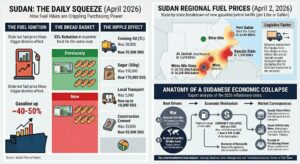
She noted that four pieces of bread now cost 1,000 Sudanese pounds, whereas the same amount previously purchased six pieces. “Meeting daily needs has become a major challenge for those of us trying to rebuild our lives,” she told Sudan Tribune.
In Atbara, resident Aisha Abdul Rahman expressed similar frustration, warning that the repeated price hikes are crushing the purchasing power of low-income families and making basic food security a luxury.
In the eastern city of Port Sudan, resident Rehab Osman reported that a 7-litre container of cooking oil jumped from 30,000 to 35,000 pounds without warning, forcing families to choose between daily essentials and rising transport costs.
Supply chain disruptions
The ripples of the fuel hike have extended deep into the logistics and construction sectors. Osama Saad Haja, head of the Wholesale Merchants Division in Al Jazirah State, confirmed that many shops in Wad Madani have halted operations to reassess their pricing models.
He attributed the halt to the soaring cost of transportation. According to Haja, a 50kg sack of sugar has risen from 155,000 to 175,000 pounds, while the price of a sack of cement has surged from 35,000 to 55,000 pounds.
Public transport has also seen a sharp rise. In Wad Madani, bus fares within the city rose 50% to 1,500 pounds, while rickshaw fares nearly doubled in some areas, reaching as high as 10,000 pounds.
Regional fuel price breakdown
The new fuel tariffs, which took effect on April 2, vary significantly between states based on logistics, transportation costs, and local administrative recommendations.
| State / Locality | Fuel Type | Price (Per Litre / Gallon) |
| River Nile (Shandi) | Gasoline | 7,220 SDG (Litre) |
| River Nile (Atbara) | Petrol | 5,109 SDG (Litre) |
| Kassala State | Gasoline | 7,538 SDG (Litre) |
| White Nile State | Petrol | 26,725 SDG (Gallon) |
| Al Jazirah State | Gasoline | 7,678 SDG (Litre) |
| Port Sudan | Gasoline | 6,449 SDG (Litre) |
Authorities in River Nile State have warned station owners that any violation of these official prices will result in legal action, including fines starting at one million pounds and the potential withdrawal of licenses.
Analysis: A “War Economy” in crisis
Ali Jiddo, Sudan’s former Minister of Trade, told Sudan Tribune that the primary driver of the economic collapse is the country’s transition into a “war economy” over the last three years.
He noted that the regional conflict in the Middle East has added a layer of complexity, specifically regarding maritime security in the Red Sea and the potential closure of the Strait of Hormuz, which has pushed global oil prices higher.
Economic analyst Haitham Mohamed Fathi added that the government is likely to double down on austerity measures. He clarified that this “economy of necessity” involves restricting state spending to only the most critical sectors to manage dwindling resources.
Fathi warned that the Sudanese economy, which relies heavily on land routes and Red Sea ports, is particularly vulnerable to supply chain shocks. He noted that any further escalation in the region could worsen the humanitarian crisis, particularly for displaced populations in Darfur.
Currency collapse and inflation
Economic analyst Mohamed Al-Nayer highlighted the catastrophic decline of the Sudanese pound as a central factor in the current crisis.
Since the outbreak of the internal conflict in April 2023, the currency has plummeted from approximately 570 pounds per dollar to between 3,500 and 3,600 pounds today.
Al-Nayer criticized the absence of strategic fuel reserves, arguing that the state could have cushioned the shock by managing imports directly rather than allowing private monopolies to dictate pricing.
He called for a shift toward emergency crisis management, suggesting that the government should temporarily review fuel taxes and duties to alleviate pressure on citizens.
While some experts hope the current global spike in energy prices is temporary, Al-Nayer warned that in the Sudanese market, prices rarely retreat once they have risen, suggesting that the current inflationary wave may have a permanent impact on the country’s cost of living.