
Sudan cotton exports collapse as cultivated areas shrink by 70%
April 17, 2026 (KHARTOUM) – Sudan’s cotton exports have seen a sharp decline as cultivated areas for the cash crop shrink to unprecedented levels, the head of the country’s Exporters’ Chamber said on Friday.
Historically a leading global producer that once anchored the Gezira Scheme to supply British textile mills, Sudan has fallen to the ranks of minor exporters. Wajdi Mirghani Mahjoub told Sudan Tribune that cultivated land plummeted from over 1.2 million acres in the 2021-2022 season to just over 300,000 acres currently—a drop of approximately 70%.
Exports fell to roughly $64 million last year, Mahjoub added. He detailed significant losses across key regions: Al Qadarif dropped from 500,000 to 100,000 acres, Blue Nile fell from 400,000 to under 200,000 acres, and the Gezira state saw a collapse from 180,000 acres to between 20,000 and 30,000 acres.
Mahjoub attributed the downturn to a severe credit crunch, the Agricultural Bank’s withdrawal from financing, and a spike in production costs. Fertilizer prices jumped from $400 to $850 per tonne, an increase of over 100%, while fuel and pesticide costs also rose sharply.
Reviving the sector requires the Agricultural Bank to resume its financing role for the upcoming season, Mahjoub said. He noted that while the private sector previously supported farmers through contract farming, many firms suffered losses when farmers failed to deliver crops as agreed.
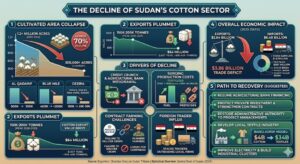
He also pointed out that foreign traders, including those from Egypt and Syria, have moved in to buy cotton directly, often outbidding local private firms. Mahjoub called for better protection of private investment and the restoration of administrative authority to project management to regulate production.
Sudan’s current exports range between 30,000 and 40,000 tonnes, far below the peak of 150,000 to 200,000 tonnes recorded in the 2020-2021 season. Meanwhile, competitors such as Brazil, the United States, and West African nations like Benin and Burkina Faso continue to dominate the market.
Mahjoub urged the development of a local textile industry through long-term concessional financing to add value rather than exporting raw fibre. He cited Bangladesh as a model, which imports $4 billion in cotton to export $34 billion in finished textiles annually.
According to a Central Bank of Sudan report for 2025, the country faced a trade deficit of $3.86 billion. Total exports stood at $2.64 billion, against $6.49 billion in imports, including $357 million in textiles and $1.8 billion in food supplies.