
Sudan importers blame government bans for currency drop and inflation
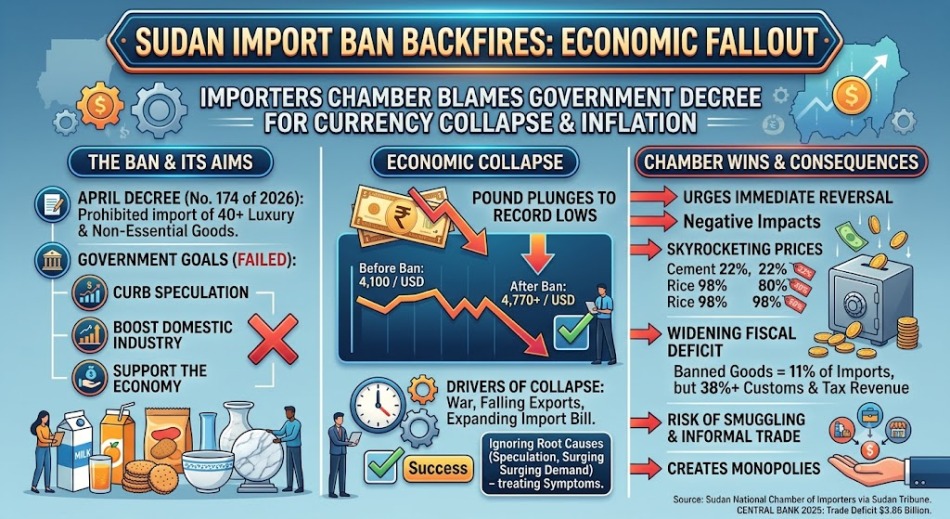
June 10, 2026 (KHARTOUM) – Sudan’s National Chamber of Importers has blamed the government for rising inflation and the depreciation of the local currency, following an April decree banning the import of dozens of goods.
The Sudanese cabinet prohibited the import of over 40 luxury and non-essential goods in late April. The move aimed to curb speculation in parallel foreign exchange markets, boost domestic manufacturing, and support the economy.
However, the Sudanese pound plunged to a record low on Wednesday, with the U.S. dollar trading at around 4,700 pounds, marking its sharpest depreciation yet. The collapse is driven by the ongoing war, falling exports, and an expanding import bill.
The importers’ chamber urged the government to immediately reverse the ban, arguing the policy had failed to stabilize the exchange rate, driven up prices, and reduced state revenues.
Al-Sadiq Jalal Al-Din Salih, head of the National Chamber of Importers, told reporters on Wednesday that data proved the decision was ineffective. He said the chamber had previously warned the prime minister in a memorandum about the economic fallout.
Salih stated that the decree ignored the core drivers of the pound’s decline, which he identified as market speculation and surging demand for foreign currency. Instead, he said, the government treated the symptoms rather than the root causes of the crisis.
He added that banning 46 items would not lower foreign currency demand or stabilize the pound. Instead, it would create monopolies as importers leave the market, leading to supply shortages and higher prices.
The banned commodities accounted for about 11% of total imports in 2025 but contributed over 38% of customs and tax revenues collected at ports, Salih said, warning that a drop in these revenues would widen the fiscal deficit.
Salih also warned that the restrictions would drive informal trade and smuggling along Sudan’s porous borders to meet market demand. He argued that the ban benefits only a small group, making profits at the expense of consumers and the public treasury.
Citing data compiled by specialized market divisions on May 24, Salih said prices had surged since the ban took effect. Domestic cement rose by 22%, Egyptian ceramics by 42%, rice by 98%, and Egyptian instant noodles by 54%.
He attributed the current price hikes to a psychological reaction as traders and consumers stockpile goods in anticipation of shortages. Salih warned that steeper price increases are likely as supply scarcity worsens and market competition decreases.
Furthermore, Salih noted that the exchange rate weakened from about 4,100 pounds per dollar when the decree was issued to around 4,770 pounds on Wednesday, which he cited as evidence that the ban had failed to stabilize the foreign exchange market.
Salih renewed his call for the government to review the policy and adopt measures that target structural economic imbalances rather than restrict trade. He affirmed that the chamber would continue to oppose the decree to protect market stability and state revenue.
The transitional cabinet issued Decree No. 174 of 2026 in April to block the import of luxury and non-essential commodities.
The ban was based on recommendations from a committee tasked with curbing the national currency’s decline, guidelines from the High Economic Committee, and a report from the Ministry of Industry and Trade.
The restriction covered more than 40 items, including packaged milk, except powder and infant formula, some processed foods, biscuits, sweets, jams, mineral and carbonated water, ready-made juices, ceramics, and marble.
According to the Central Bank of Sudan’s 2025 foreign trade statistical summary, Sudanese exports totalled $2.64 billion, while imports totalled $6.49 billion, resulting in a trade deficit of $3.86 billion.