
SF siege of Sudan’s El Obeid leaves city facing 70% water shortage
July 17, 2026 (EL OBEID) – The paramilitary Rapid Support Forces (RSF) have knocked out the main water sources in the Sudanese city of El Obeid through direct control or drone strikes, widening the water deficit to about 70%, local officials said.
The influx of displaced people fleeing to El Obeid, the capital of North Kordofan State, has worsened the acute water shortage. The city’s population has more than tripled during the war, welcoming those fleeing fighting in South and West Kordofan, as well as displaced individuals from Bara and RSF-controlled areas.
According to the last census conducted by local authorities in 2022, El Obeid’s population was around 750,000 people.
However, the state’s Humanitarian Aid Commission (HAC) now estimates that the population has reached 3.4 million. Approximately half of them are displaced persons living across eight camps or hosted within residential neighbourhoods.
The Unified Shelter Camp, the largest camp in El Obeid, alone houses 7,200 displaced families.
Reports obtained from the North Kordofan HAC state that the RSF’s targeting of El Obeid’s main water infrastructure has knocked it offline, resulting in a 70% water gap.
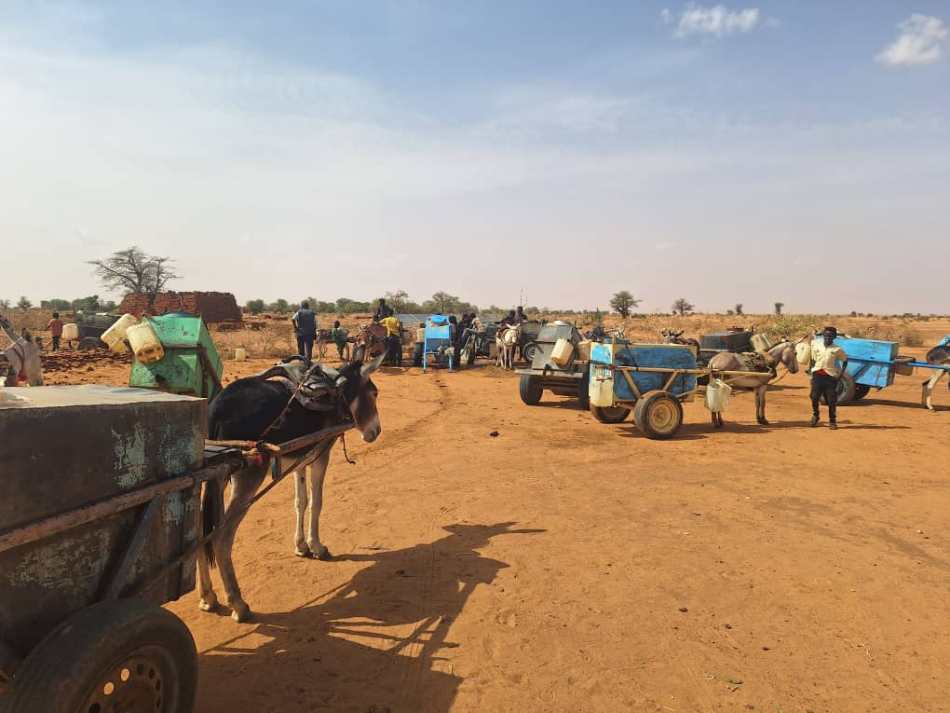
In response, the commission launched an emergency “Suqia” (Watering) initiative with the help of humanitarian organizations and philanthropists. The initiative includes deploying mobile water tankers to neighbourhoods, drilling wells, and equipping some with desalination plants.
The initiative has provided about 650 water tankers in phases, which the commission says deliver safe drinking water free of charge.
Implementation has also begun on a plan to drill 61 wells. Of these, 34 wells have already been drilled and equipped with solar energy to ensure continuous pumping amid electricity shortages and high fuel prices.
The HAC noted that 50 desalination plants, each with a capacity of 3,000 gallons per day, are being attached to the wells.
These emergency measures have reduced the price of four gallons of water by approximately 50%.
Some city residents said that they previously had to buy a barrel of water for 30,000 Sudanese pounds, equivalent to about $6.
Officials from the El Obeid Water Authority told Sudan Tribune there is a plan to rehabilitate the city’s main northern and southern water sources, but the RSF is preventing technicians from carrying out the work.
Historically, El Obeid suffered from severe water crises, but several projects implemented about ten years ago in the north and south of the city created relative stability in drinking water availability for the largest city in the Kordofan region.
Water authority officials said that before the war, the city drew water from the Al-Sidr basin near Bara, a cluster of groundwater wells equipped with pumps and a transmission network located about 65 kilometres (40 miles) north of El Obeid. It also relied on surface reservoirs in the Wad al-Baga area, about 26 kilometres south of the city.
The Al-Sidr basin is under RSF control. Officials said the paramilitary group completely destroyed the remote-controlled SCADA system, a digital control room used to monitor water operations supplying El Obeid’s northern neighbourhoods.
In the southern sources at Wad al-Baga, the RSF used drones to target pumps at the main reservoirs supplying the southern neighbourhoods of the city.
The RSF siege has expanded in recent weeks, with drone strikes targeting internal water tankers within El Obeid itself.
Given the situation on the ground, a permanent solution to El Obeid’s water crisis remains contingent on a halt to attacks on key infrastructure. In the meantime, residents have resorted to harvesting rainwater from rooftops in an arduous effort to secure fresh water.