
Sudan plans 22,000 micro-projects to curb war-driven poverty, minister says
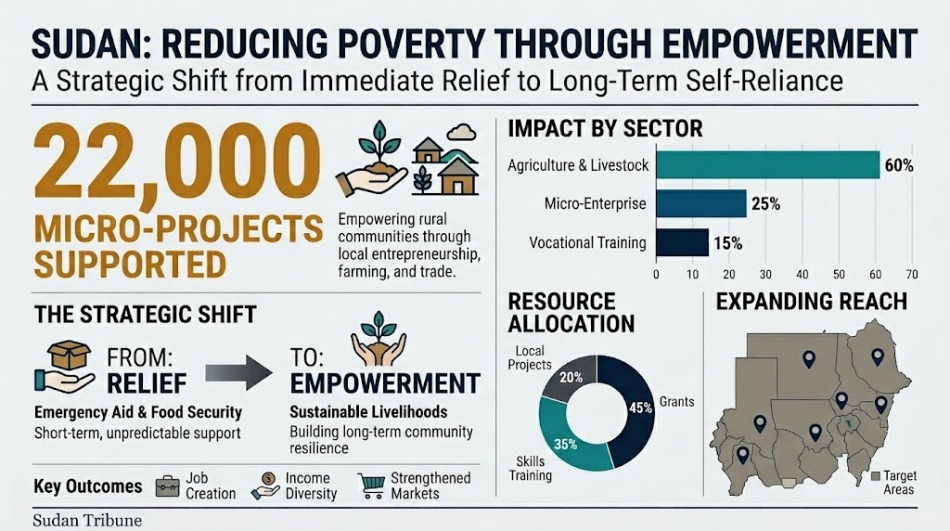
October 17, 2026 (KHARTOUM) – Sudan is moving to make social protection a sustainable tool for poverty reduction, with plans to launch 22,000 micro-projects to secure household incomes, Human Resources and Social Welfare Minister Mutasim Ahmed Saleh said on Saturday.
The announcement comes as official data indicates that poverty rates surged from 21% before the conflict to 73% by last June.
In November 2025, the ministry reported that roughly 24 million people had fallen below the World Bank poverty threshold of three dollars per day due to the devastating impact of the war.
Speaking at an event in Khartoum marking the International Day for the Eradication of Poverty, Saleh stated that the upcoming phase prioritizes stopping the intergenerational cycle of poverty.
He announced a partnership between the Social Safety, Solidarity, and Poverty Reduction Commission, the Zakat Chamber, and the Savings and Social Development Bank.
The initiative aims to finance 22,000 micro- and small-scale projects across 11 states to help targeted families secure sustainable livelihoods.
Saleh emphasized that the war has compounded vulnerability across the country through mass displacement, loss of income sources, and widespread disruption of commercial activity and basic services.
He called for shifting away from relief aid toward economic empowerment and building an integrated national social protection network.
The conflict that broke out on April 15, 2023, stripped most Sudanese of jobs and businesses across rural and urban centres, leaving millions reliant on remittances and emergency aid.
Families have increasingly resorted to negative coping strategies, including reducing meals, selling assets, child labour, and child marriage.
Saleh noted that combating poverty goes beyond macroeconomic indicators to restore livelihoods and enable citizens to work and become self-reliant.
He added that poverty includes deprivation in education, healthcare, and employment, as well as an inability to withstand crises.
The minister said interventions by the Zakat Chamber exceeded 239 billion Sudanese pounds by late August, benefiting about 2.9 million people through direct aid, healthcare support, productive projects, and assistance with voluntary return.
Additionally, the Social Safety, Solidarity, and Poverty Reduction Commission provided cash transfers to roughly 326,000 beneficiaries across 12 states at a cost exceeding 48 billion pounds.
National Health Insurance Fund coverage reached 36.2 million subscribers, accounting for 86.2% of the population, amid continued efforts to rehabilitate health facilities damaged in the fighting.
Saleh acknowledged that these relief interventions cannot meet expanding needs unless linked to long-term sustainable programs.
The ministry’s strategic approach focuses on moving from emergency relief to production-driven empowerment, he stated.
In April 2026, the United Nations reported that 52.3% of Sudanese suffered from multidimensional poverty—defined as acute deprivation in health, education, and living standards.
Sudan had achieved notable gains in poverty reduction over two decades, cutting poverty from 38.1% in 1990 to 15.6% in 2011, before figures rebounded sharply after the war erupted.