
International envoys demand immediate de-escalation and halt to foreign interference in Sudan
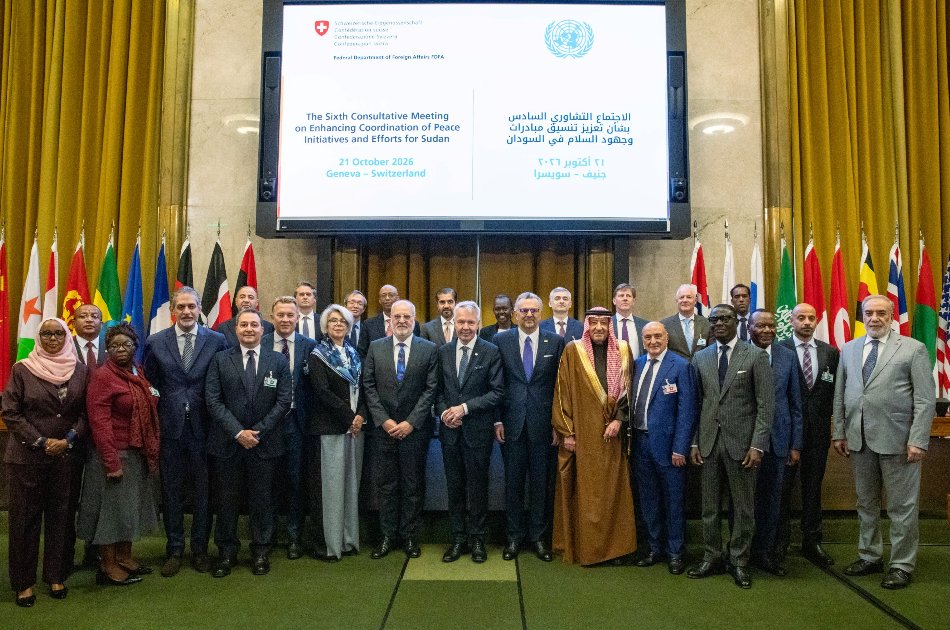
October 21, 2026 (GENEVA) – Representatives from more than 20 countries and international bodies meeting in Geneva on Wednesday called for an immediate de-escalation of the conflict in Sudan, warning of a deepening humanitarian catastrophe and rising famine risks.
The talks took place during the Sixth Consultative Meeting on Enhancing Coordination of Peace Initiatives and Efforts in Sudan, co-hosted at the Palais des Nations by the Swiss Confederation and the United Nations Office of the Secretary-General’s Personal Envoy for Sudan.
Alexandre Fasel, Switzerland’s State Secretary for Foreign Affairs, and Pekka Haavisto, the U.N. Secretary-General’s Personal Envoy for Sudan, co-chaired the meeting.
The gathering aimed to align international diplomatic engagement with the urgent needs of the Sudanese people, identify concrete ways to strengthen coordination among disparate peace initiatives, draw on each partner’s comparative advantages, and ensure peace efforts reinforce one another.
Building on discussions held on the margins of the U.N. General Assembly, members of the Quad and the Quintet also met to coordinate their actions in support of peacemaking efforts and strengthen the coherence of their diplomatic engagement.
Participating nations included the Central African Republic, Chad, China, Djibouti, Egypt, Eritrea, Ethiopia, France, Germany, Kenya, Libya, Norway, Qatar, Russia, Saudi Arabia, South Sudan, Switzerland, Türkiye, Uganda, the United Arab Emirates, the United Kingdom, and the United States.
Regional and multilateral organizations taking part included the African Union, the European Union, the Intergovernmental Authority on Development (IGAD), the League of Arab States, and the United Nations.
Participants urged foreign states and non-state actors to stop fueling the war, explicitly calling for an end to the supply of mercenaries, financial backing, and military hardware.
The envoys expressed particular alarm over the escalation of drone warfare, emphasizing that weaponized unmanned aerial vehicles are proving especially lethal to civilians across the country.
Emphasizing that there is no military solution to the conflict, the participants called on all warring parties to engage genuinely and in good faith to de-escalate fighting, protect civilians, and commit to a humanitarian truce.
The co-chairs expressed deep concern over ongoing atrocities and acute food shortages.
Continued clashes and obstacles to aid delivery, coupled with climate-related shocks including dry conditions and delayed rainfall, are worsening the danger of famine.
The gathering reaffirmed its commitment to Sudan’s sovereignty, unity, and territorial integrity, and to preserving its state institutions.
The envoys firmly rejected creating parallel governments or competing governance bodies, as well as any move that could partition the country.
On the political track, participants insisted that sustainable peace depends on an inclusive, transparent, and Sudanese-owned process that includes diverse civilian actors, notably women and youth.
Delegates also warned of the severe risks of regional spillover, cautioning that a wider regional destabilization would be catastrophic and difficult to reverse.
Participants affirmed plans to convene a Seventh Consultative Meeting at a date and venue to be determined, while a technical task force continues coordination work in the interim.