
Sudan warring parties trade blame over strikes on civilian, UN sites
November 5, 2026 (KHARTOUM) – Sudan’s warring parties mutually deny bombing civilian sites and United Nations facilities, leaving the attacks attributed to unknown perpetrators.
Both sides continue to distance themselves from officially claiming responsibility for recent drone and warplane strikes.
Following an increase in drone attacks by the Sudanese army and the Rapid Support Forces (RSF), neither party has claimed responsibility for the bombings, except in limited cases acknowledged by the army.
Responsibility for drone strikes is routinely determined through press sources or analytical assessments weighing a specific party’s strategic interest in bombing a location.
Between mid-October and November 4, drones bombed approximately 18 power stations in army-controlled areas. No official claim of responsibility was issued by the RSF.
In October, drones also struck the Dumaya market in the RSF-controlled city of Nyala in South Darfur. The attack resulted in civilian and military casualties, according to Médecins Sans Frontières, with neither party claiming the operation.
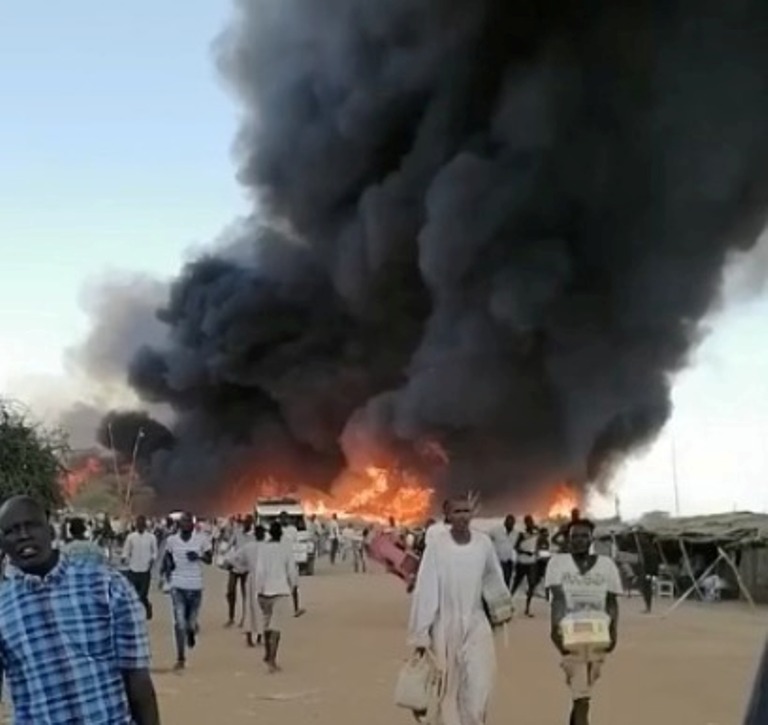
On October 19, the Al-Naam market affiliated with Abyei, where the UNISFA peacekeeping force is deployed, was subjected to a drone strike for the second time. The attack resulted in dozens of casualties and widespread fires.
Both the army and RSF denied responsibility for the Abyei operation, trading accusations instead over the bombing of the crowded fuel market.
Earlier, on December 13, 2025, the UNISFA base in Kadugli, capital of South Kordofan State, was subjected to a bombing that killed six soldiers from the Bangladeshi battalion and wounded others. The warring parties also exchanged accusations over the attack.
During the conflict in Khartoum state, two bridges on the Nile between Khartoum North and Omdurman were destroyed. The Shambat bridge was severed on November 11, 2023, followed by the partial destruction of the Halfaya bridge on July 1, 2024.
In both bridge operations, neither the army nor the RSF claimed responsibility, and both sides exchanged accusations.
Feasibility of independent investigations
As the parties exchange accusations over targeted infrastructure, demands for independent investigations are escalating. Advocates are calling for technical and military evidence to determine responsibility for airstrikes affecting hospitals, markets, water stations, and residential areas.
Regarding the Khartoum bridges, Ahmed Taqad Lisan, spokesman for the RSF-aligned “Tasis” (Founding) government, told Sudan Tribune that the RSF were deployed across Khartoum North, Khartoum, and Omdurman. He noted the Shambat bridge was a vital link that RSF forces used regularly.
Lisan said the army considered the bridge a military target because the RSF used it. He indicated that military authorities treated it as a strategic necessity to disrupt RSF movements and sever communications between units in Bahri, Khartoum, and Omdurman.
Targeting bridges does not require additional evidence, Lisan argued, characterising their destruction as part of the armed forces’ strategy.
He pointed to the bombing of several other structures, including the Jebel Aulia dam bridge south of Khartoum, the Ardamata bridge in El Geneina, and the Nyala bridge.
Retired Brigadier General Jamal Al-Shaheed, a strategic military expert, said that establishing responsibility for the destruction of bridges and UN facilities must rely on technical and intelligence evidence rather than political accusations.
Al-Shaheed told Sudan Tribune that determining military responsibility requires analyzing explosion damage, projectile trajectories, and weapon types. He noted that satellite imagery and intelligence data are also essential, as identifying a weapon type alone is insufficient to prove the user’s identity.
Targeting UN and civilian facilities represents a highly dangerous development that necessitates a transparent investigation, he added. Al-Shaheed stressed that protecting civilians and vital facilities is a legal and military obligation under international humanitarian law.
Conversely, military expert Amin Ismail Majzoub suggested that the RSF deliberately sabotaged the bridges to prevent pursuit during their withdrawal from the capital.
Majzoub told Sudan Tribune that the bridge destruction caused severe economic and social losses, hampering export movements and severing communication between residents on either side of the Nile.
Some residential neighbourhoods near the bridges became uninhabitable, forcing residents to flee, he said. Majzoub warned that the Geneva Conventions mandate shielding civilian populations from the effects of military operations.
After the army severed the Shambat bridge in November 2023, it regained control of the Radio and Television headquarters and Old Omdurman by March 2024.
Despite the partial destruction of the Halfaya bridge in July 2024, the army crossed from Omdurman to Khartoum North. This advance culminated in its control over Bahri by January 2025 and all of Khartoum state by May, prompting an RSF withdrawal to Kordofan and Darfur.
Bombing markets and gatherings
Lisan accused the army and its allied forces of adopting a strategy to systematically target civilian gatherings, service facilities, markets, and hospitals.
Recent military operations targeted numerous sites, including Abu Zaima in North Kordofan, Al-Broush market in North Darfur, and markets in Nyala, South Darfur, and Ed Daein in East Darfur, he said.
He added that strikes also hit multiple locations in West Kordofan State and the Al-Naam market in Abyei. Lisan noted that these areas are predominantly under RSF control and host large civilian populations.
He said the army is responsible for these operations and said the “Tasis” government’s ready to present evidence to an independent international investigative body.
Al-Shaheed emphasized the necessity for all warring parties to distinguish between military and civilian targets, maintain proportionality, and take precautions to avoid harming civilians.
He stressed that defending the armed forces does not conflict with accountability, arguing that a military’s true strength lies in its discipline and respect for the law.
“We are with a strong army that protects the state, and with a strong state that protects the citizen, and with a law that excludes no one,” Al-Shaheed said.
He called on the armed forces to strengthen internal oversight and cooperate with independent investigations to preserve their credibility. Sudan needs a comprehensive strategy that prioritises protecting citizens and state institutions, he added.
Majzoub stated that targeting utility sites and markets is a recurring pattern for the RSF, which he accused of evading responsibility for the strikes.
He defended the Sudanese army, characterising it as an organised institution that carefully selects targets and abides by international laws.
Majzoub argued that the RSF lacks the central command and professional training needed to adhere to the Geneva Conventions. He noted that alleged RSF violations have extended to United Nations headquarters and relief convoys, citing reported attacks on World Food Programme and UNICEF operations.
These attacks could have severe repercussions, including the suspension of international humanitarian work, directly affecting civilians’ access to food and medicine, he warned.
Majzoub claimed the RSF systematically seeks to neutralize international organisations upon entering new areas to avoid the presence of reliable witnesses.
Legal responsibility
Lawyer Muaz Hadra stated that destroying civilian facilities entails severe legal responsibility, warning that such actions could constitute war crimes.
Hadra told Sudan Tribune that Sudan’s 1991 Criminal Law criminalises the destruction of facilities like bridges, categorising them as civilian objects.
He emphasised that targeting civilians and infrastructure is strictly prohibited under international humanitarian law, particularly the 1949 Geneva Conventions. These acts may amount to crimes against humanity, under frameworks in Sudanese law and the Rome Statute of the International Criminal Court.
United Nations mission headquarters enjoy special protection under international law, Hadra added, noting that unjustified targeting of these sites constitutes a war crime.
Despite the warring parties refusing entry to a UN Human Rights Council fact-finding committee, the body has continued its work. It has issued reports addressing the conflicting parties’ responsibility for targeting civilian areas.
Hadra urged the UN Security Council to refer the violations in Sudan to the International Criminal Court, drawing parallels to the referrals made for Darfur in 2003 and 2004.
The Security Council faces a moral and historical challenge to ensure accountability, he said.
Hadra also highlighted regional mechanisms, such as the African Court of Justice, noting that African Union human rights bodies have called on the Sudanese government to allow competent authorities to investigate the violations.