
Tasis coalition denies talks with army, rejects dialogue before truce
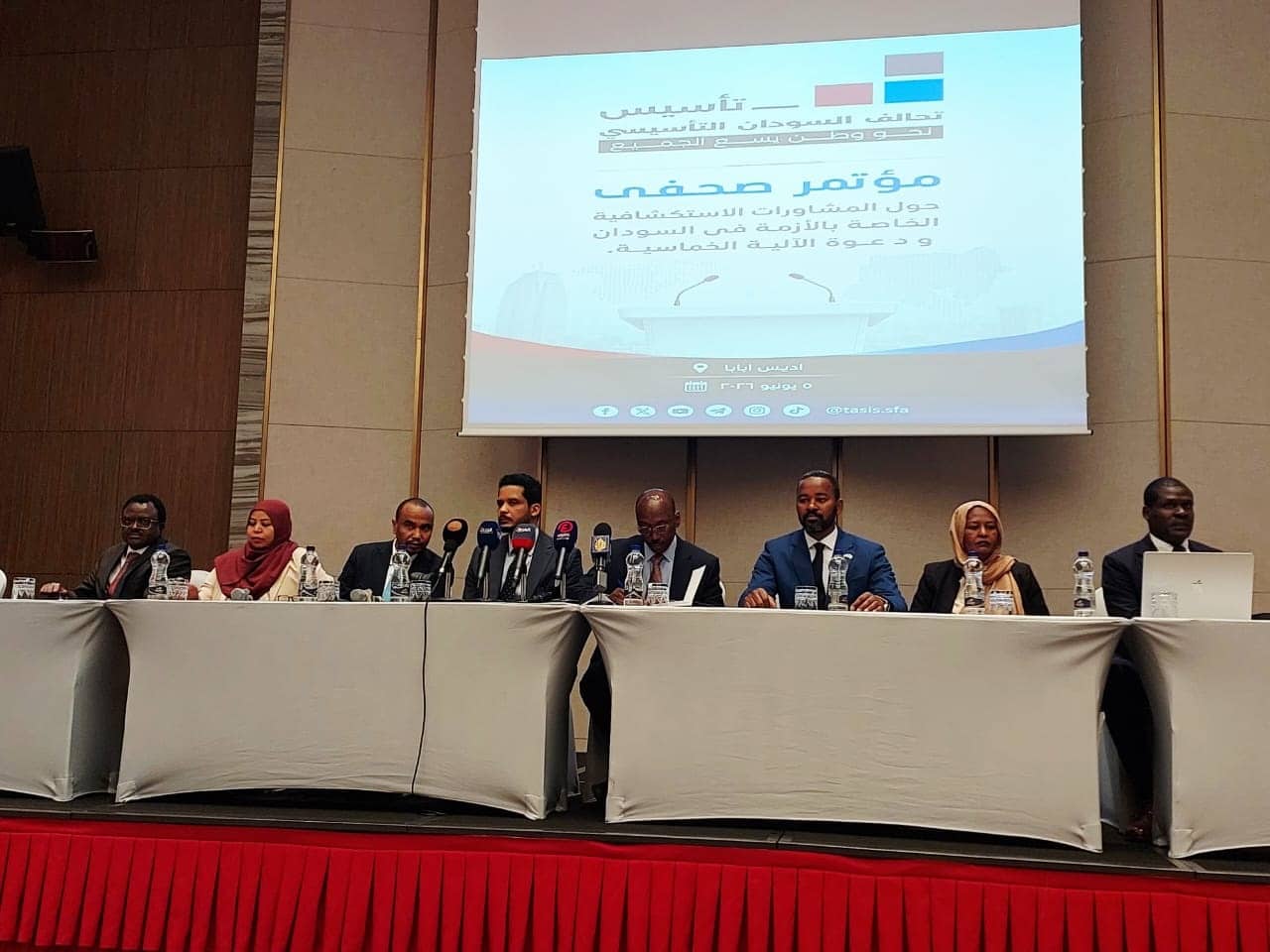
June 5, Addis Ababa — The “Tasis” coalition, the political wing of the Rapid Support Forces (RSF), has strongly denied any direct or indirect contact with the Sudanese Armed Forces (SAF) or what it termed the “de facto authority” in Port Sudan.
A high-level delegation from the coalition, led by Mohamed Mukhtar, advisor to the RSF commander, alongside Nasredeen Abdulbari and Ibrahim al-Mirghani, arrived in the Ethiopian capital, Addis Ababa, on Thursday to hold consultations on the Sudanese crisis with the international Quintet Mechanism.
While the Tasis delegation is scheduled to meet with the Quintet Mechanism on Friday evening, ambiguity surrounds a potential meeting with the Civil Democratic Alliance of the Forces of the Revolution (“Somoud”).
Sources within the delegation told Sudan Tribune that the Tasis coalition maintains reservations regarding a joint political vision announced on Thursday by several political groups, including the Somoud alliance and the Democratic Bloc of the Forces of Freedom and Change (FFC-DB).
Speaking at a press conference in Addis Ababa on Friday, Tasis spokesperson Ahmed Tugod Lisan dismissed reports of engagement with the military leadership as “inaccurate.”
“The coalition does not communicate with the army or the de facto government,” Lisan stated. “There is no contact or meeting outside the framework of the international mechanisms designated for peace in Sudan.”
Lisan stressed that any attempt to marginalize the coalition or exclude it from the peace process would remain a mere “political exercise” that would fail to alter realities on the ground. He reiterated the alliance’s absolute rejection of any role for the Islamic Movement, the National Congress Party (NCP), or their front groups in future peace talks.
The spokesperson tied the coalition’s participation in peace initiatives to the framework outlined in the May 2026 declaration by the international Quartet (the United States, Saudi Arabia, Egypt, and the United Arab Emirates). The Quartet’s roadmap calls for a three-month humanitarian truce mediated through the Jeddah platform to pave the way for a permanent ceasefire, followed by a nine-month transitional civilian administration that excludes the warring factions from power.
Lisan urged an immediate humanitarian truce, arguing that discussions regarding the formation of dialogue committees are premature before the humanitarian crisis is effectively addressed. He maintained that the current phase demands a temporary ceasefire to lay the groundwork for a broader political process, whether through direct negotiations or an inclusive Sudanese-Sudanese dialogue.
Defending the prospect of forming a parallel government, Lisan argued that official recognition is not a pressing requirement at this stage. “We maintain extensive relations with numerous countries both regionally and internationally, as well as with the broader international system,” he said.
The spokesperson also criticized recent statements made by certain members of the Quintet Mechanism, specifically targeting the African Union (AU) representative to Sudan, Mohamed Belaiche, whose remarks he described as lacking neutrality. Nevertheless, Lisan noted that the AU remains an appropriate forum for dialogue, provided that participating stakeholders are selected based on objective criteria aligned with the nature of the current conflict.
Lisan downplayed the Democratic Bloc’s refusal to sit with his coalition, stating that Tasis does not give the matter any weight. “Every party has the right to adopt the position it deems appropriate, but we emphasize that any dialogue or peace process without the participation of our coalition is nothing more than a public relations project,” he concluded.
Reinforcing this stance, Mohamed Mukhtar, a senior Tasis leader and advisor to the RSF commander, stated that there are no communications with SAF Commander Abdel Fattah al-Burhan. Mukhtar alleged that the war is being prolonged by the Islamic Movement, claiming that the RSF did not initiate the conflict but had it imposed upon them following the October 2021 coup. He further characterized the Democratic Bloc as a front for the Islamic Movement and the dissolved National Congress Party.