
Economics
Sudanese teachers’ wages cover 3% of living costs as inflation bites, union says
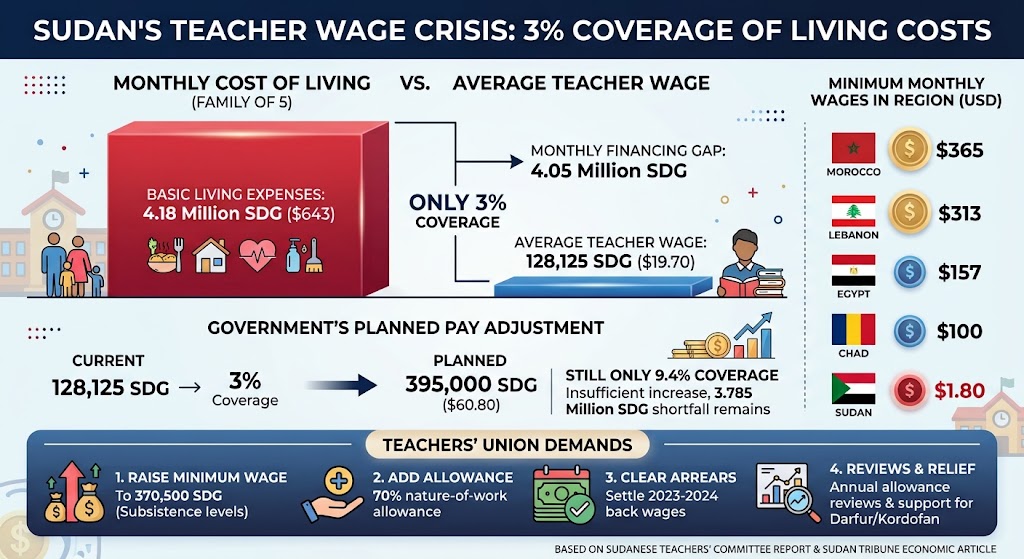
September 8, 2026 (KHARTOUM) – The average teacher’s wage in Sudan covers only about 3% of the basic cost of living for a family of five, a key teachers’ union said on Tuesday, as war-induced inflation continues to wipe out household purchasing power.
Sudan’s economy has been in freefall since civil war broke out in April 2023, causing the local currency to collapse, disrupting supply chains, and driving staple food and energy prices to record highs.
A monthly study by the Sudanese Teachers’ Committee’s social bureau showed basic living expenses for a five-member household stood at roughly 4.18 million Sudanese pounds ($643) in September. By comparison, an average teacher takes home about 128,125 pounds ($19.70) a month, leaving a monthly financing gap of 4.05 million pounds.
Sudan’s legal minimum wage remains frozen at 12,000 pounds a month, or about $1.80, ranking among the lowest in the region. The union noted statutory monthly minimum wages stand at around $365 in Morocco, $313 in Lebanon, $157 in Egypt, and $100 in neighbouring Chad.
The Sudanese government plans civil-service pay adjustments that would raise typical teachers’ salaries to roughly 395,000 pounds ($60.80), according to recent cabinet circulars.
The union dismissed the planned increase as insufficient, saying it would cover just 9.4% of basic household expenditure and leave an estimated monthly shortfall of 3.785 million pounds.
The committee demanded raising the statutory minimum wage to 370,500 pounds to reflect real subsistence thresholds, alongside a 70% nature-of-work allowance pegged to base pay.
It also called for the immediate clearance of salary arrears withheld across 2023 and 2024, institutionalized annual reviews of allowances against headline inflation, and targeted relief for public-school staff in conflict-heavy regions across Darfur and Kordofan.