
Sudan’s Tagadum to split, recommends name change amid parallel government dispute
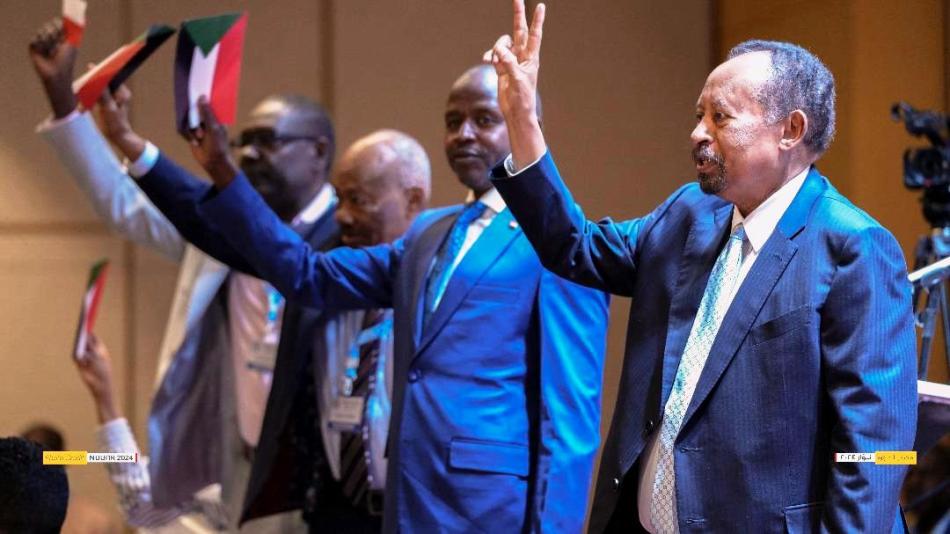
February 9, 2025 (ADDIS ABABA) – In anticipation of an imminent split over a proposed parallel government in RSF-controlled areas of Sudan, a joint political committee representing opposing factions within the Tagadum coalition has recommended abandoning the alliance’s current name. This move, aimed at mitigating the fallout from the inevitable division, underscores the deep rift that now threatens the coalition’s very existence.
The parallel government initiative, spearheaded by the Sudan Revolutionary Front (SRF) and supported by certain political parties and figures, would coordinate with the RSF paramilitary group. This proposal has fractured Tagadum, with some factions considering it a necessary strategy. In contrast, others vehemently oppose it, fearing further fragmentation of the country and undermining efforts for a unified, inclusive government.
Sources told Sudan Tribune that pro-government groups have relocated to Darfur, while others have moved to Nairobi, Kenya, in preparation for the planned announcement of the parallel administration.
As detailed in a report obtained by Sudan Tribune, the joint political committee’s recommendation to abandon the name “Tagadum” signals the irreconcilable differences that now divide the coalition. The report also outlines several areas for future coordination between the splinter groups, including collaboration on a ceasefire and a broader peace process. It further suggests aligning positions on peace platforms, managing media narratives, avoiding confrontation, prioritizing civilian protection, and jointly addressing the influence of the National Congress Party, the Islamist Movement, and their associated entities.
The report reveals that a committee established by the leadership council during a meeting in Entebbe, Uganda, failed to bridge the divide over the parallel government strategy. It acknowledges that pro-government factions will proceed with their plan, while those opposed will not participate.
The call for a parallel government has created a significant fracture within the already fragile coalition, splitting its core members. While a majority of SRF factions, some other movements, and certain civilian groups support the initiative and have begun outlining governing structures for the anticipated “peace government,” a substantial number vehemently disagree.
A smaller committee tasked with reviewing the parallel government proposal suggested a different approach: prioritizing the coalition’s internal agenda, including political and organizational arrangements, followed by the formation of a broader civilian front and then convening a round-table conference.
The smaller committee also reiterated that Tagadum’s official position remains one of non-endorsement for the parallel government, emphasizing adherence to existing mechanisms agreed upon by all coalition members, as stipulated in its bylaws.
Following the smaller committee’s report, another committee convened from January 18-23, but it, too, was unable to resolve the impasse. Discussions included proposals for dissolving the coalition altogether and calls for a renewed focus on internal arrangements.
The Political Mechanism held a virtual meeting on January 28 to establish a committee tasked with outlining procedures for a potential split and formulating recommendations for the leadership council.
The Mechanism concluded that the unresolved parallel government issue has negatively impacted Tagadum’s effectiveness and reputation, both domestically and internationally, particularly in light of statements issued since the Entebbe meeting.
In recent weeks, both proponents and opponents of the parallel government have engaged in a war of words, exchanging conflicting statements and information.
Numerous political forces, civil society organizations, unions, and professional associations have rejected the parallel government proposal, with some previously threatening to withdraw from Tagadum if it proceeded. The SRF, alongside its allies within the coalition, has been actively pursuing the parallel government plan, holding meetings in Nairobi, Kenya, in recent weeks to finalize arrangements.