
UK warns Sudan war worsens fragility in South Sudan, urges dialogue
- 15 May 2025
- In News, South Sudan
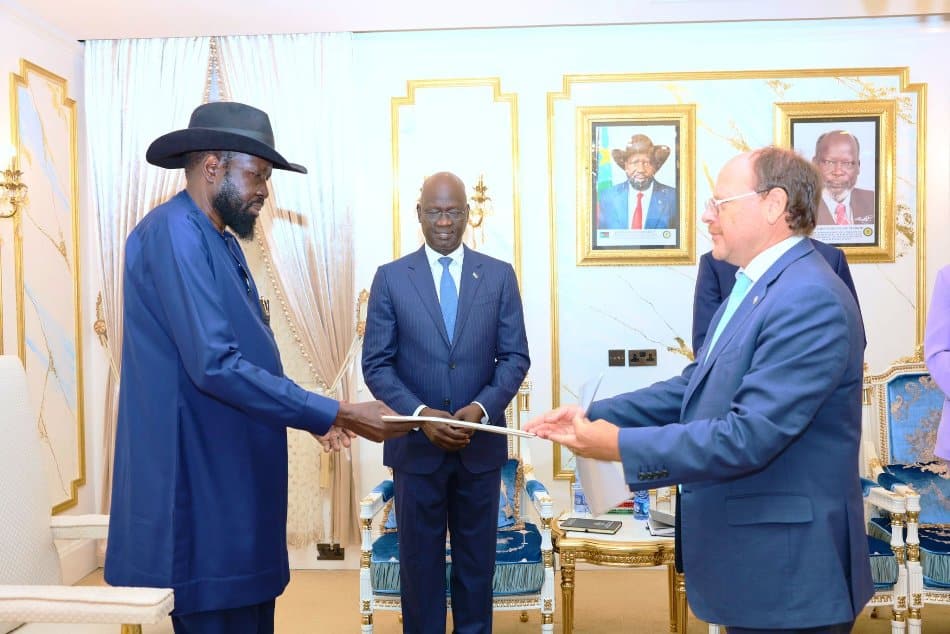
May 15, 2025 (JUBA) – The war in neighbouring Sudan has significantly worsened fragility in South Sudan, Britain’s newly appointed ambassador, David Ashley, said, urging the country’s leaders to choose dialogue over unilateral action.
Ashley was speaking at a news conference held shortly after he presented his credentials to President Salva Kiir. He stressed that his top priority was to support peace and development in South Sudan so that its people could fully enjoy the fruits of their independence.
“The Sudanese civil war has significantly impacted South Sudan, particularly in its northern and northeastern parts, due to a massive influx of refugees and the disruption of trade and supply chains,” Ashley told the news conference. He added that the conflict has led to a sharp increase in the population of these regions, straining local resources, exacerbating existing humanitarian challenges, and impacting the South Sudanese economy through border closures.
South Sudan has faced its own deep-rooted challenges. The United Kingdom is part of the Troika group of nations advocating for democratic reforms in South Sudan, which has not held elections since seceding from Sudan in 2011 after conducting a referendum on self-determination.
Political differences within the ruling Sudan People’s Liberation Movement (SPLM) escalated into violence in 2013, derailing plans for elections in 2015. A subsequent peace agreement in 2015 faltered, with conflict resuming in 2016, leading to a revitalised deal in 2018. This agreement initially scheduled elections for 2022, but a lack of commitment to implementing key provisions prompted parties to postpone them to December 2026.
Ashley stressed that peace was the only viable way to end conflict in South Sudan and enable a democratic process. “Peace is the only viable way because the everyday challenges faced by people in South Sudan are significant, and the war in Sudan, climate change and, sadly, the ongoing violence is only adding to the problem,” he said.
He reiterated Britain’s support for international mediation efforts, including those led by the Intergovernmental Authority on Development (IGAD), an eight-nation East African regional bloc, in collaboration with the African Union and the United Nations. These efforts aim to bring South Sudanese leaders to the negotiating table and halt hostilities and unilateral actions, such as the bombing of civilian areas, Ashley noted.
“Peace must be the basis for development. Neither South Sudan, nor the region, nor the world can afford another conflict here,” Ashley said. “We regret the series of repeated violations of the ceasefire we have seen since February, including the recent bombing of the Médecins Sans Frontières (MSF) hospital in Old Fangak on May 3.”
The United Kingdom is a major donor to South Sudan, providing humanitarian assistance and supporting development efforts.