
In Khartoum Bahri, returning residents find neighbourhoods turned to graveyards
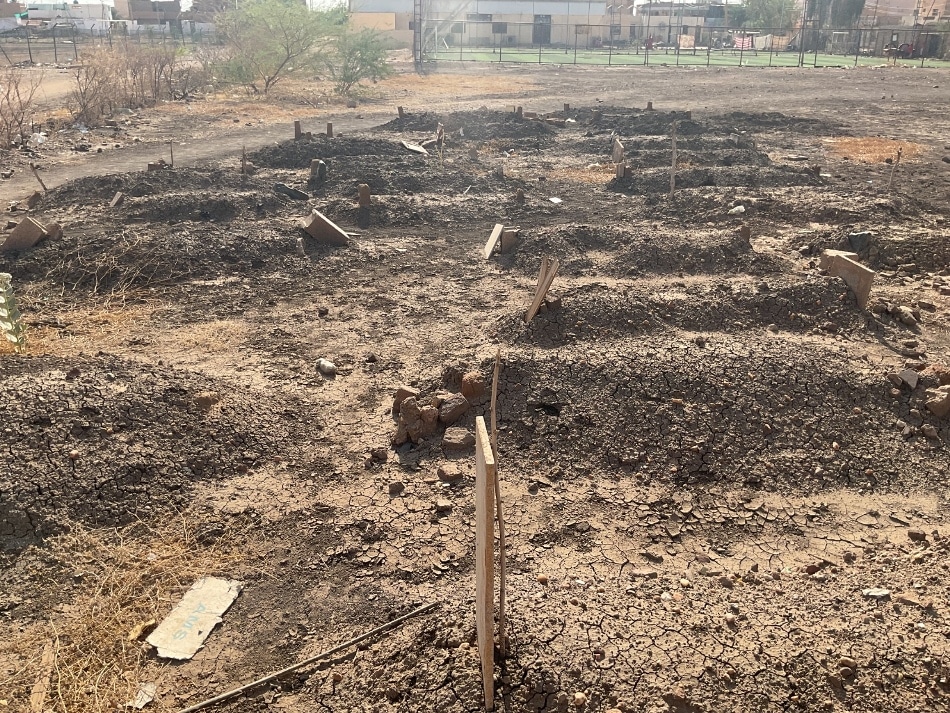
June 23, 2025 ( KHARTOUM BAHRI) – When Mohammed Abbas tried to return to his family’s neighbourhood, his goal was not to reclaim a home but to move a grave. His brother, a casualty of Sudan’s brutal war, lies buried in a makeshift plot, one of many that now scar the residential landscape of Khartoum Bahri.
Abbas’s quest, however, quickly became a bureaucratic nightmare, tangled in police procedures that have so far prevented him from giving his brother a final resting place in a proper cemetery. His story mirrors that of a small but growing number of residents tentatively returning to this part of the capital, who are discovering that the war has not only destroyed buildings but has also reshaped the very ground beneath their feet.
Forced by relentless shelling and strict movement patrols imposed by the Rapid Support Forces (RSF), who controlled the city until January, residents who couldn’t flee had no choice but to bury their dead wherever they could – in public squares, football pitches, and even their own gardens.
“There was no other option,” said Yaqoub Ahmed, a local volunteer. “You had to bury them in the nearest safe place. To walk any distance was to risk being killed by the constant shelling.”
These impromptu cemeteries are now a primary and haunting challenge for the returnees. A tour through the Shambat neighbourhood reveals the unsettling new landscape. A portion of a local sports stadium has been turned over to the dead. Small, crude markers dot the area around a neighbourhood mosque.
The legacy of the fighting, which saw control of Khartoum Bahri pass from the RSF to the Sudanese army after months of clashes, is not just in the graves. The odour of decay still clings to some areas. A “Sudan Tribune” reporter on a tour of the area witnessed the decomposing body of an RSF fighter still lying inside an abandoned house, a testament to the chaos of the conflict and a grim indicator that more remains may lie undiscovered.
During the siege, volunteers were under such constant threat that they were sometimes forced to bury two bodies in a single grave to minimize their time in the open, residents said. Dozens in the Shambat neighbourhood alone died not only from the violence but from secondary crises like cholera and other fevers that ripped through the city’s trapped population.
While some, like a Syrian national who successfully relocated his daughter’s remains, have managed to navigate the system, many others, like Abbas, remain in limbo.
“We have tried to take steps with the police to have the remains moved from the streets and squares to public cemeteries,” said Musab Al-Jack, another volunteer activist. He said the efforts stalled amid bureaucratic referrals and a demand from police to collect a larger number of individual reports before taking action.
For the families who fled over two years ago, the thought of returning to live alongside these reminders of loss is a heavy burden. Activists warn that the presence of these graves poses a significant psychological obstacle for a community trying to piece itself back together. As they face a future with no basic services and homes reduced to rubble, the graves in their backyards are a constant, grim reminder of the price their city has paid.