
The governing structure of Monyei-miji of Otuho
By Steve Paterno
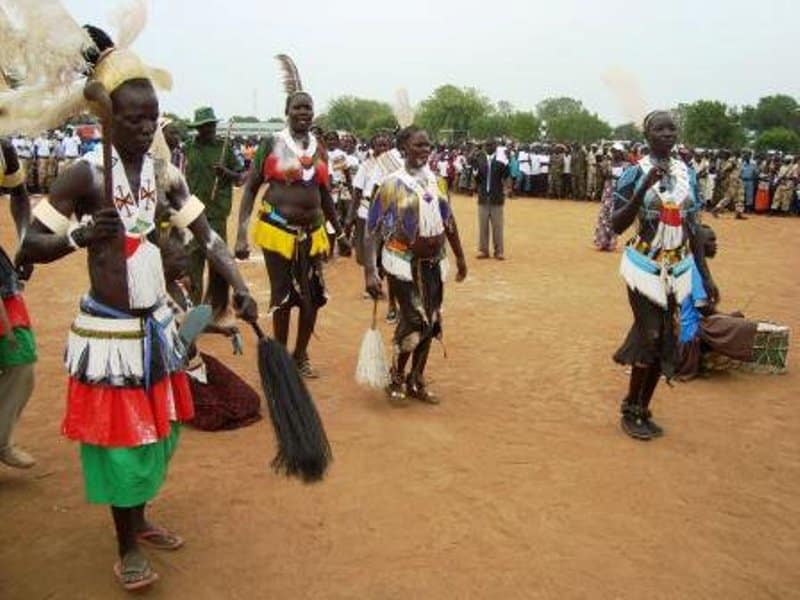
The Monyei-miji is a traditionally organized political structure of Otuho tribesmen into several specific layers. Through a long-standing institution, each fit Otuho male member must individually undergo mandatory and rigorous physical processes deeply anchored in tradition through ritual initiations and practices to qualify as a member of Monyei-miji after fulfilling the requirement of eito horwong, a junior grade below Monyei-miji. In a sense, to any Otuhoni male, qualification into Monyei-miji-hood is a traditional pride that comes with its privileges and rewards, which include proper marriage and participation in Monyei-miji activities, among others. The Monyei- miji is a derivative of two meaningful words, monyei and miji, literally translated as the “father or owner of the village or people.” Such an obligatory sense of ‘fatherhood, ownership and belonging’ establishes the Monyei-miji political power structure as the highest governing organs in the Otuho cultural system, which decides and determines the socio-political affairs of the village and the welfare of the community. (The Monyei-miji system is further supplemented by other important governing political power structures: (i) the landlords (Abalok) and (ii) the king/queen (Hobu), who play more ritualistic and cleansing roles over land, farms, animals, endemic diseases, and weather. The three institutionalized bodies, having different mandates and parallel powers, are there to check and balance the powers of each other. For example, even though the institution of Hobu acts as a supreme body, the Monyei-miji can overrule his or her orders, replace him or her, or even kill Hobu in a dispute, as happened in many instances. Likewise, Hobu can also punish Monyei-miji in so many ways, such as raising his own private army or buying mercenaries to fight the Monyei-miji, as it happened centuries ago in Imatari village, where Hobu invited Akara, the Toposa tribesmen who burned Imatari village down.
Despite the cultural richness of Monyei-miji system, which is deeply rooted in long traditional history, there is growing unsuccessful attempts by some educated, but town-oriented members of Otuho who take a feminist twist in line with the current prevailing wave of gender inclusion by coining the term Honyei-miji—an opposite gender—a non-existent feminine version of Monyei- miji. Their aim is to establish a female system of Monyei-miji-hood, which is not in line with Otuho traditional values and norms. Instead, the female counterparts of Monyei-miji are called Angorwo Monyei-miji, meaning the wives of Monyei-miji. (Therefore, Angorwo Monyei-miji is more fitting with Otuho proven patriarchal traditional society to collectively refers to all females who are properly married to a Monyei-miji regardless of her tribal, lineage, social, educational, political or military status).
Even though different tribes practice various versions of Monyei-miji age-set system, it is unfortunate that today some challenged political and military leaders, particularly those from Eastern Equatoria State tend to recklessly use Otuho Monyei-miji brand in their propaganda as a concept that can easily be replicated and use as a vehicle to achieve an ill-motivated and divisive political agenda. This unfortunate situation is further exacerbated by some Otuho members who are culturally lost in the name of educational advancement and civilization like those who try to create a fantasized feminine version of Monyei-miji. All these confusions contribute to misunderstanding of Monyei-miji traditional values, norms, and role in society in advancing humanity. (It is important to note that education and civilization are authentically rooted in one’s culture, that demonstrates the advancement of humanity. That is why some of us are privileged to study and learn the cultural history and civilizations of Greeks, Romans, and Christianity in their authentic and unique forms. This means, our traditional cultures and civilizations are important as well in their authentic and unique forms. That is why scholars and experts from outside the continent of Africa take great interest in studying our so-called primitive cultures, which are by the way, rich and lively).
Background
In recent history, the Otuho people migrated from somewhere in the east, in what is now known as the Federal Republic of Ethiopia, about some four or five centuries ago and came to settle into their current location in Torit Country of Eastern Equatoria State, South Sudan. There are not much historical materials known or collected, either orally or in written forms in the preceding centuries of the place of their origins and migratory journeys and routes. However, it is commonly believed that the two political power structures of Monyei-miji and Abalok played instrumental roles among the Otuho community during their migratory period. For example, the provision of protection and security, decisions of when and where to move, and determination of which location to settle in might have been the work of Monyei-miji and Abalok. The establishment of kingdoms among Otuho political power structure system came on much later, at least about three centuries ago or so, within their current settlement. The established kingdom has since been divided into two kingdoms, a different undertaking which is not the subject of this write-up. There is so much details known about the evolution of the kingdom of Otuho because more historical narratives have been passed orally throughout the preceding generations about that particular epic era. For example, one with certainty and accuracy can recount the existing Monyei- miji generational age-set, dating back to 286 years ago from their current settlement and the roles they play within and outside their kingdom sphere. (In perspective, the establishment of the complete Monyei-miji governing system, which includes the Monyei-miji, Abalok, and Hobu as we surely know it today, is older than the government of the United States of America).
The period of settlement of Otuho in their current location can easily be traceable because Otuho practices power handover to a brand-new breed of Monyei-miji every twenty-two years. (This power succession process continues in that twenty-two-year cycle in determining the ruling age- set in a spectacular ceremony of Efira at the kingdom level often presided over by king or queen after power handover ceremony performance a year prior at the villages levels. To complete this process, a Monyei-miji must first be initiated into amangat, a section of the village, after graduating from eito horwong grade. Each amangat for the initial initiation ritual ceremony has its own ritual infrastructure, drum house, wooden pole shrine, dancing ground and meeting space for Monyei-miji).
The Monyei-miji Age-set
The age-set, which spread on a span of twenty-two years is further graded into four asik, (houses), in accordance with the simple arithmetic interval concept. Here below are the classifications by the time they receive the reign of power, the power that they will reign over for the next twenty-two years:
- Elohagi eta-botie (first house): this is the oldest group age-set who serves as ahou,the head or collective as executive Their age-set ranges at least from 38 through 44 at most.
- Elohagi eta-harihi (second house): the group is called amurut, the neck, as to a function that significantly holding and supporting the In other words, this means that they are assistants to the head. The age-set for this group ranges anywhere from at least 32 through 38 years old.
- Elohagi eta-hunihi (third house): this group is asuhe or ehiji, the breast or middle. They are assigned to execute and implement Their age-set range anywhere from at least 25 through 33 years old.
- Elohagi eta-Angani (fourth house): this is the last grading of the groupings of members of Monyei-miji. They act as advisors to the upcoming generation after them who will assume the head of the next ruling generation. This group also helps in executing and implementing orders along with the third house. Their age range is anywhere from at least 20 through 27 at most.
There is, however, leeway, based on other prevailing circumstances, whereby an individual within their set numerical grading group can float by either jumping to the next high-ranking grade or sliding back to a lower-ranking grade, because age alone is not a strict determining factor for confining one to a particular grading group. This grade ranking is accompanied by strict adherence to seniority within the system. (In any joint formation, such as setting defensive or offensive posture, or in case of participating in a joint ritualistic festivity, where food and drinks are served and shared, which all age-sets of Monyei-miji are involved, the grades are arranged to align in correspondence to their numerical grading alternation. For example, the first house grade in the current ruling generation will join together with members of first house grades from the retired generations in a given formation or gathering. It simply means that members of the same house grade should be assisting each other.
The First Monyei-miji Encounter with Outside World
The first recently recorded encounter of Monyei-miji with outside world, the none South Sudanese natives in history is about two centuries ago during Turko-Egyptian conquest of the then Sudan. That encounter was not pleasant with all its syndicated glory as one can imagine. We are reminded with war songs passed orally through generations, which depict hostile interactions between the Monyei-miji and Turko-Egyptian conquerors. There are also recorded historical accounts of the Otuho by the colonialists, which show of difficult times. Sir Samuel Baker, a renowned British explorer commissioned to establish a governing system in the Equatoria region and suppress the slave trade, and Emin Pasha, the highest Turko-Egyptian official in the region, were the first important figures to visit Otuho land. Their accounts, which indicated evolutionary progressive political governing system in Otuho land sparks great interest on later generations of scholars and anthropologists who concluded that the Otuho Monyei-miji system is a ’primary model’ of political organization, anthropologically speaking).
By early twentieth century, the Anglo-Egyptian Condominium rolled in as another conqueror to take over the rule of the then Sudan after decisively defeating the Mahadi Islamic rule, which was headquartered in Khartoum. (The Mahadi Islamic movement overthrew the Turko-Egyptian rule, but fortunately they never had a chance to establish foothold in the Southern Sudan in its ine years victorious military campaign and rule in northern Sudan and Darfur region. Fearing Mahadi military adventure, the then Turko-Egyptian government officials and soldiers, headquartered in Juba bolted into Uganda. Some of those officials and soldiers who moved to East Africa ended up forming a distinct tribe found in Uganda and Kenya known as the Nubi. In Uganda and Kenya, the Nubi are conspicuous through their practice of Islamic religion, awkward spoken Arabic language, and strong affinity to the Sudan in general, and South Sudan in particular).
Upon arriving in Otuho land, the British were smart by using the already existing political power structured system to extend its rule. Their policy was known as “indirect rule.” Through “indirect rule”, they extensively exploited the institutions of Hobu and Abalok by empowering them such as supplying them with machineguns and ammunitions, tragically at the expense of Monyei-miji. The Hobwok, the kings and Abalok grew powerful and became antagonistic against the Monyei- miji. The case in point is that of Prince Lomoro a heir apparent to the kingdom of Hujang. The Prince received massive support from colonial rulers. He eventually grew so powerful to the point of forming his private army that he called the Royal Army. On his commands, his army carried out raids, kidnapping, and looting spree. He was ultimately expelled out of Tirangore village, the headquarter of Hujang Kingdom by Monyei-miji. The powerful Prince was later assassinated in a conspiracy, which involved some members of Monyei-miji.
The Catholic Church also infiltrated the Otuho community through taking advantage of the already existing cultural values and norms to carry proselytization with ease. (The planed conversion of Christianity throughout Southern Sudan was part of the grand scheme of British colonialization policy in an attempt to pre-empt and deny Islamic fertile ground from spreading south of equator. The Mahida rise and rule in north of Sudan was like a dreadful combination of the al-Qaeda, the Taliban, the Ayatollah, and the al-Shabab of today. The British saw the imminent dangers of such brand of Islamic movement).
By thoroughly implementing its policy, the British quickly gained dominance over Otuho people. They found out that members of Monyei-miji were suitable and fit to be recruited and serve in the military due to their disciplinary temperament, physical conditions, and acumen to quickly learn and adapt to the fast-changing realities and situations. Some regiments of those ended up serving under allied forces in World War II in a showdown campaign of Ethiopia. The bulk of whom formed the core of South Sudanese individuals who revolted in the famous 1955 Torit Mutiny against the Sudanese government in Khartoum. (The 1955 Torit Mutiny laid the foundation for South Sudan historical arms liberation struggles, which ended in peace deal in 2005, and led into independence of the South Sudan in 2011).
The Role of Monyei-miji in South Sudan’s Arms Liberation Struggles
During the first Sudanese Civil War, from 1955 through 1972, the Otuho land automatically became one of the theaters of war, not just because the area was where the war started but also because the terrain of the area provided strategic advantage for South Sudanese rebel fighters, the Anyanya I to conduct effective insurgency activities. As a result, the Khartoum government unleashed scorched-earth policy where many villages were attacked and razed aground. The members of Monyei-miji were targeted, arrested or killed. Some members joined the Anyanya movement, constituting the core of the fighting forces. Others fled into neighbouring countries as refugees, while some remained in the villages, in hiding. (The war went on for almost two decades until a short-lived peace agreement, which was signed in 1972. The war broke out again in 1983).
The breaking out of Sudanese Second Civil War in 1983, led by Sudan People’s Liberation Movement/Army (SPLM/A) found a brand-new breed of Monyei-miji who were just handed over power in 1977, in a spectacular Efira ceremony. This brand-new breed of Monyei-miji were eagerly seeking meaningful purpose in life to define their resolved as a ruling generation. The SPLM/A provided them with a suitable platform to individually find purpose. Majority of them ended up joining SPLM/A in drove as a ‘groupthink,’ with shared destiny.
Just as like the first war, the Otuho area again became another theater of war, where big battles were fought, strategic territories were gained or lost, and the minds and hearts of the people were at stake. The Sudanese army again launched scorched-earth campaign, which devastated the area. As a result, all the Otuho villages, which happened to be located along the major roads were burned to ashes. Some villages are burned down more than once in the course of twenty-one-year long war. Torit, the potentially growing major metropolitan, was reduced into a mere military
garrison and emptied of native inhabitants.
The members of Monyei-miji who remained in the villages were automatically drawn into direct armed conflicts either fighting against the Sudanese soldiers or among themselves in the villages as a result of cattle raiding and revenge killings. The period marked the beginning of heavy militarization of members of Monyei-miji for both strategic offensive and defensive purpose. The weapons also became readily available, widely accessible and affordable to every member of Monyei-miji in the village.
By 1999, when another round of power handover came, the Queen who presided over the ceremony looked over to the sprawling brand-new breed of Monyei-miji, most of whom spent all their life in war and lost most of their peers as a result. The Queen held her tears backed and exclaimed, “I declare your name, ofitu fere,” remnants of war. (unfortunately, members of this ruling generation, both soldiers and civilians continued to be front and center of the armed conflicts as the war persisted until 2005, when the peace agreement was signed).
The Role of Monyei-miji in Nation Building
In 2021, another brand-new breed of Monyei-miji raised to the helm of power. This generation is not like the other two previous generations ahead of them, which their reigns were so much consumed by the war. The once heavy militarization of Monyei-miji has stopped due to peace and presence of governance, which provides stability like never before. The modus operando for cattle raiding and revenge killings which were being practiced have somewhat changed. Instead, few individual criminals from various villages formed themselves into networks who steal cattle, carryout killings, and set out road ambushes and robberies. Those actions in some instances escalate in clashes between and among villages, which eventually involves government authorities. On the positive note, majority members of this generation are migrating into urban centers to pursue education or search economic opportunities. (The evolving pattern is showing that the prevailing challenges and opportunities shape the characteristic of Monyei-miji roles in a given era).
Conclusion
It is important to understand that in Otuho, the members of Monyei-miji are those male individuals who are ritually initiated into amangat. In the community, the Monyei-miji system forms political institutional framework in the villages, responsible for safeguarding the interest of the community, providing security, maintaining peace, conserving moral integrity and promotion of harmonious environment.
The Otuho Monyei-miji system, with long historical context and roots, which is deeply anchored in rich traditional values and norms should be appreciated in its authentic and unique cultural forms. Therefore, it is just outright wrong to compare Otuho Monyei-miji system by others who are outside the system and not knowledgeable of the system to any other group or system, when in fact the system is authentic and unique in its all ways by comparison. It is also not acceptable for some members of Otuho who are out of touch with realities to redefine Monyei-miji system at whim. Of course, cultures are dynamics where they change over the course of time. However, such a process takes its natural course.
The Otuho Monyei-miji system is evolutionary just like any other culture. The system is taking natural changing course, but it is important to note that only direct Monyei-miji participants are the ones who are shaping the destiny of generations of Monyei-miji, but not by those outside of the system as it seems to have been the case by reading and hearing others referencing the Monyei-miji.
Some of the challenged politicians and military leaders who are trying to use Otuho Monye-miji brand to advance their ill-motivated and divisive political agenda are just chasing after wild wind. At this juncture, it is important to know that if Monyei-miji are not subordinate to their Hobu, then who else in this world would they be subordinate to? The Otuho Monyei-miji allegiance and loyalty is to their respective villages and people. One can better deduce this fact by understanding the literal meaning of a Monyei-miji, which is “father or owner of the village or people.”
The power of Monyei-miji entirely rest within the collective structured body of Monyei-miji, with ahou acting as an executive body, who are principal interlocutors to Hobu and Abalok who, in turn assume the ceremonial position of supreme body in microcosm of Otuho institutionalized society within the Republic of South Sudan.
Also, noteworthy, those other groups, especially the militant armed groups, which sprung as recently as yesterday without any fundamental foundation of cultural and political values, but yet trying to compare themselves to Otuho Monyei-miji system, are simply embracing ignorance. Until those groups learn and begin to appreciate the differences between them and the Monyei- miji system, they can never succeed in any of their bogus agendas. The efforts to try to replicate and compare Monyei-miji system is not just a matter of copy and paste, when the Monyei-miji system have been in existence for centuries and seamlessly adapting to changes and challenges of times of modernity in managing to stay successfully afloat.
*Steve Paterno is an independent Research Analyst Consultant and Author. He can be reached through paternosteve@gmail.com