
Trump offers ‘art of the deal’ to settle Nile dam dispute

January 20, 2026 (ADDIS ABABA) – The concrete colossus rising from the Blue Nile has become a test for Donald Trump’s famed deal-making prowess. As Ethiopia celebrates the completion of Africa’s largest hydroelectric dam, Egypt clings to colonial-era water rights, and Sudan watches nervously from the middle ground, the U.S. president is gambling that his “Art of the Deal” can succeed where 13 years of negotiations failed.
The diplomatic landscape shifted on January 16 when the U.S. president dispatched a letter to Egyptian President Abdel Fattah al-Sisi, signalling a determined return to the fray. For Cairo, the Nile is a matter of survival; for Addis Ababa, it is the key to lifting millions out of poverty. Between them sits Sudan, a nation currently grappling with its own internal fragilities and an increasingly precarious stake in how the river is managed.
The timing is fraught. Ethiopian Prime Minister Abiy Ahmed officially inaugurated the $4 billion project’s full operations on September 9, 2025, effectively creating a “fait accompli” on the ground. Despite this, the fundamental grievances that have stalled negotiations since 2011 remain unresolved. Egypt and Sudan continue to demand a legally binding agreement to govern the dam’s operation, particularly during the devastating multi-year droughts that periodically haunt the Horn of Africa.
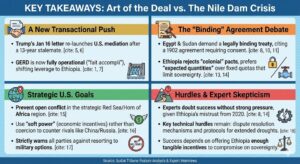
Dr. Ahmed al-Mufti, a veteran legal advisor who served on Sudan’s Nile water delegation for nearly two decades, views the renewed American interest with profound scepticism. Speaking to Sudan Tribune, he noted that this is far from Washington’s first attempt at a “zero-sum” resolution.
“All the evidence suggests that Trump’s initiative has no chance of success,” al-Mufti stated. “The only solution, in my belief, is for Sudan and Egypt to take a very strong position that forces Ethiopia to negotiate—such as claiming the land the dam is built on.”

Al-Mufti’s argument leans heavily on a century-old shadow over the modern turbines: the 1902 Anglo-Ethiopian Treaty. Signed by Emperor Menelik II and the British government on behalf of Sudan, Article III of the treaty saw the Emperor pledge not to construct any work across the Blue Nile that would arrest the flow of its waters except in agreement with the governments of Britain and Sudan.
While Sudan and Egypt view this as a cornerstone of international law, Addis Ababa has frequently dismissed such colonial-era agreements. They argue these were signed under different geopolitical realities and that a sovereign nation cannot be bound by treaties that restrict its right to development. Al-Mufti, however, maintains that this legal history is vital, noting that the land was granted to Ethiopia in 1902 on the specific condition that no water structure be built without notifying Sudan.
The legal hurdles are as steep as the dam’s spillways. Al-Mufti argues that the only practical path forward involves shared governance, suggesting that the dam should be managed through joint oversight for the benefit of all three countries. Yet, within Ethiopia, the perspective is one of hard-won sovereignty. Solomon Geleta Yohannes, an Ethiopian academic and regional expert, suggests that Trump’s latest proposal might find some traction if it sticks to the “expected quantities” of water rather than rigid, numerical quotas.
“This approach aligns with the Ethiopian vision, which refuses to commit to fixed numerical shares or binding legal agreements that touch upon its sovereignty,” Yohannes told Sudan Tribune. “The American message used the term ‘expected quantities,’ which intersects with the position Addis Ababa has adopted throughout the years of negotiation.”
Yohannes warns, however, that the shadow of the past looms large. The memory of 2020, when Trump suggested Egypt might “blow up” the dam, remains a source of deep-seated mistrust. He views the current official silence from Addis Ababa as a tactic aimed at avoiding direct confrontation with Washington while not granting legitimacy to a new path, they do not desire.
The geopolitical stakes extend far beyond the riverbanks. Dr. Ismail al-Nayer, a strategic expert in conflict resolution, argues that the U.S. intervention is less about water and more about the shifting balance of power in the Red Sea and the Horn of Africa.
“From a strategic perspective, the initiative can be understood within Washington’s quest to prevent a sovereign water dispute from sliding into an open conflict,” al-Nayer explained. “Trump possesses a relative margin to use ‘soft power’ tools on Ethiopia, relying on his political weight and the network of American relations with international financial institutions.”
Dr. Fath al-Rahman Ibrahim, a professor of international relations, believes the “Trump factor” brings a unique, if aggressive, momentum to the crisis. He notes that the core of the new American push seems to be an insistence on ending unilateralism and avoiding military conflict.
“The initiative includes warning the parties against resorting to the military option, with strict emphasis on preventing it,” Ibrahim noted. “This is an important discourse in light of the veiled Egyptian threats to resort to a military option and strike the massive dam.”
As the technical experts and diplomats prepare for a possible return to the table, the “devil in the details” remains the legal mechanism for dispute resolution and the specific protocols for the “extended drought” years. While Sudan and Egypt have officially welcomed the mediation, the true test will be whether the “Art of the Deal” can offer Ethiopia enough tangible incentives to trade a portion of its perceived sovereignty for a lasting regional peace.
Timeline: 15 Years of Tension and Concrete
- April 2011: Construction begins on the “Grand Ethiopian Renaissance Dam” (GERD).
- March 2015: Egypt, Sudan, and Ethiopia sign the Declaration of Principles in Khartoum.
- Feb 2020: Ethiopia withdraws from U.S.-mediated talks in Washington, refusing to sign a final agreement.
- July 2020: Ethiopia begins the first filling of the reservoir.
- Feb 2022: The first turbine begins producing electricity (375 MW).
- Oct 2024: Ethiopia completes the fifth and final filling, reaching full capacity.
- Sept 9, 2025: Prime Minister Abiy Ahmed officially inaugurates the dam’s full operations.
- Jan 16, 2026: President Trump sends a formal letter offering a new mediation to break the stalemate.
Sidebar: Technical Specifications of the GERD
| Feature | Specification |
| Height | 155 meters |
| Reservoir Capacity | 74 billion cubic meters |
| Installed Capacity | 5,150 MW (Largest in Africa) |
| Turbine Count | 13 Francis Turbines |
| Location | Guba, Ethiopia (approx. 15km from Sudan border) |