
Sudan drone warfare kills thousands as both sides secure advanced technology
February 17, 2026 (KHARTOUM) – Drones have claimed thousands of lives during the ongoing war between the Sudanese army and the Rapid Support Forces (RSF), with their geographical use expanding across various battles and leading to heavy casualties and the destruction of vital infrastructure.
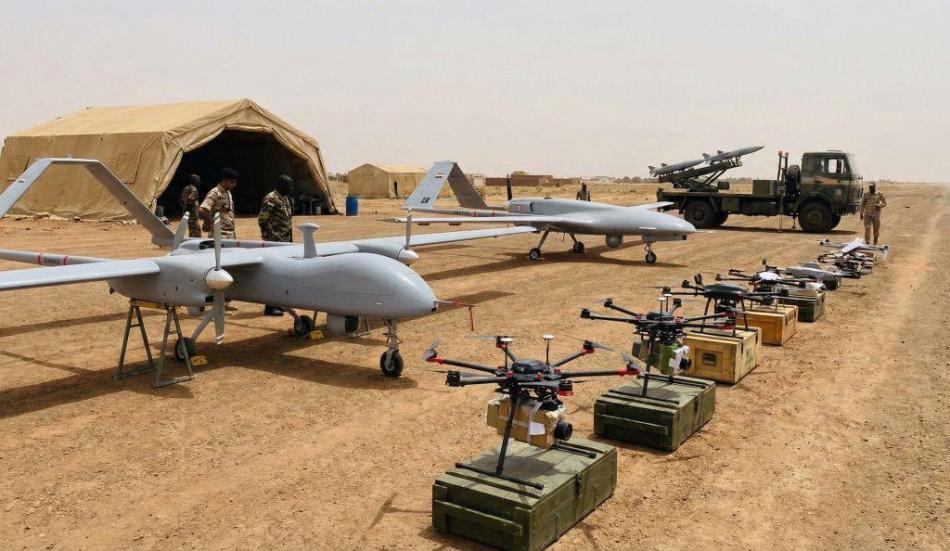
Both parties are intensely competing to acquire various unmanned aerial vehicle (UAV) technologies to achieve breakthroughs across the country. New types of drones have entered Sudan for the first time during this conflict, including the lethal Chinese-made CH-95 or FH-95 models.
Technically, the use of FPV and Kamikaze suicide drones has spread between both sides, with heavy usage observed in Khartoum, Al-Jazirah, El Fasher, and other regions. Former Sudanese Air Force pilots indicate that these drones are used to target troop concentrations, light armour, and snipers, as well as to restrict individual movements.
According to technical analysis provided by pilots speaking to Sudan Tribune, the army utilizes various models, including the Iranian-made Mohajer-6, which serves as the backbone of its air wing, alongside Chinese and Turkish Bayraktar drones. Conversely, the RSF employs Chinese models and modified commercial DJI drones capable of carrying 120mm mortar shells. Retired Brigadier General Adel Abdel Latif noted that as the war continues, both the army and the RSF have obtained a significant number of drones. While the army utilizes Bayraktar and Akinci models, Abdel Latif stated that the RSF uses CH-95 drones and smaller UAVs intended to distract and saturate air defences. These drones possess highly effective weaponry and significant destructive power, including conventional and guided missiles and bombs.
International supply lines and strategic targeting
Abdel Latif emphasized that both sides are deliberately attempting to paralyze troop movements and target strategic objectives, including infrastructure like power and water stations. He noted that both parties possess the necessary capabilities to compensate for the loss of downed drones. Reports from United Nations experts and Amnesty International suggest that several international parties, including Iran, Turkey, and Russia, have supplied the army with drones, while the RSF has received support from the United Arab Emirates via logistical corridors in Libya and Chad.
The war in Sudan during 2024 and 2025 has seen a radical shift toward drone warfare, with the scope of targeting expanding to include all states. Data from the Armed Conflict Location & Event Data Project (ACLED) attributes at least 2,200 deaths to drone attacks since the start of the conflict, with 80% of those occurring in 2025 alone. Field monitoring indicates an escalating pace of attacks, with approximately 277 drone strikes recorded in 2024. This number rose sharply to 472 attacks in 2025, reflecting a growing reliance on this technology.
Key Drone Models and Technical Capabilities
| Drone Model | Origin | Type | Capabilities & Armament |
| Mohajer-6 | Iran | Medium-altitude (MALE) | Backbone of the army air wing. Features a 12-hour endurance and 18,000-foot ceiling. Carries up to four precision-guided munitions (Qaem missiles). |
| CH-95 / FH-95 | China | High-end Strike UAV | Capable of long-range surveillance and electronic warfare. Used for precision strikes with guided missiles; observed operating from Nyala. |
| Bayraktar TB2 / Akinci | Turkey | Tactical / Heavy UCAV | High precision and long-endurance. The Akinci is a heavier model used for destroying air defense systems and strategic infrastructure. |
| Modified DJI | Commercial | Tactical Quadcopter | Modified by RSF to carry and drop 120mm mortar shells. Cheap and highly effective in urban environments for targeting individual movements. |
| FPV / Kamikaze | Various | Loitering Munition | “Suicide drones” designed to crash into targets. Used for sniping and destroying light armor. Highly effective for psychological warfare in cities. |
Regional death tolls and the Kordofan massacres
The geographical distribution of victims by most-affected areas shows that North Darfur recorded 577 deaths, followed by West Kordofan with 567, North Kordofan with 548, Khartoum with 403, and South Kordofan with 396. Among the deadliest incidents was the Kaluqi massacre in December 2025, where a drone strike targeted a kindergarten, followed by attacks on first responders and the hospital where victims were being treated in South Kordofan. This incident resulted in 79 deaths, including more than 40 children. In total, the United Nations documented the deaths of 104 civilians in a series of drone strikes targeting the Kordofan region during a single week in December 2025.
The Sudan Witness project indicates that the Sudanese army has carried out bombing operations that killed at least 1,700 civilians in attacks on residential neighbourhoods, markets, schools, and displacement camps. The project has compiled the largest known database of military airstrikes in the conflict that began in April 2023. Recently, a swarm of suicide drones attacked the city of Sanha, targeting a meeting at an army centre and killing at least 27 people. RSF drones also recently attacked three locations in South and North Kordofan, including a Quranic school, which left at least one student dead and others injured, while the army attacked RSF positions in the vicinity of Bara in North Kordofan.
Deadliest Individual Drone Incidents
| Date | Location | Incident Description | Estimated Deaths |
| December 2025 | Kaluqi, South Kordofan | Strike on kindergarten, rescuers, and hospital | 79 (including 40+ children) |
| September 19, 2025 | Abu Shouk Camp | Strike on displacement camp | 75 |
| October 10, 2025 | Dar al-Arqam, El Fasher | Strike on shelter for displaced persons | 60 |
| December 31, 2025 | Samasim, South Kordofan | Strike on gathering of displaced persons | 41 |
| Recent | Sanha | Strike on meeting at an army centre | 27 |
Global alarm over escalating civilian casualties
Two weeks ago, the UN High Commissioner for Human Rights stated that at least 104 people, including 43 children, were killed in multiple drone attacks in the Kordofan region since early December. UN High Commissioner Volker Türk expressed alarm over the increasing intensity of hostilities, referring to clashes between the army, the RSF, and the Sudan People’s Liberation Movement-North in Kordofan.
Retired Brigadier General Walid Ezzedine Abdel Majid, a member of the Higher Central Command for Retired Officers and Soldiers (Tadamon), explained that while drones originated in the mid-20th century for reconnaissance, they have evolved into armed combat versions. He noted that the war in Sudan has seen an unprecedented use of drones in urban warfare, particularly in Khartoum and Darfur. He added that what is occurring represents the first African model of large-scale drone usage within a civil war context. He warned that poor programming, unstudied usage, and the nature of fighting within cities have contributed to massive civilian casualties. The presence of fighting forces within residential areas and the use of schools and service facilities as military headquarters make citizens direct targets.
The illusion of military resolution
Fouad Osman, a researcher in political and Horn of Africa affairs, told Sudan Tribune that since the outbreak of the war, the parties have rushed to promote the possibility of a near-military resolution. Othman described this as a “costly myth” and one of the largest illusions the parties are trying to instil in the public consciousness. He argued that the decision to stop the war has become hostage to the consensus of the supporters of both sides, noting that the heavy use of drones has increased death tolls and eroded the sense of security among citizens. He characterized the “path of bullets” as a dead end, stressing that despite the destruction, there is still an opportunity to stop the war if the will for peace overcomes the “illusion of military victory.”
UN and media reports have detailed hundreds of civilian victims from drone attacks across 2024 and 2025 in various regions. In El Fasher, North Darfur, more than 120 civilians were killed in strikes targeting neighbourhoods, shelters, and mosques, including one attack on a mosque that killed approximately 75 people. In Kadugli, South Kordofan, the UN reported that drone strikes targeted a kindergarten and a hospital in December 2025, leading to at least 100 to 116 civilian deaths. The city of Dilling also recorded approximately 45 to 50 civilian deaths in scattered drone attacks late in 2025. UN High Commissioner Volker Türk has called on both the army and the RSF to stop attacks on civilian objects and infrastructure, warning that drone strikes on civilian facilities may amount to war crimes.
Documenting attacks on displacement camps
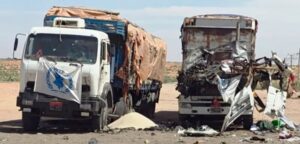
Mohamed Salahuddin, a member of the executive office of the Emergency Lawyers, stated that approximately 129 drone attacks have targeted civilian objectives by both sides. These attacks resulted in 218 deaths and 112 injuries during 2024 and 2025. He noted that drone attacks targeting displacement camps, shelters, markets, and power stations began in mid-April 2024. One of the largest attacks occurred at the Abu Shouk camp on September 19, 2025, killing nearly 75 people. Another strike targeted a gathering of displaced persons in the Samasim area of South Kordofan on December 31, killing 41 people, while a strike on Dar al-Arqam in El Fasher on October 10 killed 60 people.
Retired Brigadier General Jamal al-Shahid, a military and strategic expert, explained that drones have become a staple of modern warfare due to their lower operating costs relative to traditional aircraft and their ability to conduct precise strikes from long distances. He noted that while drones play a significant tactical role in reconnaissance and exhausting the opponent, they cannot alone control territory without ground forces. He suggested that the RSF resorts to drones whenever they face ground pressure from the army to compensate for losses. He warned that targeting vital infrastructure deeply affects civilian life and hampers relief efforts.
Infantry remains decisive factor in territorial control
Retired Major General Mutasim Abdel Qader added that while drones are effective, they cannot resolve battles alone. He emphasized that territorial control remains the decisive factor requiring infantry. He noted that while drone use was limited at the start of the conflict, the past year has seen a significant escalation. He accused the RSF of using drones to target electricity, hospitals, and relief facilities as well as carrying out retaliatory attacks. He concluded that drones will remain an important element of modern warfare but must be integrated into a comprehensive combat system to achieve a military resolution.
Volker Türk reiterated that drone attacks continue to take civilian lives even as the army broke long-standing sieges on cities previously controlled by the RSF. He documented more than 90 deaths and 142 injuries between late January and February 6. Army spokesperson Brigadier General Asim Awad recently stated that army units had successfully monitored and destroyed numerous enemy drones and their systems with high precision, targeting storage facilities and operational units to degrade the RSF’s unconventional aerial capabilities.