
UN agencies warn of life-threatening aid cuts for Sudanese refugees in Chad
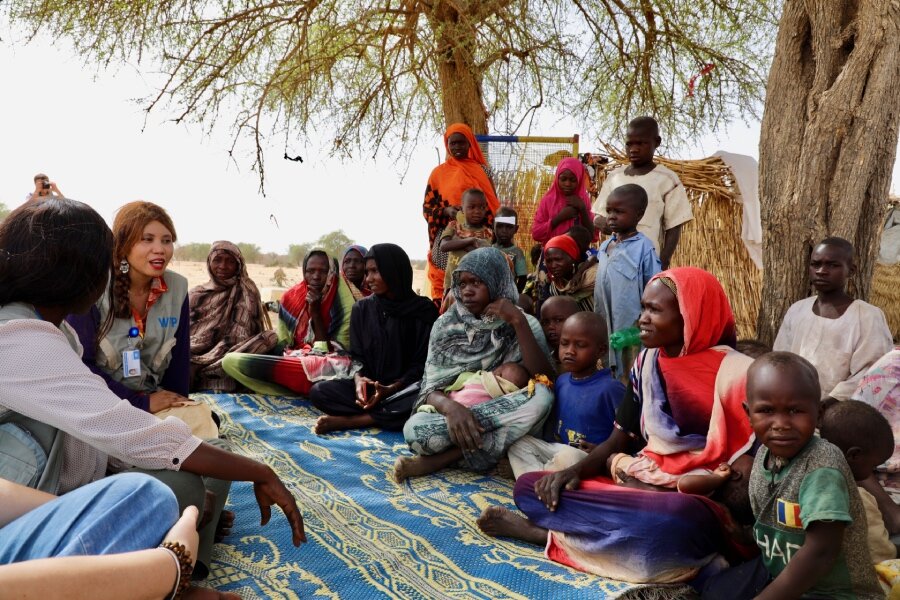
WFP and other humanitarian workers speak to new Sudanese arrivals in Chad (Photo: WFP/Jacques David)
April 9, 2026 (N’DJAMENA) – More than a million Sudanese refugees in Chad face immediate and life-threatening cuts to essential services as humanitarian funding dries up, two United Nations agencies warned on Thursday.
The UN Refugee Agency (UNHCR) and the World Food Programme (WFP) said that food, water, shelter, and healthcare will be drastically scaled back unless a $428 million funding gap is closed.
The warning comes as the conflict in neighbouring Sudan approaches its third year, leaving Chad to host 1.3 million Sudanese refugees. Over 900,000 of those individuals arrived after the war broke out in 2023.
The UNHCR currently has enough resources to provide basic assistance to only four out of every ten refugees. Critical shortages have left 80,000 families without shelter, while some settlements receive less than half the minimum daily water requirements.
Health centres and schools are also failing under the strain. In most locations, classrooms are overwhelmed with more than 100 children per teacher, and protection services for survivors of gender-based violence are being reduced.
The WFP reported it has less than half the resources needed to sustain its operations. The agency has already halved food rations for the majority of refugees, with women and young children most severely affected.
Nearly 243,000 people remain stranded in eastern border areas because there is no funding to relocate them to safer settlements further inland. These families are forced to sleep in the open, exposed to disease and insecurity.
Patrice Ahouansou, the UNHCR representative in Chad, said the humanitarian response ended in 2025 with only one-third of the required resources. He warned that without urgent donor support, the current year would bring deeper cuts and greater suffering.
WFP Chad Country Director Sarah Gordon-Gibson said the lack of resources would force refugees into “devastating coping strategies” and put lives at risk.
Chad remains on the front line of the crisis, with one in thirteen people in the country now a refugee. In eastern Chad, that ratio rises to one in three.
The agencies called on the international community for immediate responsibility-sharing to match Chad’s commitment to keeping its borders open. They are requesting $289 million for UNHCR and $139 million for WFP to sustain aid for the next six months.