
Yale report reveals Ethiopian base weaponizing civilian vehicles for Sudan’s RSF
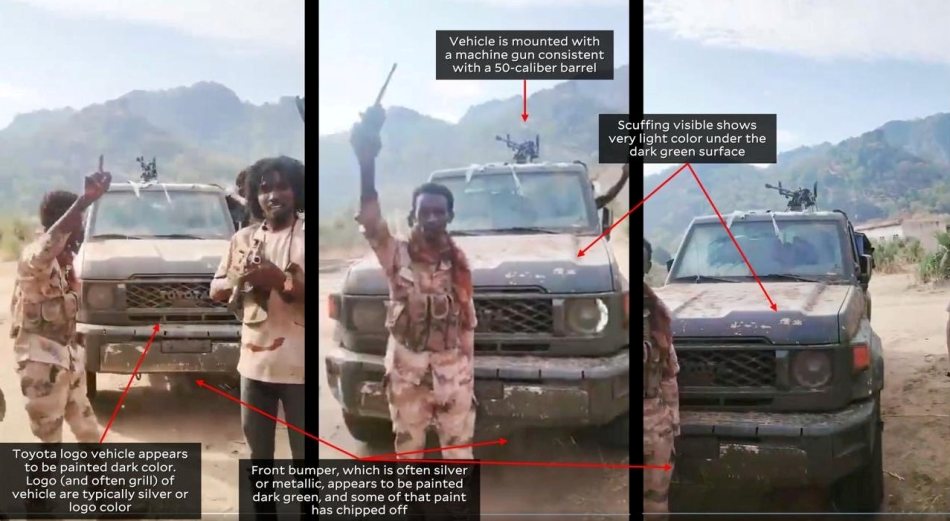
June 10, 2026 (ASOSA) – A new investigation by the Yale School of Public Health’s Humanitarian Research Lab (HRL) has exposed an active military logistics chain inside an Ethiopian National Defense Forces (ENDF) base, where civilian vehicles are systematically modified, armed, and painted to supply Sudan’s Rapid Support Forces (RSF).
The report, based on satellite imagery analyzed between March 29 and May 21, 2026, reveals a large-scale refitting operation at the ENDF base in Asosa, Ethiopia. The activity indicates that the Ethiopian military facility is providing ongoing support to the Sudanese paramilitary group that is entirely inconsistent with standard ENDF operations.
According to the findings, the base serves as a modification hub where light commercial vehicles, originally white or light-coloured, are repainted in dark colours matching the distinctive livery used by the RSF on the frontlines of Blue Nile State. Satellite images from May 21 captured vehicles with irregular light and dark splotches, proving that the painting process was actively underway.
Yale researchers cross-corroborated these satellite observations with verified open-source video footage of RSF technicals fighting in the Blue Nile region. The field vehicles showed clear evidence of aftermarket modification: their outer bodies were painted a matte, non-reflective dark green, but their unpainted interior doors and footrests remained bright white from the factory floor. Front bumpers and corporate logos had also been painted over to conceal their commercial origins.
Beyond cosmetic changes, the Asosa base is being used to weaponize these civilian transports into lethal “light technical vehicles”. Analysts repeatedly identified clusters of narrow, dark objects approximately 1.6 meters long, situated next to vehicles with mounting equipment in their beds. Based on the exact dimensions and positioning, the report assesses with high confidence that these objects are heavy machine guns, consistent with 50-calibre barrels, being affixed to the modified trucks.
The logistics chain feeding this operation is extensive. On May 10, satellite imagery captured at least 10 commercial car carriers arriving at the base, several of which were heavily loaded with light-toned civilian vehicles ready for modification. Concurrently, a fluctuating fleet of up to 13 large commercial car carriers and 25 smaller transport vehicles was tracked as it moved through civilian and residential areas of Asosa town, matching the transport equipment observed inside the military base.
The report also highlights a significant shift in operational patterns within the base, suggesting an effort to hide the pipeline from international scrutiny. Following Yale’s initial reporting on the base in April, the locus of activity shifted away from an exposed, trapezoidal open field. The operation pivoted to the northeast area of the base, concentrating around a large, roofed warehouse structure—a move analysts state is consistent with an attempt to mitigate satellite detection.
By May 21, activity at this covered warehouse location peaked. Researchers documented a surge of 36 transport containers and a total of 82 light technical vehicles packed across the Asosa base, with over 70 clustered directly around the new warehouse position.
Yale HRL investigated more than 10 other ENDF-related facilities across Ethiopia during this reporting period. The laboratory confirmed that none of the other bases showed any evidence of the transport, weaponization, or distribution of civilian vehicles for cross-border combat, indicating that the Asosa facility is a uniquely designated hub for equipping the RSF.