
Sudan Central Bank issues new import rules as pound weakens
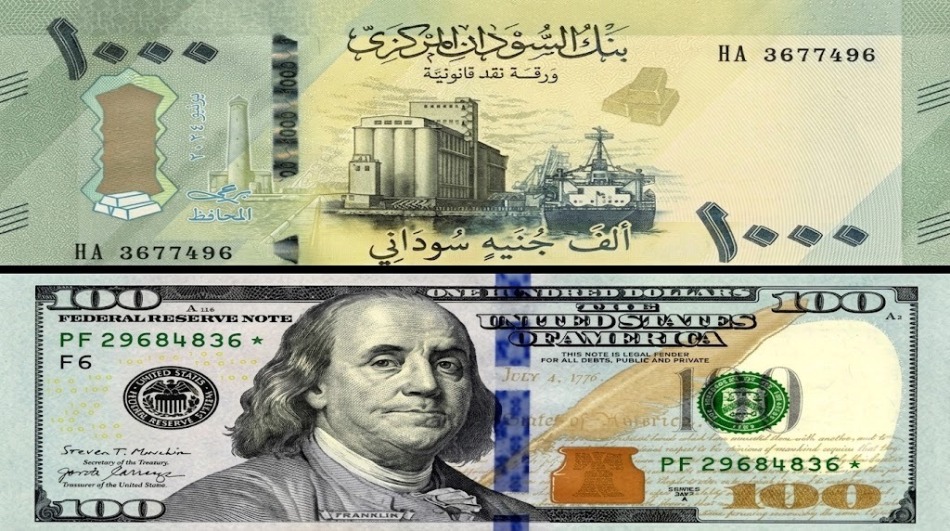
June 28, 2026 (KHARTOUM) – Sudan’s local currency weakened slightly during Sunday’s trading while gold prices continued to rise, coinciding with new central bank directives aiming to unify the exchange rate applied to import financing.
The U.S. dollar was recorded at 5,100 Sudanese pounds in the parallel market, compared to 5,000 pounds on Saturday, marking a further decline for the local currency against foreign currencies.
Traders told Sudan Tribune that the UAE dirham also rose to 1,440 pounds on Sunday, up from 1,370 pounds on Saturday.
Meanwhile, the price of gold per gram rose to 590,000 pounds, compared to 575,000 pounds the previous day, while the Sudan Gold Refinery set Sunday’s official price at 581,000 pounds per gram.
The Central Bank of Sudan directed all banks, in a circular, to adhere to the exchange rate set by the central bank during foreign currency injections when executing approved import requests for clients, to avoid multiple exchange rates for the same purpose.
The central bank added that if commercial banks wish to use their own foreign exchange reserves or export revenues to finance clients’ import requests, they must coordinate in advance with the central bank.
The regulator stated that this move is part of efforts to unify the exchange rate applied to import financing operations.
The central bank continued to inject foreign currency into banks, announcing that it had met all import requests submitted by both the private and public sectors through commercial banks at a rate of 1,220 pounds per dirham.
The Gold Exporters Association praised the central bank’s measures to curb the rise of foreign exchange rates against the Sudanese pound.
Motasim Mohamed Saleh, secretary-general of the association, told Sudan Tribune that meeting importers’ foreign exchange needs for a third consecutive day is expected to lead to a further drop in exchange rates in the coming days if the policy persists.
Saleh said current limited increases in the market are mostly driven by speculation and traders exploiting anticipation rather than reflecting genuine demand or shifts in market fundamentals.
He expressed hope that these measures would continue alongside tighter market controls to help stabilize the exchange rate and relieve economic pressures.
Saleh also commended the Sudan Gold Refinery for maintaining rewarding prices for gold to attract production into official channels, curb smuggling, and maximize foreign currency revenues.