
Sudanese political forces reject al-Burhan dialogue and outline peace process roadmap
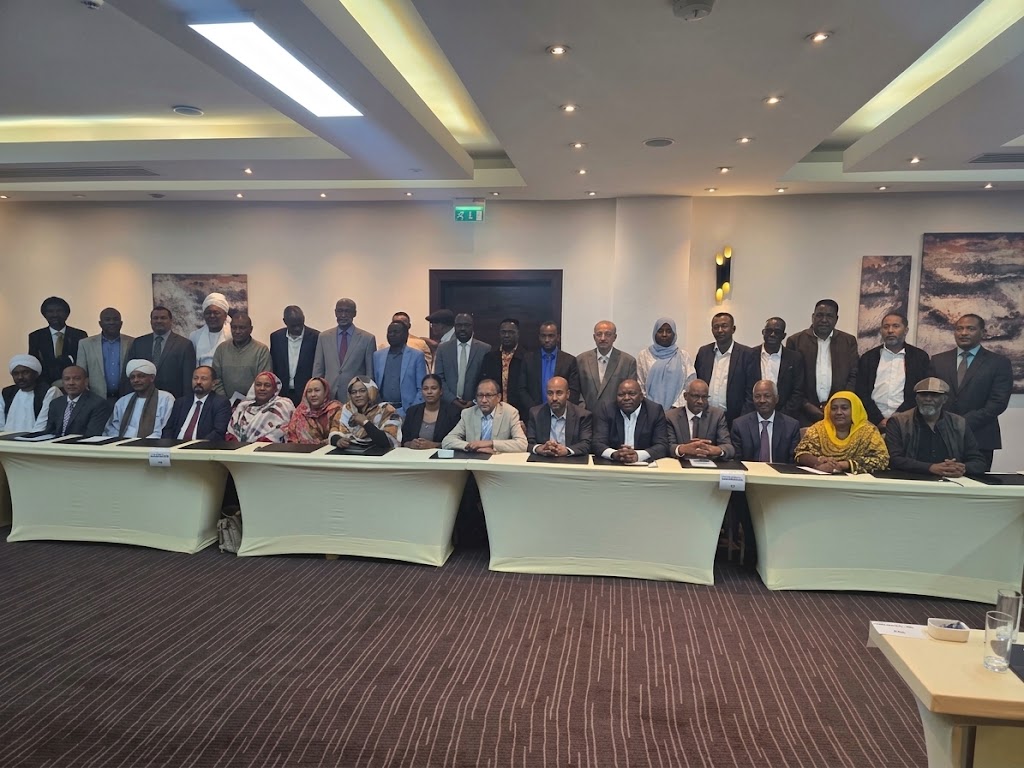
August 23, 2026 (ADDIS ABABA) – Sudanese anti-war political and civil forces have rejected an initiative launched by army chief Abdel Fattah al-Burhan for a “Sudanese-Sudanese dialogue,” declaring they will neither participate in it nor recognize its outcomes, while presenting an alternative roadmap anchored on three concurrent tracks.
The decision was announced at the conclusion of consultative meetings held in the Ethiopian capital, Addis Ababa, on August 22–23. The gathering brought together the Sudanese Declaration of Principles forces, the Popular Congress Party, the National Umma Party, civil society organizations, women’s and youth networks, as well as independent public figures and academics unaligned with the warring parties.
Participants included the head of the Sumood Coalition Abdalla Hamdok; senior members of the anti-war coalition, the leader of the Sudan Liberation Movement, Abdel Wahid al-Nur, alongside Umma Party leader Mubarak al-Fadel, a leading member of the Baath party, Wajedi Sleh and civil society figures, to assess the deepening humanitarian disaster, halt the fighting, and restore the democratic transition.
In a joint position paper, the groups detailed their reasons for rejecting the military leader’s call, describing it as a unilateral initiative run entirely within areas under single-party control and subject to its security apparatus. They warned that the process would legitimize the reality of the war and entrench the de facto partition of Sudan into separate zones of control.
The statement noted that the initiative serves as a political cover to perpetuate military rule established by the October 25, 2021 coup, while creating a backdoor for the return of the dissolved National Congress Party and the Islamic Movement. It added that the unilaterally appointed preparatory committee lacks national legitimacy, and pointed out that the process decouples political talks from an immediate ceasefire, unhindered aid delivery, and addressing ongoing atrocities.
As an alternative, the anti-war coalition proposed a genuine peace process based on equal negotiation under an agreed-upon, independent international umbrella. The process rests on three integrated, concurrent tracks: an urgent humanitarian track, a permanent ceasefire track, and an exclusively civilian political track that addresses root causes such as governance, equal citizenship, the building of a unified, professional national army, the dismantling of the remnants of the former regime, and transitional justice.
The document identified participants across three main political currents: anti-war forces unaligned with the belligerents, forces aligned with the Sudanese Armed Forces, and forces aligned with the Rapid Support Forces. It specified that participation by both military factions must remain limited to the ceasefire and humanitarian tracks, completely excluding the National Congress Party and its affiliated entities from the political process.
Regarding external mediation, the coalition affirmed that the Quartet Roadmap issued on September 12, 2025, represents the best framework for peace because it sets a clear timeline and commits to a civilian-led future. The groups also expressed readiness to engage constructively with the Quintet Mechanism, provided that Sudanese ownership of decisions is preserved and international mediation efforts are unified into a single, coherent track to prevent warring parties from exploiting divisions among mediators.
Al-Burhan had announced on August 14 his agreement to legal, political, and security guarantees to facilitate an internal dialogue, but the Addis Ababa coalition firmly dismissed the move as an attempt to impose a fait accompli that cannot deliver sustainable peace.