
US proposes nationwide Sudan arms embargo amid China, Russia pushback
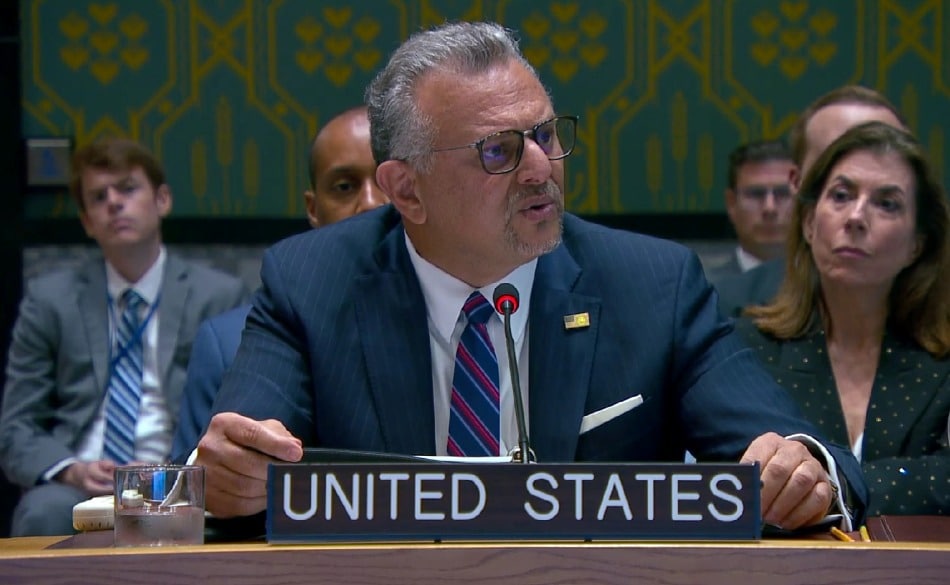
August 24, 2026 (NEW YORK) – The United States on Monday introduced a draft resolution to the UN Security Council to expand the arms embargo across all of Sudan, explicitly including unmanned aerial vehicles, amid opposition from the Sudanese government and China and Russia.
The Security Council held a briefing on the situation in Sudan, addressed by senior UN officials, including Massad Boulos, Senior Adviser to the U.S. President for Africa, Arab, and Middle Eastern Affairs, and Sudan’s Permanent Representative to the UN, Al-Harith Idriss, and by deliberations among council members.
Boulos said Washington put forward a strong resolution containing four key provisions: expanding the arms embargo across the entire territory of Sudan, reaffirming that unmanned aerial vehicles, systems, and related technologies fall under the scope of the embargo, requesting the Secretary-General to increase the number of experts on the 1591 panel, and directing the panel to collaborate with other panels covering the region to better inform the Council of violations regarding the asset freeze, travel ban, and arms embargo.
He noted that the resolution aims to reflect the harsh realities of the current conflict, address external military support fuelling the war, and build pressure on all parties to seek an end to the fighting.
“These measures do not seek to create any advantages or disadvantages among the parties or alter battlefield dynamics beyond pushing for a swift end to fighting,” Boulos said. “Nor do these measures seek to create or imply equivalence among the conflict parties beyond the fact that all must pursue peace and bear the burdens of accountability.”
The UN Security Council established the Sudan sanctions regime in 2005 under Resolution 1591, which prohibits the sale and supply of arms to all warring parties in Darfur, while imposing targeted sanctions including travel bans and asset freezes on designated individuals.
Under Resolution 1591, the Security Council formed a Panel of Experts to assist the sanctions committee in monitoring implementation and investigating the financing and supply networks of armed, military, and political groups.
Boulos stated that the brutality of the war waged by the Sudanese Armed Forces (SAF) and the Rapid Support Forces (RSF) has discredited their claims to legitimate governance, noting that civilians have been driven from their homes, subjected to looting, and forced to hide from planes and drones targeting civilian sites.
He emphasized that armed drones have caused immense devastation, taking the lives of more than 1,120 Sudanese civilians during the first half of this year, representing approximately 80 per cent of all recorded civilian deaths in 2026.
He said armed drones continue to inflict damage on markets, health facilities, humanitarian convoys, and critical infrastructure, deepening hardship and humanitarian needs across the country.
Boulos pointed out that the RSF continues to block humanitarian access, attack water stations and electricity grids, and recently killed at least 14 civilians in Um Arda in North Kordofan, displacing over 4,000 people.
He added that the army conducted over a dozen drone attacks and raids during August in North and South Kordofan, including a strike on Jabra el Sheikh that killed five civilians.
Boulos said both the army and the RSF prefer to focus their efforts on escalating violence, seizing new territory, and pursuing an unattainable military victory motivated by revenge and a hunger for power, rather than pursuing a humanitarian truce and a path to peace.
He called on the Security Council to expand its tools, prevent further atrocities, ease civilian suffering, and hold perpetrators accountable.
France’s representative to the Security Council expressed his country’s support for expanding the arms embargo to cover the entirety of Sudanese territory.
Danish Foreign Minister Lars Løkke Rasmussen, whose country holds the Security Council presidency for August, called for expanding the International Criminal Court’s mandate to cover all of Sudan.
Rasmussen held the Security Council responsible for halting the conflict, which he warned is destabilizing the wider region, and urged a humanitarian truce leading to a full ceasefire as the only genuine path to civilian protection.
He urged international donors to increase humanitarian assistance, announcing that Denmark would contribute $15.6 million, bringing its total funding since 2023 to approximately $105 million.
Renewed Sudanese rejection
Speaking to police personnel in Khartoum concurrently with the Security Council session, Sovereign Council Chairman and SAF Commander Abdel Fattah al-Burhan said discussions regarding potential international sanctions would not affect the military or weaken its resolve.
Al-Burhan called on the Sudanese people to disregard what he described as enemy propaganda regarding an air embargo, reiterating the military’s determination to fight until every inch of Sudanese territory held by the rebellion is liberated.
“Our message to those sitting in foreign hotels applauding sanctions to subjugate the Sudanese people is that the people will not break, and defeat and disappointment will fall upon you. These people will not be able to rule the people again,” al-Burhan said.
Sudan’s UN Representative Al-Harith Idriss rejected the proposal to expand the arms embargo beyond Darfur during the Security Council deliberations.
Idriss argued that the draft resolution would effectively equate the national army with the RSF and undermine Sudan’s sovereignty, stating that the proposal was neither a technical adjustment nor a simple adaptation to developments on the ground.
He urged the Security Council to maintain existing measures while improving enforcement against violators and subjecting external networks supplying arms and drones to greater scrutiny.
Idriss said the Sudanese government remains committed to civilian protection, citing the creation of a national protection mechanism and efforts that facilitated the voluntary return of 5.8 million displaced persons by the end of June.
He added that Sudanese authorities adhere to international humanitarian and human rights laws, and that security forces are redeploying as territorial control is restored.
China, Russia mark their opposition
China has urged the UN Security Council to exercise prudence regarding sanctions on Sudan, warning against expanding punitive measures as council members discuss renewing restrictions on the war-torn country.
Addressing the Security Council, Chinese Ambassador Li Song said sanctions must serve strictly as a means to encourage peace rather than an end in themselves or a substitute for diplomatic efforts, adding that any measures must fully respect Sudan’s national sovereignty, territorial integrity, and legitimate concerns.
Li cautioned against the arbitrary expansion of coercive measures, stressing that widening their severity and scope risks undermining Sudan’s long-term stability and disrupting normal economic life, while urging the international community to focus instead on enforcing existing measures and supporting political dialogue.
Russia’s Permanent Representative to the UN, Vassily Nebenzia, firmly rejected the U.S.-led push to expand the UN sanctions regime or widen the arms embargo across all of Sudan.
Nebenzia condemned Western measures, criticizing the European Union’s recent ban on Sudanese gold imports and U.S. restrictions blocking international financial institutions from providing credit and technical assistance, describing them as hostile policies of “economic strangulation” that directly harm ordinary citizens.
He rejected establishing moral equivalence between the belligerents over weapon and drone use, arguing that while the RSF uses strike UAVs indiscriminately and deliberately against civilians, the army operates to neutralize insurgent forces destroying the state.
Nebenzia also warned of the critical situation in El Obeid, where rebel attacks continue against overcrowded civilian shelters, and highlighted that fertilizer shortages from the Persian Gulf and surging fuel prices threaten Sudan’s planting season.
He stressed that all humanitarian aid must be delivered in close coordination with the Sudanese government rather than in circumvention of Khartoum, while criticizing outside mediation efforts by the Sudan Quartet for using “pressure, blackmail and arm-twisting” against the state authorities.
China and Russia hold veto power as permanent members of the Security Council, enabling them to block the adoption of the draft resolution.
Permanent Security Council members Britain and France supported a U.S. proposal to expand the arms embargo across all of Sudan, a measure also backed by Denmark, which holds the Council’s rotating presidency this month.