
Sudan and Egypt reject Red Sea militarization and non-littoral maritime access
November 24, 2026 (CAIRO) – Sudan and Egypt on Monday rejected any attempts to militarize the Red Sea or take unilateral actions infringing on the sovereignty of their coastal states, asserting that governance of the waterway belongs exclusively to littoral nations under international law.
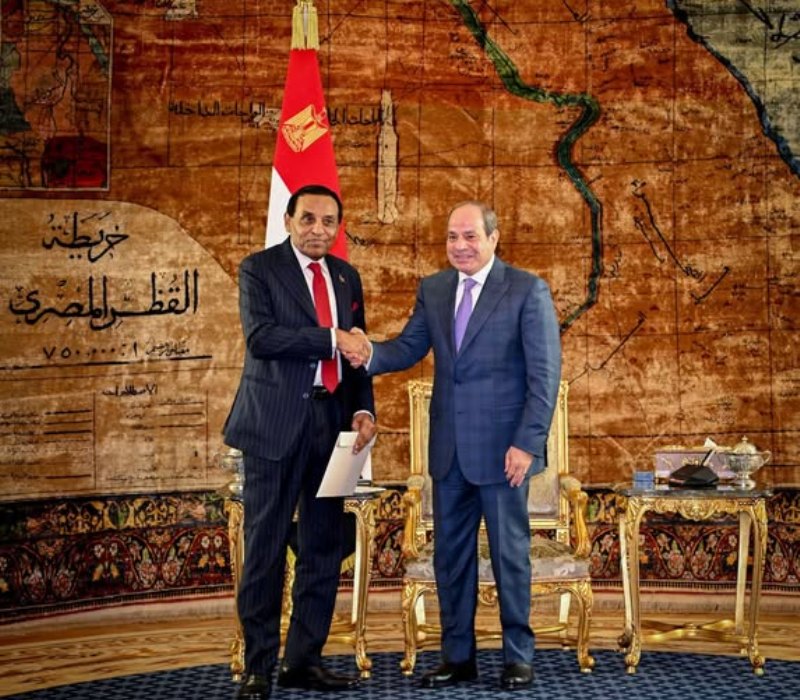
The joint declaration followed talks in Cairo between Sudanese Prime Minister Kamil Idris, Egyptian President Abdel Fattah al-Sisi, and Egyptian Prime Minister Mostafa Madbouly. During the visit, Idris also delivered a message to Sisi from Sudan’s Transitional Sovereign Council Chairman Abdel Fattah al-Burhan.
In a joint statement issued at the end of the visit, the two sides stressed the need to respect freedom of navigation and affirmed that bordering states alone are responsible for Red Sea governance.
They voiced total rejection of any maritime access granted to non-littoral countries at the expense of the sovereignty, territorial integrity, and ports of coastal states, as well as any exploitation of regional conditions to militarize the sea.
The remarks come as Ethiopian officials have intensified statements asserting that securing access to the Red Sea is an irreversible strategic and developmental necessity. Ethiopian Prime Minister Abiy Ahmed has repeatedly stated that his country will work to secure a sea outlet.
On water security, Cairo and Khartoum stated that their water security forms an indivisible, interconnected system, stressing the need to protect their water rights and historical uses.
They emphasized the importance of following up on meetings of the Permanent Joint Technical Commission for Nile Waters under the 1959 agreement, alongside the “2+2” mechanism bringing together both countries’ foreign and irrigation ministers to forge a unified stance on Nile issues.
Both sides also underscored the centrality of the Nile Basin Initiative and supported completing the consultative process to restore consensus among basin states toward an inclusive commission.
Egypt reiterated its rejection of any threat to Sudan’s unity and sovereignty, expressing firm opposition to creating or recognising any parallel governing entities and affirming its readiness to take necessary measures under international law and their joint defence agreement.
The two nations condemned attacks on civilians and vital infrastructure in Sudan—particularly power stations and water facilities—carried out by drones launched from a neighbouring country, stressing support for the Sudanese Armed Forces in protecting national security and borders.
They agreed to boost bilateral trade and expand cooperation across economic, industrial, agricultural, health, educational, cultural, and pharmaceutical sectors, and to promote joint investments.
During his meeting with Idris, Sisi reaffirmed Egypt’s support for Sudan’s national institutions and its backing for post-war reconstruction and stability efforts.
Idris said his visit to Cairo marked the actual launch of Sudan’s reconstruction process, opening new horizons for bilateral partnership, and called for Egyptian support in restoring Sudan’s active role within the African Union.
The Sudanese prime minister also outlined his government’s plans to launch an inclusive Sudanese-Sudanese national dialogue to foster national healing, overcome the current crisis, and restore internal consensus.