
Two authorities in warring Sudan: Zero government, zero state (2)
Professor Mekki El Shibly
Executive Director, Cognisance Centre for Strategic Studies
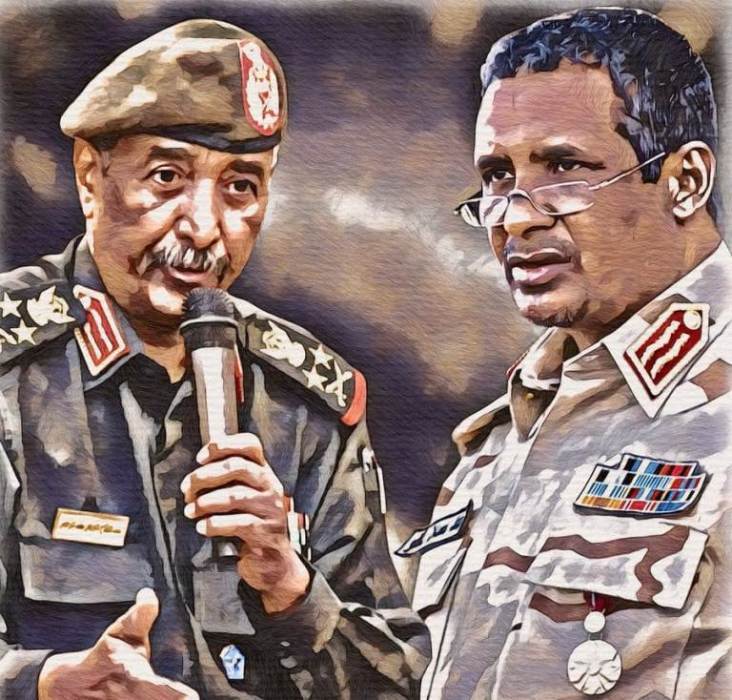
The collapse of governance under the Sudanese Armed Forces (SAF) and the Rapid Support Forces (RSF) has not merely paralysed public administration; it has dismantled the very foundations of the Sudanese state. What began as a political and military rivalry has metastasised into a structural implosion in which no entity possesses the territorial reach, institutional capacity, or legitimacy to perform the most basic functions of a state. In this condition, Sudan exists more as a battlefield than a political entity, its borders porous, its economy predatory, and its institutions either destroyed or subsumed by armed factions.
This descent into “zero state” is not a theoretical abstraction. It is measurable in economic freefall, the disintegration of territorial control, the collapse of the rule of law, and the displacement of millions. The previous article examined why governance is impossible under the current SAF–RSF duality, “zero government”; this article confronts the deeper reality: that Sudan’s structural, institutional, and territorial fragmentation has resulted in a “zero state” situation in Sudan.
- Economic Fiasco: A State Without Fiscal Capacity
Sudan’s fiscal architecture is in free fall. The country’s GDP contracted by 12% in 2023, with the IMF projecting a further 18.3% decline in 2024, resulting in a cumulative drop of more than 50% over the two-year period. Alternate estimates suggest that state revenues have collapsed by up to 80%, a consequence of both territorial losses and the diversion of resources into sustaining the war effort.
The Central Bank of Sudan has lost control over monetary policy. Two versions of the Sudanese pound now circulate simultaneously, as the government in Port Sudan has failed to replace old banknotes, even in areas nominally under its control. This dual currency system undermines fiscal discipline, fuels inflation now exceeding 400%, and facilitates illicit financial flows.
Public sector salaries, when paid, are financed through opaque and irregular channels, often supplemented by humanitarian cash transfers. The tax-to-GDP ratio has fallen to around 2%, from an already weak 5% before the conflict, signalling the near-total erosion of domestic revenue mobilisation.
The African Development Bank estimates that Sudan loses over USD 5 billion annually through capital flight, misinvoicing, and evasion, practiced by the components of the two authorities in Port Sudan and Niyala.
- Territorial and Institutional Disintegration
The Sudanese state no longer has a single authority capable of enforcing laws or administering services across its recognised territory.
- Khartoum as a ghost city: Once the administrative and economic heart of Sudan, the capital has been largely depopulated since early 2024, with the exodus accelerating despite nominal SAF control. Ministries, courts, and public offices remain shuttered, and essential services such as water and electricity are absent.
- RSF-held regions: Lawlessness dominates. Arbitrary taxation, forced recruitment, and the absence of judicial oversight drive mass displacement from Darfur, South Kordofan, and other contested areas.
- Institutional collapse: The judiciary, civil service, and policing have either ceased to function or been replaced by factional command structures, further eroding public trust.
- Humanitarian Collapse as a Tombstone of Statelessness
The humanitarian disaster in Sudan is both a consequence and a confirmation of state collapse.
- Displacement: According to UN OCHA, 12.8 million people have been forced from their homes, including 3.9 million who have sought refuge in neighbouring states.
- Education: According to UNICEF, nearly 17 million children—approximately 90% of Sudan’s school-aged population—are out of school, marking one of the largest education crises in the world.
- Health: Over 25 million people now face acute food insecurity. Severe acute malnutrition threatens 770,000 children under five in 2025, while cholera outbreaks have affected nearly 100,000 people, spilling into Chad.
- Hunger: A massive food crisis afflicts over 25 million people. Acute hunger and famine have taken hold in multiple regions, including North Darfur.
The inability of either authority to maintain functioning education or healthcare systems underscores the absence of state capacity.
- Lawlessness and the Breakdown of the Rule of Law
The legal system has largely collapsed in many parts of Sudan. Police stations, courts, and prison facilities have been destroyed, looted, or abandoned. In IDP camps and RSF-controlled zones, there is no functioning law enforcement.
The UN Office of the High Commissioner for Human Rights has documented mass graves containing more than 1,000 bodies near RSF detention sites in Khartoum and Omdurman. Arbitrary detention, enforced disappearances, and extrajudicial executions have replaced due process. Property rights and civil disputes are increasingly settled by militia commanders, further entrenching the phenomenon of warlordism.
- Political Economy of State Erasure
War economies are now Sudan’s dominant political-economic system.
- RSF gold economy: Controlling gold-rich areas in Darfur and South Kordofan, the RSF smuggles bullion through UAE-linked channels. Estimates suggest unrecorded gold exports worth billions of dollars annually, depriving the public treasury of revenue.
- SAF trade corridor monopolies: The SAF utilises its control over Port Sudan and the Red Sea corridor to levy customs duties, port handling fees, and fuel levies, diverting a significant portion of this income into off-budget military accounts.
- Civilian priorities abandoned: Budget allocations for infrastructure, education, and health have been replaced by military procurement. Humanitarian actors now provide services once delivered by the state, further normalising the absence of governance.
The war economy is not simply a by-product of conflict; it is a structural incentive to prolong it. Both sides benefit financially from the continuation of hostilities, making peace a direct threat to their economic interests.
- Statelessness Causes Regional Spillover and International Risk
Sudan’s collapse poses an acute threat to regional stability and global security.
- Refugee pressures: Egypt hosts more than 1.5 million Sudanese refugees, Chad over 400,000, and South Sudan over 1 million, numbers that strain already fragile economies and institutions.
- Security risks: The governance vacuum risks turning Sudan into a haven for transnational terrorist groups, arms traffickers, and human smugglers, with Red Sea and Mediterranean migration routes already under pressure.
- Proxy conflict: External actors, including Egypt, the UAE, and Saudi Arabia, continue to back different sides, perpetuating the conflict and obstructing unified state restoration.
- Reconstructing State and Governance: Pathways to State Reconstruction
Rebuilding Sudan’s state capacity requires an integrated, sequenced approach that addresses both the urgent humanitarian crisis and the structural collapse of governance.
- A nationwide monitored ceasefire with an AU/IGAD-led Ceasefire Monitoring Mission (CMM) using satellite verification, hotline de-confliction, and local ceasefire committees (civil society, elders, women’s groups).
- Humanitarian corridors codified in binding orders; violations trigger automatic financial penalties on the responsible party’s support windows.
- An institutionally neutral cash transfer mechanism should be established to channel donor funds directly to pay public sector salaries, restore basic services, and stabilise communities, kept strictly free from military or factional control.
- An inclusive political settlement must extend beyond SAF–RSF deals to embrace civilian coalitions, resistance committees, women’s movements, regional actors, and marginalised groups, ensuring legitimacy and broad-based ownership.
- Regional alignment is essential, with Egypt, UAE, and Saudi Arabia shifting from competing proxy strategies to coordinated peace facilitation under an agreed Arab-African framework.
- International oversight should guide the transition, with a monitored governance restoration plan that benchmarks institutional recovery, strengthens the rule of law, and embeds safeguards to prevent relapse into authoritarianism or war.
This roadmap provides a pragmatic foundation for restoring a functioning, legitimate, and resilient Sudanese state managed by a single popular civilian government.
Reversing Sudan’s “zero-state” condition will require dismantling entrenched war economies, neutralising external spoilers, and rebuilding institutions from the ground up.
“Zero Government, Zero State” — A Regional and Global Anguish
Sudan embodies how war and external meddling can reduce a nation to competing warlords with no legitimate authority or functional institutions. The “zero government, zero state” condition is not only a Sudanese crisis; it reflects a regional and international failure of diplomacy and statecraft.
Left unaddressed, Sudan’s collapse will not remain contained within its borders. The governance vacuum, porous frontiers, and illicit war economy dynamics risk turning Sudan into a haven for transnational terrorist networks, a launchpad for illegal migration flows across the Red Sea and Mediterranean, and a perpetual generator of refugees destabilising neighbouring states. Such dynamics threaten not only the stability of Africa and the Arab world but also international peace and security, making the Sudan crisis a truly global concern.
The SAF–RSF duality has destroyed governance; its deeper legacy is the breakdown of the Sudanese state itself. Restoring the state and rebuilding Sudan will require more than just ending the fighting; it will need recognizing both the internal collapse and the importance of a strategic, multidimensional peace process. The key to this is building a legitimate civilian government that can exercise authority throughout Sudan, provide public goods, and restore the country as a functioning, sovereign member of the international community. Without restoring the state, peace remains out of reach; without peace, the “zero state” becomes permanent; and without a credible Sudanese state, regional and global suffering will continue indefinitely.
melshibly@hotmail.com