
Sudan’s palace victory must lead to political, not Just military, change
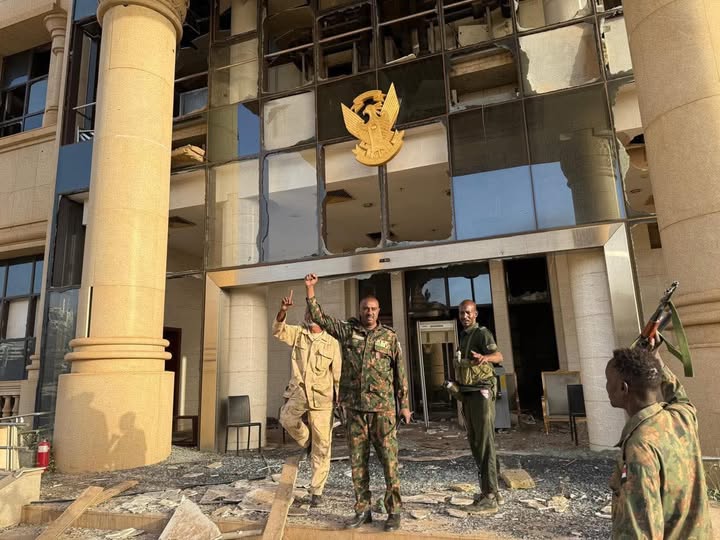
Recapturing the Republican Palace In Sudan: Through the gate of 1989 and the past experience, or towards renewal?
by Yasir Arman
The seizure of the Republican Palace by the Sudanese Armed Forces (SAF) and their allies, after nearly two years of military battles and despite being only a few kilometres away in geographical terms, is a military achievement that should not be underestimated. With this, the SAF has fought one of its most significant battles since its inception a century ago. The truth is that, in many neighbouring countries, armies inherited from the colonial era have collapsed and had to be rebuilt multiple times due to deep crises and failures in nation-building. Only a few neighbouring nations, such as Egypt and Kenya, have enjoyed stable and continuous armies with accumulated experience.
However, the SAF’s recapture of the Presidential Palace raises political questions that supersede military ones. It does not conceal the deep-rooted crisis linked to the 1989 governance system of the Islamists and its predecessors. The 1989 regime hijacked the state and politicized the Armed Forces. It is the remnants of that regime who bear responsibility for the multiplicity of armies and parallel militias, while simultaneously rejecting political pluralism, historical diversity, and the contemporary diversity of our country. Their ideological and political program is unilateral, closed, exclusionary, and ambiguous – it does not address the nation-building crisis and is the source of past, present, and potential future wars, if it continues!
The current war began with the rejection of the change brought by the greatest contemporary Sudanese revolution – the December Revolution – that defeated Islamic fascism. Their response was akin to the infamous Sudanese saying “Basira Umm Hamad” – first with a coup, and when that failed, they attempted to remedy it with the very problem that caused it, escalating into a war between the coup factions with further fragmentation of military forces. The Islamists, who are remnants of the old regime, relish the seat of power symbolized by the Palace. Meanwhile, they have no regard for the millions of victims of this cursed war. They take photos and videos in areas of governance and control, but they are absent from the battles of the deeply marginalized areas of Sudan, such as Al-Maliha and El Fasher. They prefer war zones that are picturesque, media-friendly, and televised while avoiding the marginalized areas – an old habit of theirs, even in choosing battle locations. They have a history of marginalizing and erasing from public memory martyrs from the professional officers of the SAF in the war in South Sudan while praising their Islamist colleagues. Who among them remembers Brigadier General Othman Abdel Rasul El-Daw, Colonel Abdel Rahman Balaa, Colonel Farah Adam Farah, and Lieutenant Colonel Salem Saeed Mohi El-Din, among many others?
Recapturing the palace is a military achievement that raises a crucial political question: Did they enter through the gate of June 30, 1989, which deepens the political crisis and ensures the continuation of wars? Those who said this war marked an end of the 1956 state should recall that the 1956 state was effectively buried by the 1989 coup. If it were to be revived, it might be celebrated as a prelude to a new project. Despite its structural flaws – foremost among them the lack of equal citizenship and social justice – it still represented a noble dream compared to the June 30, 1989, Islamist state, where a terrorist, ideological, and political faction systematically destroyed the revolution in both rural and urban areas and captured state institutions.
Therefore, recapturing the palace to resolve the entrenched political and historical crisis must not be through eastern, western, or southern geographical gates – despite their military significance. The key lies in entering politically through a new renaissance program that provides a historic compromise to address nation-building issues, with freedom, peace, justice, and equal citizenship as its pillars. The true gateway to the Republican Palace is through the ongoing Sudanese revolution, which began in 1924 and was led by great leaders in a civilian-military unity. From this, we must draw light to place our country on the path of development, progress, democracy, and the resolution of its historical dilemmas. Those who have entered the palace today from the marginalized areas must keep this in mind.
Today’s celebration does not erase the historical questions posed by the December Revolution. What happened today is not the end of the war but the beginning of serious questions on how to end it and how to achieve a program that completes the revolution and establishes the state. Such a program is not found in the archives of the 1989 remnants. Entering the palace is a new opportunity for the army leadership to listen to the people, who hold the first and final word in shaping a new future – one that prioritizes building a single, professional, and non-politicized armed force that reflects Sudan’s diversity. The revolution is stronger and more enduring than the gun. When the tides of military battles recede and people return to the homes they were unjustly forced from, the questions of the revolution and how to end wars permanently will resurface once again.