
Life returns tentatively to Sudan’s battle-scarred Khartoum Bahri
May 2, 2025 (KHARTOUM BAHRI) – Creeping weeds cover building facades and shattered signs litter main streets in Khartoum Bahri, a testament to a bustling city life abruptly halted by war months ago.
The city, north of Sudan’s capital Khartoum across the Blue Nile, remains largely empty, sustained by hopes for normalcy amid a daunting struggle to restore basic water and electricity supplies.
The Sudanese Armed Forces (SAF) announced they took full control of Khartoum Bahri in February following months of fierce battles, part of a wider offensive launched last September to recapture the capital from the paramilitary Rapid Support Forces (RSF).
Near the Halfaya Bridge connecting to Omdurman, some activity resembles normal life despite scarce services. Further south towards the Shambat district, streets are deserted but for small groups digging for water. A slight return of commerce is visible near the Central Station and main market, according to residents and local media reports.
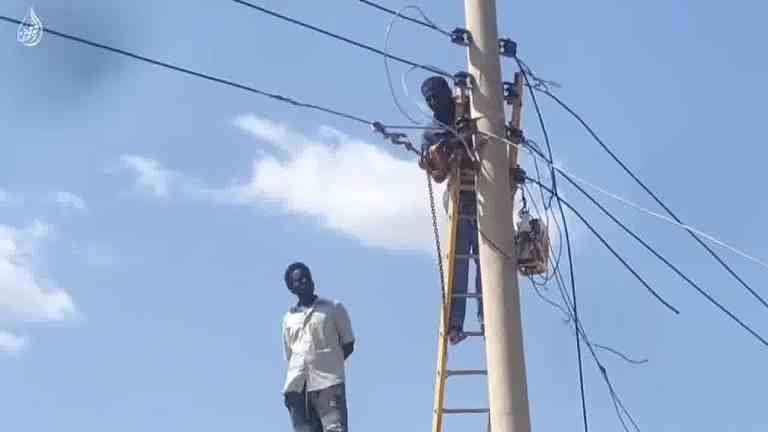
Extensive damage to electricity infrastructure, including looted copper wiring from cables, is visible, confirming earlier reports of widespread theft, residents said.
Bus drivers told Sudan Tribune that routes connecting the area to Omdurman, Khartoum’s central market, and the eastern Haj Youssif district have resumed, with fares ranging from 2,000 to 3,000 Sudanese pounds.
Mohammed, a driver on the Bahri-Khartoum market route, said he arrives before dawn to secure one of the few possible trips each day due to low passenger numbers. “It’s no longer possible to run more than one trip per bus,” he said, adding that activity ceases around 4 p.m. The limited income, however, is better than being unable to work while displaced in Wad Madani due to his Khartoum-issued license, he noted.
Signs of returning state functions are also appearing. Near the Central Station, the local traffic police department has reopened and is undertaking cleaning and repairs. Officers told local media the vehicle licensing section would resume soon, while current work focuses on logging reports of vehicles missing since the conflict.
Nearby, tea seller Fatima relies solely on drivers for custom. “Currently, the drivers are our only customers,” she said. Her daily income is precarious, sometimes covering basic needs, sometimes not. She hopes a return to normalcy will restore her livelihood.
Juice seller Mohammed Abdo Bilal echoed the sentiment, noting limited foot traffic beyond returning residents and drivers. His daily earnings of around 15,000 pounds are a fraction of his pre-war income.
“If the official authorities can restore water and electricity, the area will return to normal very soon,” Bilal told Sudan Tribune, adding he frequently fields calls from people asking when services will resume. An official technical source told local media that work was underway to restore supplies “as soon as possible”.
For now, residents fetch water from the Nile river. A 20-litre jerrycan currently sells for 500 Sudanese pounds (about $0.25), vendors said.