
South Sudan women’s union urges ceasefire, cites conflict abuses
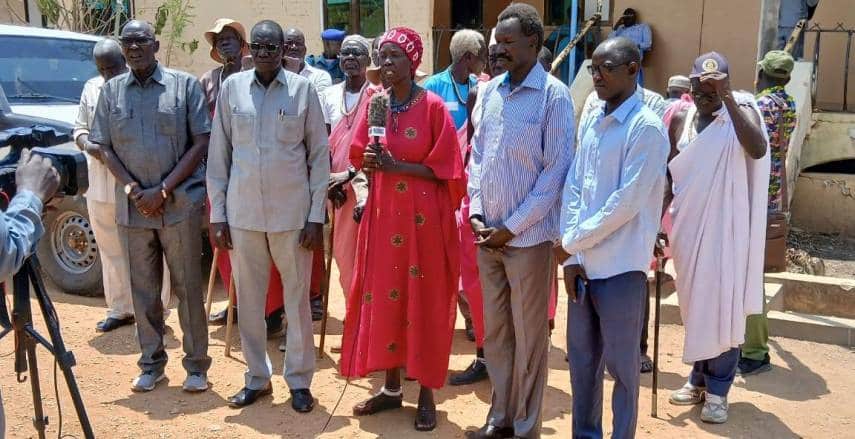
May 4, 2025 (JUBA) – A South Sudanese women’s union urged warring parties to cease hostilities, citing immense suffering caused by the ongoing conflict.
The union’s general secretariat issued the statement following reports of renewed military confrontations between the South Sudan People’s Defence Forces (SSPDF) and fighters loyal to the Sudan People’s Liberation Army-In Opposition (SPLA-IO). The statement also noted the involvement of the “White Army,” a coalition of armed civilian groups often aligned with tribal leadership.
“As women leaders in South Sudan, we call on the parties to the conflict to cease hostilities and embrace dialogue. Armed confrontation is not the solution,” the statement read, in part.
“We appreciate the decision of His Excellency President Salva Kiir Mayardit to call for calm and promise that he would not return the country to war. This promise… should be respected and matched with actions on the ground to avoid the suffering of our people, especially women and children.”
Separately, Julia Aker Duany, a South Sudanese professor and head of the country’s civil service commission, described the challenges facing women as “enormous.”
“The situation on the ground is quite revealing,” Duany stated, citing reports from the UN, NGOs, journalists, and human rights groups. “Women are the ones paying the price of this senseless war, but their plight is not moving these leaders to act.”
Duany explained that women feel voiceless because men on both sides “have refused to listen,” forcing women to flee to neighbouring countries or remain trapped in war zones.
“Women are caught in the war zones and become victims of all kinds of inhumane acts, atrocities against humanity, and war crimes,” she added, describing the treatment of women in recent incidents in Nasir and Ulang counties as “deplorable.”
Rebecca Joshua Okwaci, a South Sudanese lawmaker and former information minister, echoed these concerns, calling the situation for women caught in the conflict “unfortunate, sad, and unbearable.”
Okwaci recently returned from Malakal, capital of Upper Nile state, where she witnessed the impact of fierce fighting in nearby Ulang, Nasir, and Panyikang counties while launching a Special Olympics program.
“Tonga, the capital of my own county Panyikang, was occupied by the attacking SPLA-IO with a multitude of White Army militia,” she explained. “This sent a scare through Malakal town… We were hearing the guns very close.”
Attackers also reportedly occupied Oweci, 17 kilometres from Malakal, forcing villagers, mostly women, to flee to the state capital, she said.
Okwaci stated that the fighting created a severe humanitarian crisis, with civilians fleeing in multiple directions, including towards SPLM-North-held territories in neighbouring Sudan. Many sought refuge in the already congested UN Mission in South Sudan (UNMISS) Protection of Civilians (PoC) site in Malakal.
While in Upper Nile, Okwaci also witnessed the influx of civilians fleeing the separate conflict in Sudan, noting about 90% were women and children. She met with survivors of conflict-related sexual violence (CRSV) who fled Sudan.
“Refugee women highlighted how sexual violence remains a prominent feature of the ongoing conflict in Sudan,” Okwaci reported, recounting stories of rape, often by multiple perpetrators. “Some courageous women said they had to choose between being raped at gunpoint… or being killed,” she quoted a survivor.
Human rights activists and aid organizations corroborated these accounts, citing challenges women face accessing essential services, legal aid, or justice. Local sources told Sudan Tribune the lack of specialized care, including mental health support, hinders adequate support.
Sexual violence in conflict is often underreported due to the crisis scale, distance to facilities, and stigma, experts note. Sources indicate some women only seek medical help upon realizing they are pregnant following an assault.
The widespread circulation of arms and lack of security in many civilian areas further expose women and girls to gender-based violence, with local authorities often failing to implement adequate mitigation measures, according to observers.
Analysts state that sexual violence is used tactically in conflict as torture, to intimidate, displace communities, and humiliate opponents. Violence against women and girls in South Sudan’s conflicts includes physical, sexual, and psychological abuse by state and non-state actors, encompassing murder, torture, abduction, rape, sexual slavery, forced marriage, and forced recruitment.