
Beyond Past Grievances: A call for a shared humanity with the Ezidi community
By: Abdalla Elfakki Elbashir, PhD
Researcher in the Humanistic Understanding of Islam
E-mail: abdallaelbashir@gmail.com
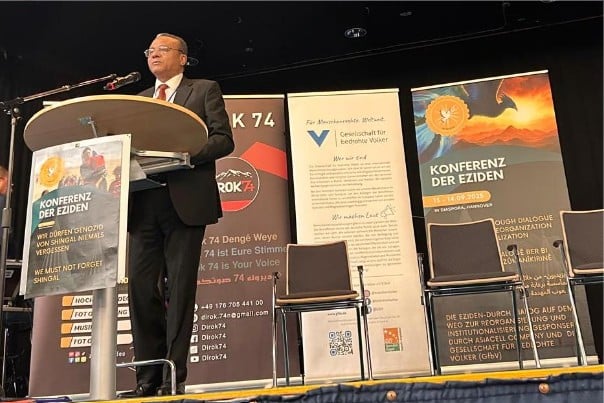
I was honoured and delighted to accept a kind invitation from members of the Ezidi diaspora to participate in an international conference they organized under the title: The Ezidi Through Dialogue on the Way to Reorganization and Institutionalization. Sponsored by Asiacell and the Society for Threatened Peoples, it was held from September 13-14, 2025, in Hannover, Germany.
The central idea revolved around reforming the reality of Ezidi society through dialogue. A large number of Ezidi intellectuals and researchers, both women and men, participated, alongside friends of the Ezidi community from various countries around the world.
I was deeply honoured that the organizing committee invited me to deliver a speech in the opening session. My speech was titled “The New Human Environment and the Need for Societal Adaptation,” grounded in the Humanistic Understanding of Islam proposed by the Sudanese thinker Mahmoud Mohamed Taha (1909–1985). His thought represents for me an open, ongoing research project through which I have published numerous books, articles, and lectures, and continue to do so.
This initiative by Ezidi intellectuals created a valuable opportunity for mutual understanding through the meeting of minds and convergence of ideas. In my contribution, I aimed to celebrate the conference itself—a creative initiative that speaks to all communities in light of the new human environment we witness today. This environment demands peace as an inevitable outcome of humanity’s shared destiny and calls for a partnership in our common human concerns and responsibilities.
Furthermore, I sought to express my love and respect for Ezidis, men and women. Through loving them, we love God, for we love God through His creations, and the most honoured of His creations is the human being, regardless of religion, language, colour, or gender. This humanistic view of Islam necessitates an open rejection of the old, regressive interpretation perpetuated by “prisoners of the past.” This old understanding, which sadly remains dominant today, is out of touch with universal human values, obstructs peaceful coexistence, and threatens both local and global peace. It invokes the “law of the jungle” and insists on resurrecting the past, creating a clash that inevitably leads to violence. Certain interpretations within some Islamic groups—from which the Ezidis have suffered greatly—even justify killing the “other.” In contrast, Taha calls for living for the sake of God, not dying for His sake.
On a personal level, I am committed to contributing to the protection of future generations of Ezidis, as well as the youth of other faiths. I aim to do this by presenting a new narrative about Ezidis from within Islam itself—a narrative that reflects the spirit of Islam and fulfils its higher objectives of life and freedom. This new narrative must be based on knowledge, ethics, and a shared human identity.
Ultimately, this conference stands as a call for a confluence of ideas—a dialogue that transcends geography and cultures. It is a call to partnership in human responsibility through the use of humanistic thought in pursuit of peace, love, and beauty. According to Taha, the beauty of human thought lies in diversity and difference, its real joy in varied perception, and its ultimate aim in tolerance and open-mindedness.
The meticulously organized conference addressed a range of critical issues over its two days. The dialogue moved from the trauma of genocide to the practical steps of societal reform, examining the situation of Ezidis from Sinjar to the diaspora. The presence of German political leaders and a representative from the U.S. Department of State underscored the international importance of the Ezidi cause. The event concluded with the election of the Ezidi Congress in the Diaspora (KED), a crucial step toward institutionalization.
In a world fractured by old hatreds, initiatives like this are not only welcome but also essential. They prove that dialogue is possible and that a shared future can be built upon the foundations of mutual respect and humanistic values. This conference was more than a meeting; it was a testament to the resilience of the Ezidi spirit and a powerful invitation to all of us to become partners in building a more just and peaceful world.