
Sudan livestock exporters halt shipments over 17% vat tax
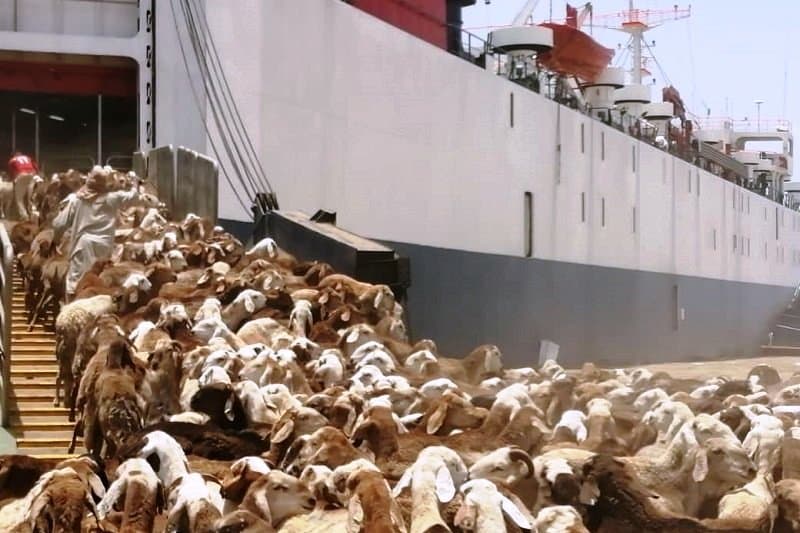
January 14, 2026 (PORT SUDAN) – Sudanese livestock exporters and shipping companies have announced a total suspension of operations to foreign markets, citing the imposition of new taxes that they say threaten the country’s national economy.
Reliable sources told Sudan Tribune that an emergency meeting is scheduled for Thursday in Port Sudan. The meeting will bring together several government and private entities to discuss potential solutions to the crisis.
Sudan primarily exports livestock to Gulf countries, with Saudi Arabia serving as the largest importer. Other major markets include Qatar and Oman, which rely on Sudanese supplies to meet the increasing regional demand for live animals.
Several exporters told Sudan Tribune they halted operations two days ago after a 17% Value Added Tax (VAT) was imposed on livestock export companies. The tax is being collected by the Sudanese-Chinese Port Services Company Limited, a joint venture based in Port Sudan.
The company issued a letter to exporters stating that, based on a certificate from the Tax Chamber, a 17% VAT must be collected on livestock export services. The letter, signed by General Manager Hatem Mahdi Hamad, noted that the fee would be added to total invoices starting in January 2026 and would be collected in advance.
Exporters and shipping companies have accused the firm of “clear circumvention,” arguing they already comply with tax payments through official files at the Tax Chamber. They noted that the joint venture is part of a project to develop Haidob Port, a facility dedicated to livestock exports that has struggled to reach full operational capacity.
Saleh Salah, head of the Livestock Exporters Division, told Sudan Tribune that the decision reflects a lack of state oversight and the legalization of faulty policies. He stated that while export laws theoretically prohibit fees on exports, government entities have increasingly sought to maximize revenues through illegal levies.
Salah claimed the company has imposed fees in euros per head for years without oversight and is now passing its own tax obligations onto exporters, despite providing no tangible services. He warned that the high cost of local levies is fueling smuggling operations.
According to a study cited by Salah, the cost of moving livestock from Ethiopia and Djibouti to Saudi Arabia is less than half that of shipping from Kassala through the Sudanese port of Suakin. He noted that since the start of the war, multiple new fees have been introduced, including 12 dollars in customs per head, 11 pounds for the Ministry of Animal Resources, 9 pounds for the Sudanese-Chinese company, 3 pounds for specifications, 2 pounds for Zakat, and 1 pound for state fees. These costs are further compounded by laboratory analysis, health certificates, and local municipality fees.