
SPECIAL REPORT-A generation in the shadows: Sudanese refugees in Egypt face education crisis
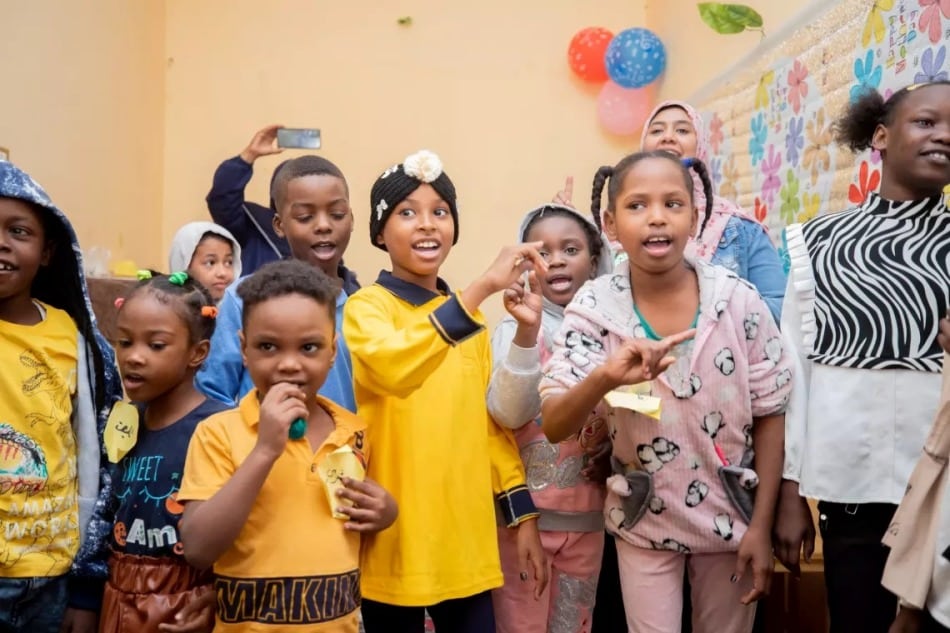
March 3 2026 (CAIRO) — When A.A., a 35-year-old Sudanese widow, fled the crossfire of the war between the Sudanese army and the Rapid Support Forces, her ambitions were modest: she simply wanted her three children to survive. She chose Cairo as a sanctuary, but three years into her displacement, she has discovered that physical safety does not guarantee a future.
The widow, who now ekes out a living through gruelling, intermittent manual labour, says her children are on the verge of losing their literacy. “They have almost forgotten how to read and write,” she said, describing a forced absence from the classroom that has become a defining feature of the Sudanese refugee experience in Egypt.
A.A. arrived in Egypt in 2024, eight months after the conflict erupted. While her first year was spent navigating the bureaucracy of residency and UNHCR registration, the subsequent two years have been a battle against economic attrition. Inflation has sent the cost of rent, utilities, and food soaring, leaving her meagre earnings as a domestic helper and factory worker insufficient to cover private tuition.
“I chose for them to stay alive, even if it meant being without schools,” she said.
Her predicament is mirrored by Mohammed Yahya, 47, a security guard in El Shorouk City. Earning just 5,000 Egyptian pounds (approximately $103) a month, Yahya faces a Solomon-like choice every September. This year, he could only afford to register his eldest son for the secondary school certificate exam. His three other children have remained out of school for the third consecutive year.
THE POLICY SHIFT
The crisis traces back to a December 2023 directive by Egyptian authorities to stop admitting Sudanese students into the state’s low-cost public school system. While officials cited “organizational reasons,” the move effectively shuttered the only affordable pathway to education for tens of thousands of families.
Othman, a teacher at an international school in Cairo, said the policy change hit the most economically vulnerable the hardest. With public schools closed to them, refugees are forced toward a fragmented market of private Sudanese schools, community centres, and international institutions.
According to Othman, the financial barrier is steep. Centres partnered with the UNHCR charge approximately 8,000 Egyptian pounds for primary stages, rising to 12,000 pounds for secondary education. Independent community centres often charge between 12,000 and 15,000 pounds, while private Sudanese schools are the most expensive.
The burden is not merely financial. Othman Saad, 51, described a labyrinthine registration process for his youngest daughter that involved digital payment platforms, equivalency certifications, and constant travel between the New Administrative Capital and government offices in Abbassia.
“The cost of registration alone exceeded 12,000 pounds,” Saad said, noting that the process is often reset for minor clerical errors. “It is psychologically exhausting for a refugee.”
CLASSROOMS IN APARTMENTS
For those who can afford the fees, the quality of education remains precarious. Educational activists estimate that 90% of Sudanese learning centres in Egypt operate out of cramped residential apartments that lack basic pedagogical infrastructure.
In these “apartment schools,” more than 30 students are often packed into rooms of just a few square meters. Teachers frequently work from hallways or balconies due to a lack of office space. These environments, which often run for eight hours a day, lack extracurricular activities and the psychological support services necessary for children traumatized by war.
The consequences are becoming visible on Cairo’s streets. Community leaders report rising rates of school dropouts and child labour in factories, farms, and cafes.
A study conducted by a consortium of community centres in October 2025, obtained by Sudan Tribune, paints a grim statistical picture. Approximately 90% of refugee families are headed by women, and more than 5,000 Sudanese children are out of school in Cairo alone. In the Maadi and Helwan districts, over 1,000 children are without access to education. In Maadi specifically, 198 students are orphans aged 9 to 14.
A COMMERCIAL COMMODITY
International organizations like Catholic Relief Services (CRS) and Save the Children have attempted to fill the void through teacher training and limited financial aid. However, Afaf Mirghani Ahmed of the Centre for Excellence and Community Leadership in Omraneya admitted these efforts are struggling to keep pace with the influx of new arrivals and rising inflation.
Educational expert Ali Saeed argues that the crisis is an extension of a “historical failure” in Sudan’s education system, which he says prioritized rote memorization over critical thinking. In the context of displacement, he warns that education has been reduced to a “commercial commodity” of low quality.
“This reality creates a psychological and social vacuum,” Saeed said. “It makes youth vulnerable to organized crime or extremist groups. We are witnessing the ‘burning’ of the educational years of an entire generation.”
Saeed, who previously worked with the UNHCR, criticized the agency’s current role, stating that protection protocols must include guaranteed access to stable education, citing his experience managing Somali refugee camps in the 1990s where structured schooling was a central pillar of safety.
THE INFORMAL SECTOR
The Sudanese Embassy in Cairo reports that there are now 145 Sudanese schools in Egypt. However, many remain in a legal gray area. Dr Assem Ahmed Hassan, the embassy’s Cultural Counsellor, noted that authorities recently closed schools in Aswan, Alexandria, and Badr City for failing to meet licensing requirements.
Despite the closures, officials maintain that 25,000 students will sit for the Sudanese Certificate exams on April 13, asserting that the administrative issues facing unlicensed schools will not disrupt the testing schedule.
Journalist Assem Ismail described the situation as a “backbreaker” for families. He noted that the lack of embassy intervention has allowed schools to pass all overhead costs—including seating, books, and stationery—directly to parents.
“This has produced a ‘shadow generation,'” social experts warned. “A generation without skills, certificates, or a sense of belonging. The cost of addressing ignorance and unemployment in the future will be far higher than the cost of education today.”
This report was produced by Sudan Tribune as part of the Sudan Media Forum to highlight the systemic barriers that Sudanese refugees in Egypt face.