
Third Gulf War – Has BRICS shaped the landscape of a new conflict?
By Mohamed Al-Hassan Mohamed Nour
Amid the major transformations underway in the global system, a terrifying scenario is unfolding in the Gulf region. It does not merely describe a new regional war but rather outlines the features of a “Third Gulf War” as an existential war par excellence. It is a complete picture where major international variables merge with military movements on the ground to create a new equation that may reshape the Middle East. Are we facing the spark of a Third World War without realizing it?
BRICS rise: The hidden spark of war?
The scene begins with the assumption that the rising power of emerging economic blocs, led by BRICS, was the hidden motive behind President Trump’s reshaping of American strategy based on the principle of “offence is the best form of defence.” As the world’s economic centre of gravity shifts toward Asia and a real challenge to unilateral American hegemony emerges, Washington appears to be recalculating.
Quick-deal policies are no longer effective, followed by a rapid shift toward the language of overt power, beginning with the replacement of the name “Department of Defence” with “Department of War.” This shift came directly from replacing the mentality of hegemony through force with the policy of deals and quick gains he began with. He then announced the goals: seizing global energy reserves, vital maritime corridors, and achieving the geopolitical dream of “Greater Israel.”
Some estimates suggest that Washington reached certain understandings with Russia and China before taking the first steps to implement this strategy, paving the way for its execution.
From Venezuela to Tehran: Deconstructing the scene
Events take us on a quick tour of the international chessboard, where Venezuela was the first stop in implementing this new strategy. Following Gaza, Syria, and Lebanon, the American administration directed its forces toward Venezuela, penetrated the capital Caracas, arrested President Nicolás Maduro, and announced the seizure of the country’s oil “for the benefit of the American and Venezuelan peoples.” The message was clear: oil resources of nations around the world have become legitimate American targets.
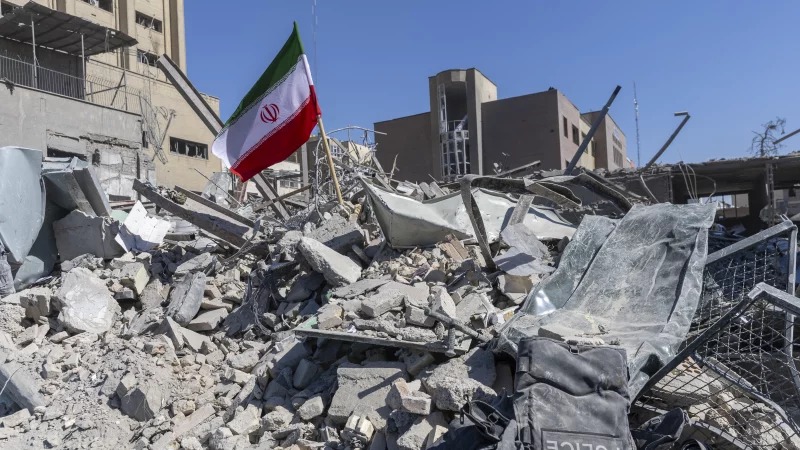
After completing the Venezuela stop peacefully, without any obstacles or objections from Russia or China, President Trump did not waste time. He headed directly toward the second and most complex stop: Iran. Here, the war began with a fierce joint operation with Israel, targeting the country’s top leadership, resulting in the assassination of Supreme Leader Ali Khamenei and a number of Revolutionary Guard leaders. Iran was ready; its response was swift, via missiles and drones targeting American and Israeli interests in the region.
The falling of Iranian missiles inside Gulf states produced a reversal in the positions of those states, which considered these strikes a violation of their sovereignty and entered into a direct verbal confrontation with Tehran. Some European capitals then joined in, declaring support for their traditional ally. Thus, the scope of the conflict began to expand, and fronts began to form.
The American dilemma: A third Vietnam?
As the war continued and costs rose, it became clear that Washington feared a prolonged confrontation. Air war alone did not and will not achieve a decisive victory, and the American leadership realized that without a ground war, it could not win. However, entering a ground war deep into Iranian territory was a nightmare reminiscent of Vietnam, Afghanistan, and Iraq.
Here, a new plan began to emerge: Washington and Israel announced their support and armament for Kurdish opponents for the purpose of bringing them into the war “to act on behalf of American soldiers in the ground war.”
Creative chaos: Smart withdrawal and conflict management
Amidst this complexity, a diabolical scenario for the American-Israeli strategy emerges. After Washington realized that victory could not be achieved without a costly ground war, it began pouring oil on the fire of sectarian conflict. The goal: to transform the regional war into a comprehensive civil war between Sunnis, Shias, and Kurds.
In this scene, America and Israel seek to ignite war between these components and then perform a “smart withdrawal,” quietly ascending to the “observers’ gallery,” leaving the region to drown in a bloody chaos that exhausts everyone. The idea is to let the region collapse into internal conflicts, so that Washington can return later to “collect the spoils” and redraw borders according to its interests after everyone has exhausted one another.
Where are Russia and China? And where has BRICS vanished?
Here, the most pressing questions arise: Where do the giants stand? And where has the BRICS alliance disappeared to?
The international scene appears closer to a new Cold War. Russia, preoccupied with its Ukrainian front and balanced in its strained relations with the West, seems unprepared to engage in a direct military adventure. Its support for Iran remained ambiguous, confined to the framework of angry diplomatic rhetoric and limited military-technical cooperation, but without joint defence commitments.
China, Iran’s largest trading partner and its economic lifeline, continues its “long-term game.” Its role is to serve as a diplomatic umbrella in the Security Council and a major buyer of Iranian oil through “ghost fleets,” while avoiding any military involvement. Beijing’s strategy seems to be based on keeping the United States preoccupied in the Middle East quagmire, without causing a total regional collapse that threatens energy supplies.
India’s position has raised a pressing question. Narendra Modi’s clear alignment with the Israeli axis and his close cooperation with Benjamin Netanyahu to establish a “Sextet Alliance” extending from India to the Eastern Mediterranean places major question marks over the cohesion of BRICS. Has New Delhi sacrificed the cheap Russian oil it has benefited from throughout the past years—since Western sanctions were imposed on Russia—and disowned its relationship with Tehran for the sake of a strategic partnership with Tel Aviv and Washington?
Toward a new, unknown world
We conclude this analysis with existential questions: Will this American plan succeed in turning the region into total chaos? Or are Russia and China hiding in the shadows, watching and waiting for the strength of all warring parties to be exhausted before baring their fangs?
What is happening today cannot be reduced to simply being a war on Iran; rather, it is the historical birth pangs of a new international order. It is a moment of reshaping alliances where interests intersect and clash, and where a Third Gulf War could be the spark that returns the world to a new era of extended conflicts.
The solution to this dilemma can only come from the leaders of the region’s countries divesting themselves of their authoritarian tendencies, elevating their sense of nationalism, acting with responsibility, and reaching a unified position based on a correct understanding of their nations’ interests.