
RSF burns agricultural convoy in Sudan’s West Kordofan
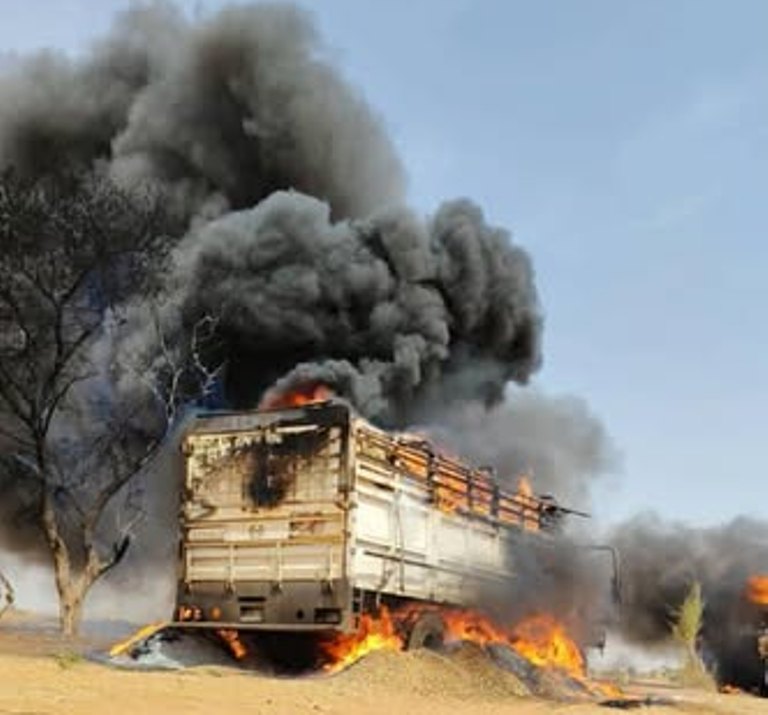
March 17 2026 (EL NAHUD) – Sudan’s Rapid Support Forces (RSF) on Tuesday set fire to a commercial convoy of heavy trucks transporting agricultural staples near the town of El Nahud in West Kordofan, according to local officials and video evidence documenting the destruction.
The convoy, which was transporting significant quantities of sorghum and peanuts, was intercepted while travelling toward El Obeid, the capital of North Kordofan. The destruction of these essential food supplies comes as the region faces escalating food insecurity and a breakdown in traditional trade routes.
Footage circulated by members of the paramilitary group showed fighters cheering as they set the cargo ablaze. The incident has sparked outrage among local trade unions and agricultural producers who rely on the El Nahud corridor to reach broader domestic markets.
El Nahud and the surrounding districts of Ghabaysh and Wad Banda serve as the primary peanut production hub in Sudan. The town also houses one of the largest agricultural commodity exchanges in the country’s western region, which has seen its operations paralyzed by repeated looting and the exodus of prominent merchants since the RSF moved into the area.
The Dar Hamar Emergency Room, a local civilian volunteer group, characterized the incident as an “economic massacre.” In a detailed statement, the group accused the RSF of systematically targeting the economic survival of the Dar Hamar people, who dominate the agricultural sector in West Kordofan.
The emergency room alleged that the RSF utilized deceptive tactics to lure the convoy into a trap. Truck owners were reportedly told that a “security escort” was available to ensure safe passage to El Obeid in exchange for substantial protection fees, often referred to locally as “escort duties.”
After the traders paid these fees, the militia allegedly turned on the convoy west of El Nahud. The resulting fire completely incinerated the vehicles and their cargo, representing a total loss of life savings for the farmers and producers involved in the shipment.
The violence is underpinned by a historical dispute between the Dar Hamar and Misseriya tribes over land ownership and the demarcation of administrative borders in the Abu Zabad region. Frequent armed confrontations often stem from seasonal competition over natural resources and migration routes for livestock.
The crisis has intensified following accusations by the Hamar tribe that the Misseriya are exploiting their partnership with the RSF to consolidate control over disputed areas. This shift has fueled further resentment, as local communities increasingly view the paramilitary group’s movements through the lens of tribal expansionism.
Civilian activists argue that the destruction of the convoy is part of a broader strategy of “economic warfare” intended to break the resistance of local communities. By striking at the region’s food security, the RSF is accused of attempting to create conditions of artificial famine to facilitate demographic shifts.
The incident highlights the devastating impact of a 2024 RSF decree that banned the movement of agricultural crops, livestock, and strategic minerals from RSF-controlled areas in Darfur and Kordofan to army-held regions. This blockade has effectively severed the economic arteries of western Sudan.
Traders in El Nahud report that the inability to transport goods has led to a collapse in local crop prices, while prices in army-held cities like Port Sudan and El Obeid continue to skyrocket. The resulting economic stagnation is pushing many rural families to the brink of starvation.
As the conflict enters its third year, the destruction of infrastructure and the disruption of the harvest season in the Kordofan belt threaten to turn a seasonal food gap into a permanent humanitarian catastrophe.