Sudan’s inflation slows to 40.22% in March as purchasing power weakens

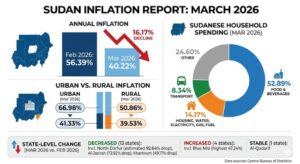
April 16, 2026 (KHARTOUM) – Sudan’s annual inflation rate fell to 40.22% in March, down from 56.39% in February, the country’s Central Bureau of Statistics said on Thursday.
The 16.17% decrease in the year-on-year rate means that, while the general level of prices is still rising, it did so at a slower pace in March than in the same month last year.
Economists attributed the continued monthly decline in inflation rates not to a decrease in prices but to a drop in purchasing power. This is due to the ongoing rise in the cost of goods and services and the depreciation of the national currency.
In urban areas, inflation slowed significantly to 41.33% in March, down from 66.98% the previous month. In rural areas, the rate decreased to 39.53%, down from 50.86% recorded in February, according to the statistics agency’s statement.
The annual inflation rate has been gradually declining since it peaked at 422% in July 2021.
The Central Bureau of Statistics said it calculated the March rate using field data from 16 states. Due to security conditions in North Darfur since October 2025, which have prevented field collection, price data for that state was estimated. Data for Central Darfur has also been estimated since the outbreak of the war in April 2023.
Inflation rates fell in 13 states in March, remained stable in Al-Qadarif, and rose in four. The highest increase was recorded in Blue Nile state at 47.24%. The sharpest decline was in North Darfur (based on estimates) at 92.64%, followed by Al-Jazirah at 72.82% and Khartoum at 49.17%.
The agency measures inflation using a basket of 663 goods that represent societal consumption patterns in rural and urban areas. The basket is divided into 12 groups, led by food and beverages, followed by tobacco, clothing and footwear, housing, water, electricity, and fuel.
Sudanese spend 52.89% of their income on food and beverages, 14.17% on housing, water, electricity, gas, and fuel, and 8.34% on transport.
Sudanese citizens, most of whom have lost their livelihoods and income sources due to the ongoing conflict, complain that high prices are difficult to cope with. Job opportunities are scarce following extensive destruction of infrastructure and commercial and agricultural activities.